Cable Back Workouts: Best Exercises for Thickness & Width
8 cable exercises split by what they build: pulldowns for width, rows for thickness.
 By Amnon V. ·
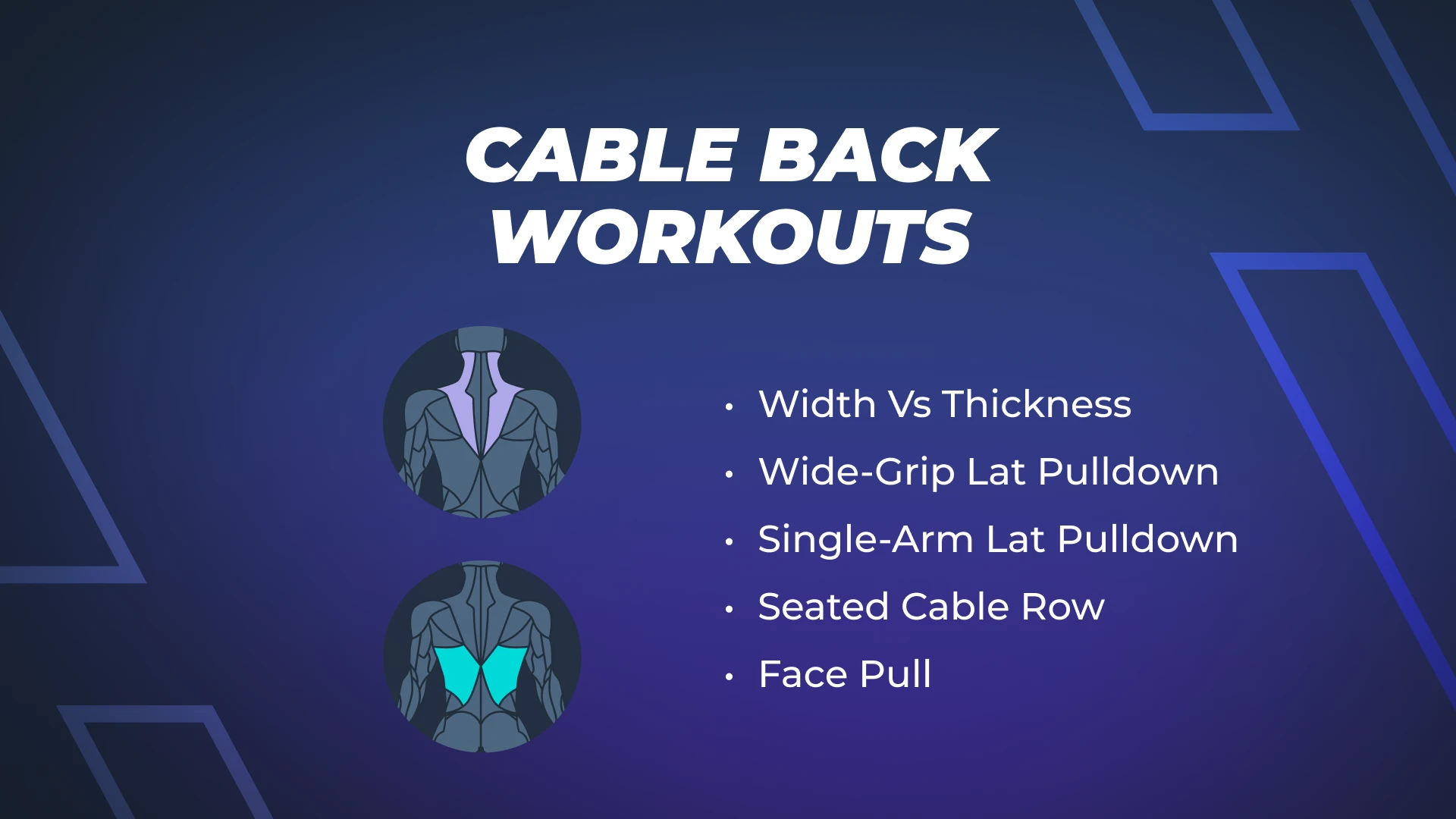
Most back days turn into guesswork. You grab a bar, pull from a few angles, and hope something lands. But your back isn’t one muscle. It’s a wide, layered group, and width and thickness come from two different jobs. Mix them up and you train hard without building the back you want.
Cable back workouts fix a lot of that. A cable keeps tension on the muscle through the whole rep, and you can change the angle in seconds. That makes the cable machine one of the best tools for hitting every part of your back on purpose. Below are 8 of the best cable exercises, split by what they build. Pulldowns handle width. Rows handle thickness. You focus on the pull, we handle the reason each one is there.
TL;DR
- Cables keep constant tension and let you change angles fast, so your back gets loaded from every direction.
- Width comes from vertical pulls (pulldowns). Thickness comes from horizontal pulls (rows). Train both.
- The 4 best cable moves for width are the wide-grip and single-arm lat pulldowns, plus the straight-arm and close-grip versions.
- The 4 best cable moves for thickness are the seated and chest-supported rows, plus the single-arm row and the face pull.
- Cables aren’t better than free weights. They load the muscle differently, and a full back uses both.
- Program 10 to 20 hard sets for your back each week, split across 2 sessions, most sets 1 to 3 reps from failure.
Why cables work so well for back training
A cable pulls at a steady angle from the pulley, so the resistance stays on the muscle from full stretch to full squeeze. Free weights depend on gravity, which only pulls straight down. On most back exercises you pull horizontally or overhead, so a barbell or dumbbell hands the muscle an easy patch where the load drops off. A cable removes that easy patch.
Two things follow. Your lats and mid-back stay under load for the whole rep, which tends to build a stronger pump. And you can move the pulley high or low to hit your back from angles a fixed bar can’t reach. That angle control is why one cable stack covers both width and thickness, and it’s gentler on the shoulders and elbows than heavy barbell rows.
Width vs thickness: what you’re actually training
Back width and back thickness are two targets that need two different movement patterns. Width is the side-to-side sweep that gives you a V-taper from the front. It comes from the latissimus dorsi, the large fan-shaped muscle down the sides of your back. Thickness is the depth you see from the side. It comes from the mid-back: the rhomboids, mid-traps, and rear delts between your shoulder blades.

The rule is simple. Vertical pulls build width. You pull down from overhead, and the lats do most of the work. Horizontal pulls build thickness. You pull toward your torso, and the mid-back draws the shoulder blades together. A back that only pulls down looks wide but flat. A back that only rows looks thick but narrow. You want both every week.
The 4 best cable exercises for back width
These are vertical pulls. The goal is long, loaded lats and a clean stretch at the top of every rep.
1. Wide-grip lat pulldown. The staple width builder on the lat pulldown machine. Set a grip wider than your shoulders with palms facing away. Sit tall, drive your elbows down, and bring the bar to your upper chest. Control it back up until your arms are straight and your lats stretch. Here’s the honest part on grip. A pronated palms-away grip does hit the lats harder than a supinated one, but going super wide adds little. Research comparing narrow, medium, and wide grips found similar lat activation across all three, so pick a width you can control through a full range. Tempo: 2 seconds down, 1 second squeeze, 2 seconds up. Aim for 3 to 4 sets of 8 to 12.
2. Single-arm lat pulldown. One arm at a time on a single handle at the high pulley. Working one side lets each lat move through its full range and lets a weaker side catch up. Kneel or sit, reach up to a full stretch, then pull your elbow down toward your hip. Let the shoulder blade rise at the top and pull it back down as you go. Tempo: slow and controlled, no yanking. Aim for 3 sets of 10 to 12 each side.
3. Straight-arm cable pulldown. A lat isolation move with almost no biceps. Stand facing a high pulley with a straight bar or rope and your arms nearly straight. Keep a soft elbow and pull the bar down to your thighs in an arc, squeezing the lats at the bottom. It teaches you to feel the lats work, which carries into every other pull. Tempo: 2 seconds down, hold 1 second, 2 seconds up. Aim for 3 sets of 12 to 15.
4. Close-grip lat pulldown. A narrow or neutral grip, usually with a V-handle. The closer grip changes the line of pull and lets you get a strong contraction at the bottom. It also tends to feel friendlier on the shoulders and wrists. Sit tall, pull the handle to your upper chest, and keep your torso close to upright. Tempo: 2 seconds down, 1 second squeeze, 2 seconds up. Aim for 3 sets of 10 to 12.
The 4 best cable exercises for back thickness
These are horizontal pulls. The goal is a hard shoulder-blade squeeze on every rep, with the mid-back doing the work instead of momentum.
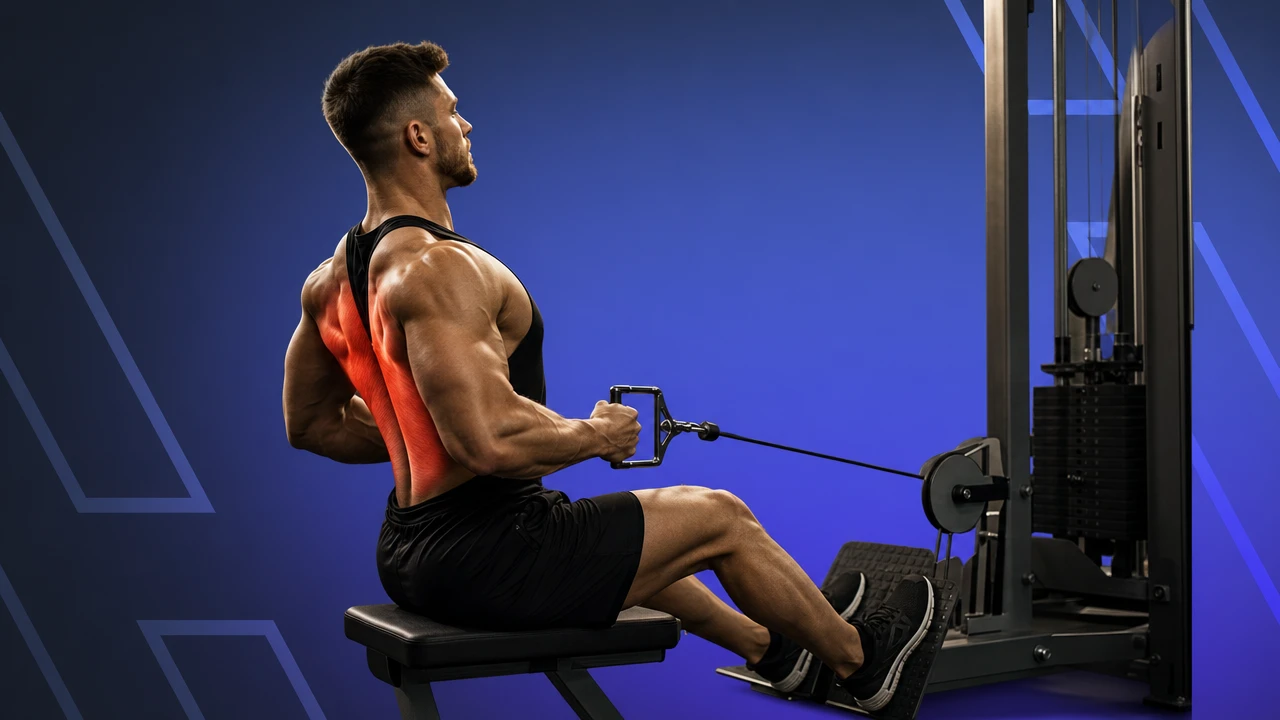
5. Seated cable row. The heavy thickness builder. Sit with feet planted, grab a close-grip or wide handle, and keep a tall chest. Let the weight draw your shoulders slightly forward for a stretch, then pull the handle to your belly button and squeeze your shoulder blades together. Don’t lean way back or heave the weight. Tempo: 1 second pull, 1 second squeeze, 2 seconds back. Aim for 3 to 4 sets of 8 to 12.
6. Chest-supported cable row. A row done with your chest against a pad or bench so your lower back stays out of it. That support kills momentum and forces the mid-back to do the pulling. It’s a smart pick if heavy rows bother your lower back. Brace your chest and row the handle to your ribs with a firm squeeze. Tempo: controlled both ways. Aim for 3 sets of 10 to 12.
7. Single-arm cable row. One arm rowing from a low pulley. Like the single-arm pulldown, it works each side through a full range and closes the gap between a strong and weak side. Row the handle to your side and drive the elbow back past your ribs. Keep the shoulder down and the pull strict. Tempo: 2 seconds back, 1 second squeeze, 2 seconds out. Aim for 3 sets of 10 to 12 each side.
8. Face pull. The rear-delt and upper-back finisher that keeps your shoulders healthy. Set a rope at head height, pull it toward your face, and split the rope apart as your hands reach your ears. This hits the rear delts and mid-traps and balances all the pressing most people do. It won’t build the thickness a heavy row does, but it rounds out your back. Tempo: 1 second pull, 1 second hold, 2 seconds out. Aim for 3 sets of 15 to 20.
Cable vs free weights for back: which is better?
Neither wins outright. Cables and free weights load your back in different ways, and a full program uses both. Cables give constant tension and easy angle changes, and they go easy on the joints. Free weights let you load heavier, force more stabilizer work, and build the raw pulling strength a stack struggles to match.
Use cables when you want steady tension and control from the first rep to the last. Use free weights when you want to move real load and build brute strength. Most strong backs are built on a mix: a heavy compound pull or two, then cable work for the angles and extra volume. If a cable machine is all you have, the 8 moves above still build a complete back.
How to program these into a back or pull day
Aim for about 10 to 20 hard sets for your back each week, the range Gymverse’s method is built around. A large review of training volume found muscle growth keeps climbing as weekly sets rise, with roughly 10 or more sets per muscle where it’s maximized. How much you need depends on your experience and recovery. Start near the bottom and add sets only as your progress allows.
Split those sets across 2 sessions instead of one long grind. Research on training frequency shows that hitting a muscle at least twice a week beats once a week for growth. A back or pull day that follows the width-and-thickness rule looks like this: 2 pulldown variations for width, 2 row variations for thickness, then a face-pull finisher. Pick different moves on your second session to cover more angles.
Keep most sets 1 to 3 reps from failure. That effort level, tracked with a Reps in Reserve approach, is high enough to force adaptation without wrecking your recovery. If you’re carrying a back or shoulder injury, clear these moves with a doctor or physical therapist before you load up.
This is the same evidence-based method behind Gymverse. The app picks your sets and reps and adjusts your load week to week. Every movement comes with a form video from our library of 500+ professional exercise videos. For rep targets, our guide on how many sets and reps to do breaks it down, and our lat pulldown machine guide covers the width work in more depth. Get your plan and start a free 7-day trial to see a full back routine built around your schedule and equipment.
Frequently asked questions
What are the best cable exercises for back?
The best cable back exercises split into width work and thickness work. For width, use the wide-grip and single-arm lat pulldowns, then add the straight-arm and close-grip pulldowns. For thickness, use the seated cable row and the chest-supported row, then add the single-arm row and the face pull. Together they train your lats and mid-back through a full range.
How do you build back width vs thickness with cables?
Build width with vertical pulls and thickness with horizontal pulls. Pulldowns and straight-arm pulldowns load the lats, which create the side-to-side sweep. Rows load the rhomboids and mid-traps between your shoulder blades, which create depth. Run both patterns every week, roughly two pulldowns and two rows, for a back that looks full from the front and the side.
Are cables better than free weights for back?
No, cables aren't strictly better. Cables keep tension constant across the whole rep and go easy on the joints. Free weights let you load heavier and build more raw pulling strength. A complete back program uses both. Cables shine for angle work and controlled tension, and heavy free-weight pulls build the strength base.
Can you build a big back with cables only?
Yes. A cable machine can train width and thickness through a full range, so the 8 moves above are enough to build a complete back. You get constant tension and plenty of angle options. A heavy free-weight pull helps with raw strength, but it isn't required to grow.
Sources & further reading
- Lusk SJ, Hale BD, Russell DM. Grip width and forearm orientation effects on muscle activity during the lat pull-down. J Strength Cond Res. 2010, 24(7):1895-1900
- Andersen V, Fimland MS, Wiik E, Skoglund A, Saeterbakken AH. Effects of grip width on muscle strength and activation in the lat pull-down. J Strength Cond Res. 2014, 28(4):1135-1142
- Schoenfeld BJ, Ogborn D, Krieger JW. Dose-response relationship between weekly resistance training volume and increases in muscle mass. J Sports Sci. 2017, 35(11):1073-1082
- Schoenfeld BJ, Ogborn D, Krieger JW. Effects of resistance training frequency on measures of muscle hypertrophy. Sports Med. 2016, 46(11):1689-1697
All Gymverse articles are reviewed against current research. See our full References & Research page.
Turn what you just learned into a training plan that works for you. Personalized structure. AI coaching. Real progress.
START TRAINING →