Gymverse vs Fitbod (2026): which adaptive training app matches you?
 By Amnon V. ·
TL;DR
- The verdict: both are strong and evidence-based. Pick Gymverse for a structured plan that progresses. Pick Fitbod for fresh workouts built around recovery.
- How each adapts: Fitbod rebuilds every session around muscle recovery. Gymverse builds a multi-week plan that progresses and re-sequences when you miss.
- Exercise library: Fitbod's library is larger. Gymverse's 500+ exercises each come with multi-angle video.
- Apple Watch: both have hands-free Apple Watch apps, so this one is close to a wash.
- Scheduling: Fitbod never leaves you behind because there's no fixed plan. Gymverse keeps a structure and flexes it around your week.
- Price: both bill in-app with a free trial. Only Gymverse offers a lifetime option.
- Which matches you: structure and progression lean Gymverse. Recovery-driven variety leans Fitbod.
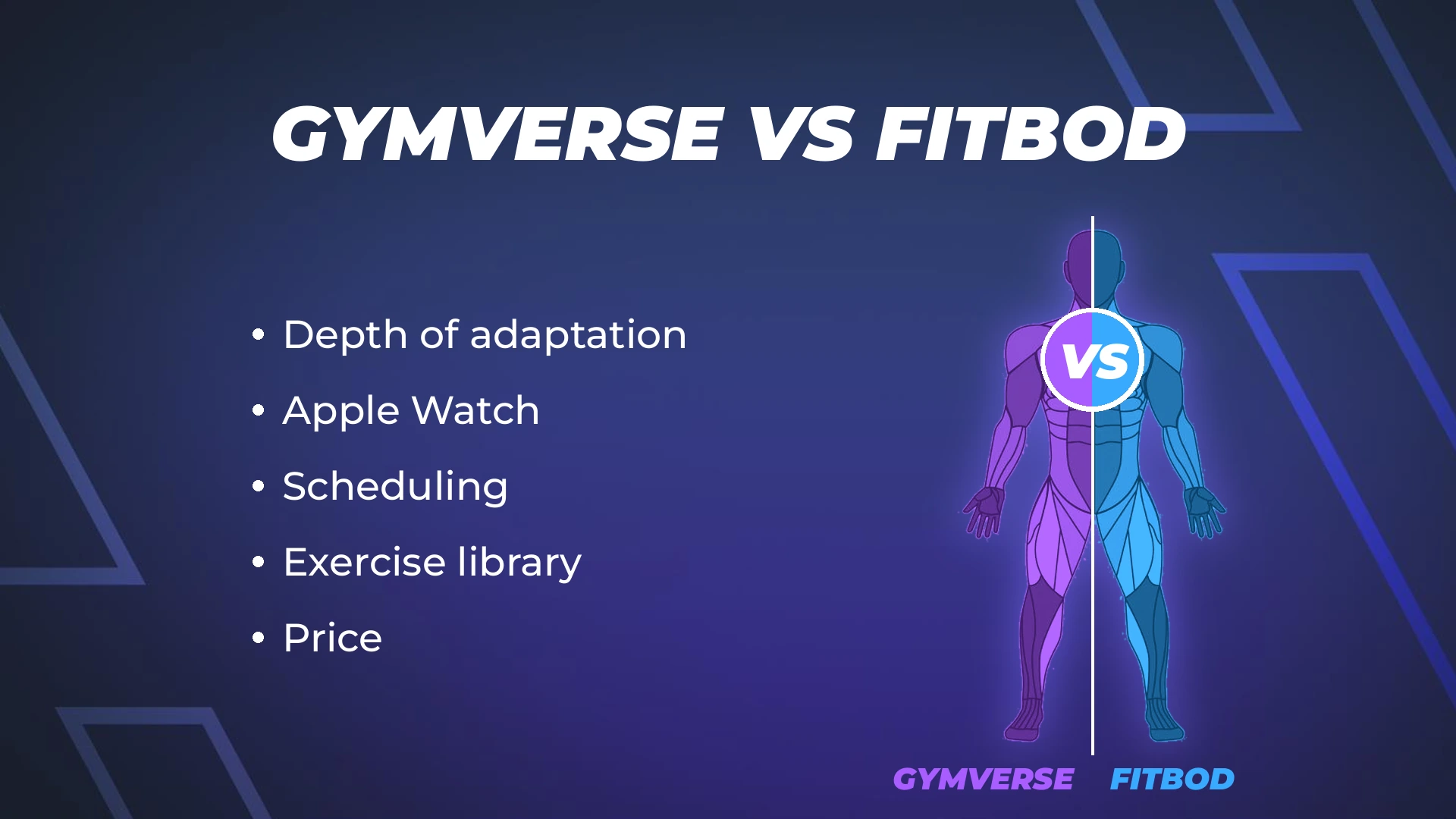
Both apps promise the same thing. Open the app, get a workout that adapts to you, stop guessing in the gym. From a store listing you can’t tell which one actually fits your goal, your schedule, or the equipment in front of you. This Gymverse vs Fitbod comparison cuts through that. If you landed here looking for a Fitbod alternative, or weighing two of the best adaptive workout apps against each other, you’re in the right place. Here’s the honest breakdown. What each one does well, where each one falls short, and which lifter each is built for. Both are good. They adapt in different ways, and that difference is the whole decision.
The verdict in sixty seconds
Here’s the honest answer before the detail. Gymverse and Fitbod are both strong, both grounded in real exercise science, and both beat training without a plan. The right pick comes down to one question. Do you want a structured program that progresses week to week, or a fresh workout generated around how recovered your muscles are each time you train?
Choose Gymverse if you want a tailored multi-week plan with built-in progression and deload weeks, you like seeing where your training is headed, and you want progress tracking with group leaderboards. Choose Fitbod if you want the app to build each session from scratch around muscle recovery, you train on a flexible schedule, and you also do cardio you want folded into the plan. Where Fitbod pulls ahead: a larger exercise library and a live per-muscle recovery view. Where Gymverse pulls ahead: a structured plan you can follow toward a goal, plus a one-time lifetime option.
Here’s how they stack up side by side.
| Category | Gymverse | Fitbod |
|---|---|---|
| How it adapts | Multi-week plan that progresses and re-sequences when you miss | Rebuilds each session around muscle recovery |
| Exercise library | 500+, each with multi-angle video | 800+ exercises |
| Form guidance | Multi-angle professional video | Exercise demonstrations |
| Recovery handling | Built-in deload weeks and progression | Live 0 to 100 percent recovery score per muscle |
| Outside cardio | Centered on your strength plan | Pulls Apple Health, Fitbit, and Strava into recovery |
| Apple Watch | Yes, hands-free logging | Yes, plan and tracking on your wrist |
| Platforms | iOS and Android | iOS and Android |
| Scheduling | Structured week that flexes when life gets busy | Open the app and train, with no fixed plan to fall behind on |
| Community | Group leaderboards and shareable achievements | Personal records and achievements |
| Pricing tiers | Monthly, yearly, lifetime | Monthly, yearly |
| Free trial | 7 days | Free trial (length varies) |
| Best for | Lifters who want structure and progression | Lifters who want recovery-driven variety |
How each app adapts, the real difference
This is the part that decides it, so start here. The word adaptive means something different in each app.
Fitbod adapts at the session level. Every time you open it, the app builds that workout from scratch. Its engine scores your exercises against how recovered each muscle group is, shown as a recovery score from 0 to 100 percent per muscle. It favors the muscles you have not trained hard in the last couple of days. It estimates your one-rep max from your logged sets and nudges the weight up as you get stronger. Fitbod says its recommendations draw on more than 400 million logged workouts, and its own guidance notes the algorithm sharpens after a few weeks of consistent logging. The payoff is variety and recovery awareness. You rarely repeat the same session. If you ran this morning and connected Strava, Fitbod folds that into today’s fatigue.
Gymverse adapts at the plan level. It doesn’t hand you a one-off session. It builds a tailored multi-week plan around your goal, schedule, and equipment, then progresses it week to week. The structure is deliberate. It applies progressive overload over training blocks and keeps each muscle’s weekly volume in the productive 10 to 20 hard set range. It holds most sets to within 1 to 3 reps of failure and builds in deload weeks so recovery can catch up. Miss a session and the plan re-sequences your week, so you pick up where it makes sense instead of falling off a fixed calendar. The Gymverse method puts this in writing. You can see where your training is going, which is the point.
Here’s the honest part. Neither approach is more adaptive. They adapt on different time horizons. Fitbod is reactive and granular, tuned to this session and this week’s recovery. Gymverse is structured and directional, tuned to a goal several weeks out. Under the hood, they lean on the same mainstream training science. Research shows muscle grows when you train each muscle often enough and do enough hard sets over the week. Research on frequency found that once weekly volume is equal, training a muscle more often adds little on its own. Spreading sets across about two sessions mainly helps keep every set high quality. Work on proximity to failure shows sets stopped a rep or two short build muscle about as well as sets taken all the way to failure. That shared science is why both apps spread your sets across the week instead of cramming them into one session. The real difference you feel day to day is whether the app hands you a plan or hands you a workout.
These are general training principles, not personal prescriptions. Your needs shift with your age, training history, and health. Check with a doctor or a qualified trainer before a big change, especially if you are carrying an injury.
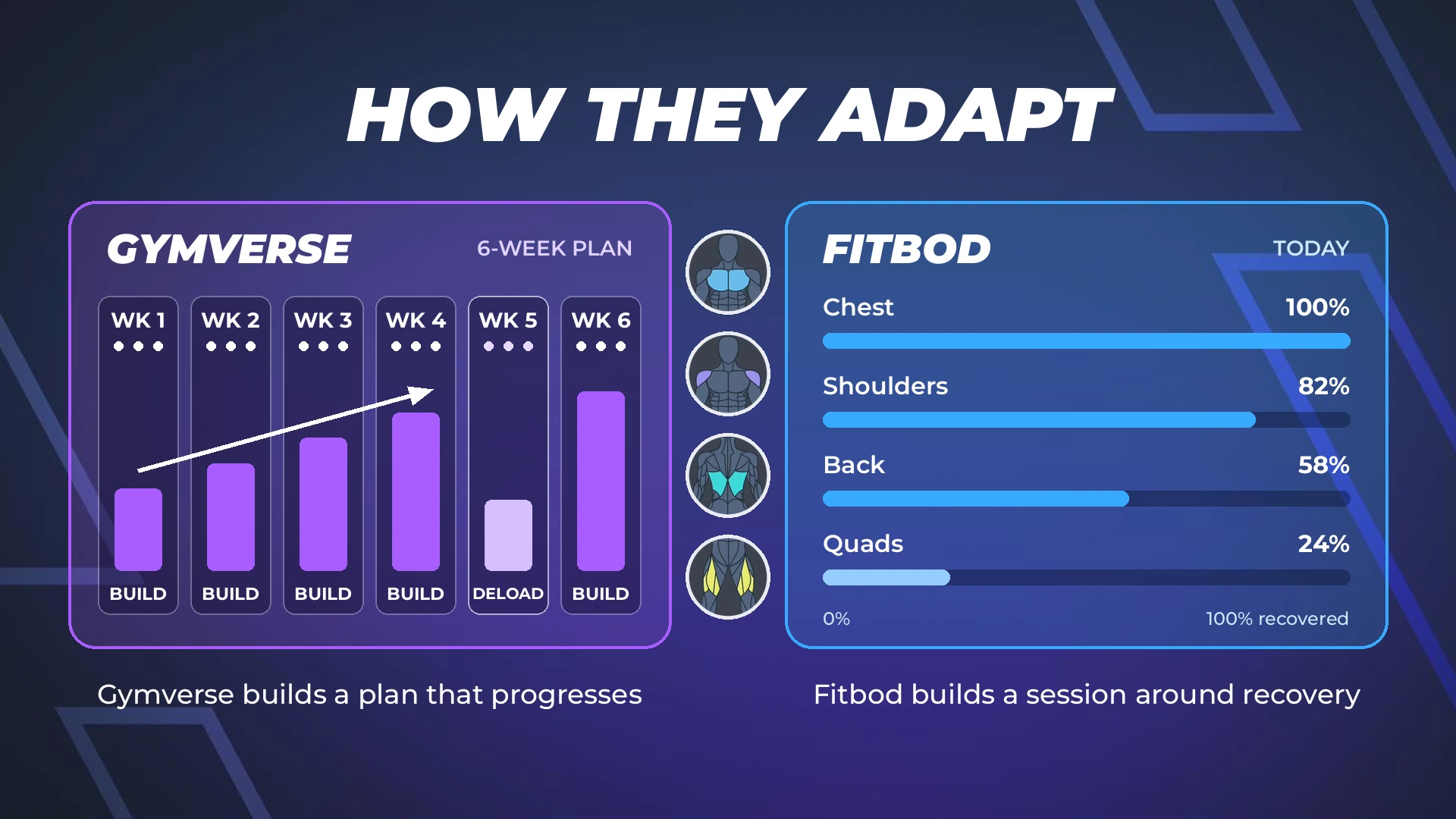
Both apps adapt. The real question is whether you want a plan that progresses or a workout that regenerates.
Exercise library and form guidance
If raw exercise count is your priority, Fitbod wins this one. By its own count, the app scores a library of 800+ exercises when it builds each session, and that breadth keeps workouts varied. Gymverse carries 500+ exercises, a smaller catalog on paper.
The counter is what comes with each movement. Every Gymverse exercise includes high-quality video shot from multiple angles, built to take you from machine setup to clean form before you load the bar. You can favorite the lifts you like, exclude the ones you can’t do, and swap any exercise for another that hits the same muscle. Fitbod also demonstrates its movements and lets you swap and exclude. So the split is simple. Fitbod gives you more options to keep things fresh. Gymverse gives you fewer options but puts more into coaching each rep. If you learn best by watching good form from several angles, that matters more than a bigger number.
Apple Watch and progress tracking
This axis is close to even, so don’t let it decide for you. Both apps ship a real Apple Watch experience. Gymverse lets you train hands-free from your wrist and log your sets, reps, and weights without touching your phone. Fitbod puts your plan and tracking on the Watch so you can move through a session at a glance. Both also run on iPhone and Android.
Where they differ is what the tracking is built around. Fitbod’s standout is the recovery view, a color-coded body map that shows how recovered each muscle is. It can also pull in cardio and other activity from Apple Health, Fitbit, and Strava to keep that picture accurate. Gymverse leans into progress and motivation. It tracks personal records, shareable achievements, and group leaderboards that make consistency a friendly competition. One app is built to show you fatigue. The other is built to show you momentum. Pick the feedback that actually keeps you training.
Scheduling around real life
Plenty of apps struggle with the messy reality of a real week. Both of these handle it, in opposite ways.
Fitbod is flexible by design. There’s no fixed weekly plan to fall behind on, so you open the app when you can train and it builds today’s session around what is recovered. Take three days off and nothing is missed, because the next workout is generated fresh the moment you come back. If your schedule is unpredictable, that is freeing.
Gymverse keeps a structure and bends it. You get a planned week, and when life gets busy the plan re-sequences so a skipped session doesn’t reset your progression. You still follow a program. It just flexes around you. A rigid app punishes you for missing a day. Gymverse is built so a missed day never means starting over. The trade-off mirrors Fitbod’s. You get structure that adjusts, rather than spontaneity with no plan to track. Which one keeps you consistent depends on whether a visible plan motivates you or boxes you in.
Price and the lifetime option
Neither app posts prices on its website, and both sell through in-app purchase, so the real numbers show up at the paywall and can shift by region and promotion. Both offer a free trial, 7 days on Gymverse, so you can test everything before you pay.
The difference is the plans on offer. Gymverse sells monthly, yearly, and a one-time lifetime purchase. If you know you are in it for the long haul, you can pay once and be done. Fitbod offers monthly or yearly only, with no lifetime option. Both offer a free trial, so you can try either before you commit. If a one-time payment appeals to you more than a forever subscription, that is a point for Gymverse. If you would rather keep it month to month, both do that.
Which one matches you
Strip away the feature lists and it comes down to how you want to train.
Pick Gymverse if you want a plan to follow, not a daily decision. It fits the lifter who wants structure and a clear path. You get a multi-week program that applies progressive overload and calibrated volume for you, with deloads built in and a plan that re-sequences when you miss. It’s a strong fit if you are newer and want to be told exactly what to do, with video on every movement. It’s also a fit if you like leaderboards, or you want the option to pay once with a lifetime plan.
Pick Fitbod if you want a fresh session every time, built around recovery. It fits the lifter who trains on an unpredictable schedule, who also runs or cycles, and who likes variety over a fixed program. Its per-muscle recovery view and larger exercise library are the real draws. If you are happy to log consistently for a few weeks while the algorithm learns you, it rewards that.
Both are among the best adaptive workout apps you can download right now, and you can’t go far wrong with either. If you want a structured plan that moves you toward a goal with the set math handled for you, start a free 7-day trial of Gymverse. Watch your first plan get built around your body and your week. You focus on the workout. We handle the structure.
Frequently asked questions
Is Gymverse a good Fitbod alternative?
Yes. Gymverse is a strong Fitbod alternative if you want a structured multi-week plan that progresses toward a goal rather than a workout generated fresh each session. Both are evidence-based strength apps on iOS and Android, with Apple Watch support and a free trial.
Is Gymverse better than Fitbod?
Neither is better across the board. Gymverse is better if you want a structured plan with built-in deloads, progress leaderboards, and a lifetime purchase option. Fitbod is better if you want a larger exercise library and workouts rebuilt around a live muscle recovery score.
What is the main difference between Gymverse and Fitbod?
The main difference is how they adapt. Gymverse builds a multi-week plan that progresses and re-sequences when you miss a session. Fitbod builds each workout from scratch around how recovered your muscles are.
Which works better for beginners, Gymverse or Fitbod?
Beginners often do well with Gymverse, because it hands you a clear, ordered plan with form video on every exercise and no deciding on the spot. Fitbod also suits beginners, though it asks for a few weeks of logged workouts before its recommendations fully calibrate.
Do both apps work on Android and Apple Watch?
Yes. Both Gymverse and Fitbod run on iPhone and Android, and both offer hands-free Apple Watch training, so your platform usually won't be the deciding factor.
Sources & further reading
- Fitbod builds each workout from scratch and scores an 800+ exercise library against a 0 to 100 percent per-muscle recovery score. It estimates your one-rep max from logged sets and draws on 400 million logged workouts. It pulls Apple Health, Fitbit, and Strava into recovery. Source, Fitbod, How Fitbod Generates Your Personalized Workouts
- Fitbod runs on iOS, Android, and Apple Watch and offers monthly or yearly plans with a free trial through in-app purchase. Source, Fitbod on the App Store
- Gymverse builds a tailored multi-week plan with planned deload weeks and gradual progression, re-sequences the week when you miss, and offers 500+ exercises with multi-angle video. It supports hands-free Apple Watch training and group leaderboards. It sells monthly, yearly, and lifetime plans with a 7-day trial on iOS and Android. Source, Gymverse on the App Store
- The Gymverse method covers progressive overload, training each muscle about twice a week across 10 to 20 hard sets, and planned deload weeks. Source, Gymverse
- When weekly volume is equal, training a muscle more often adds little to hypertrophy on its own. Schoenfeld BJ, Grgic J, Krieger J. How many times per week should a muscle be trained to maximize muscle hypertrophy? A systematic review and meta-analysis of studies examining the effects of resistance training frequency. Journal of Sports Sciences, 2019
- Sets stopped a rep or two short of failure build muscle comparably to sets taken to failure, which supports a reps-in-reserve approach. Refalo MC, Helms ER, Trexler ET, Hamilton DL, Fyfe JJ. Influence of Resistance Training Proximity-to-Failure on Skeletal Muscle Hypertrophy. Sports Medicine, 2023
- Full reference list behind our guides, Gymverse References and Research
All Gymverse articles are reviewed against current research. See our full References & Research page.
Turn what you just learned into a training plan that works for you. Personalized structure. AI coaching. Real progress.
START TRAINING →