Workout App Statistics & Trends in 2026: What the Data Says About Fitness Apps
 By Amnon V. ·
TL;DR
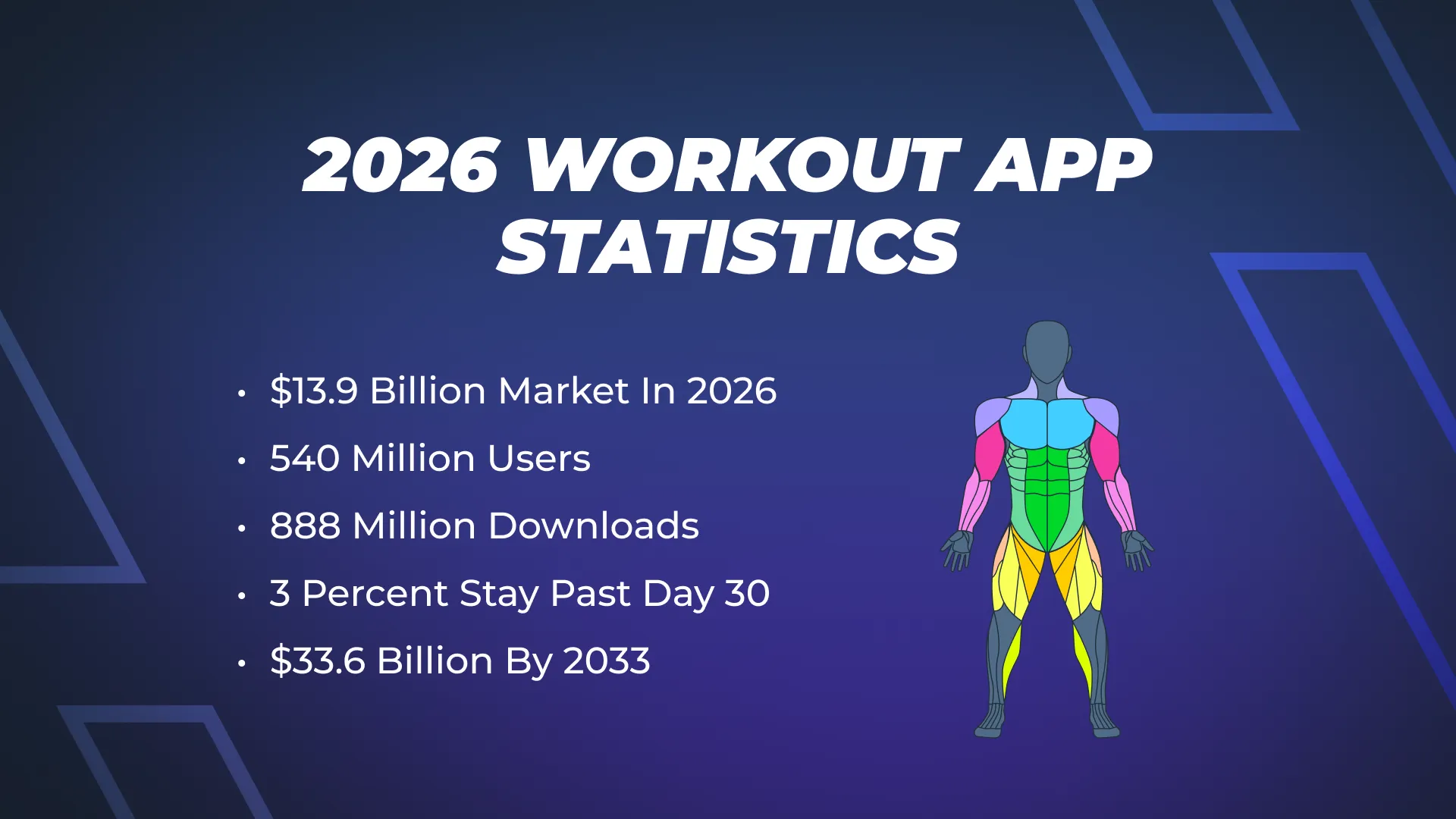
- The workout app market hit about $12.1 billion in 2025 and is on track for $13.9 billion in 2026.
- Around 540 million people used fitness apps in 2025, pulling 888 million downloads.
- Consumer spending crossed $3.4 billion in 2025, up nearly a quarter in a year.
- Day 30 retention for fitness apps sat near 3 percent. The growth hides a quitting problem.
- AI personalization and wearables are the trends pulling the market toward $33.6 billion by 2033.
- The apps that keep you are the ones that adapt to your real life, not the ones with the longest feature list.
You downloaded a workout app in January. By March it was buried on your phone’s third screen. You’re not alone, and the workout app statistics for 2026 explain exactly why. The market behind that app is huge and growing fast. More people opened a workout planner app, a gym app, or a workout trainer last year than ever before. Yet most of them quit within a month. This is the honest data on the fitness app market in 2026: how big it is, who actually uses these apps, and why most of them get deleted inside a month. We pulled every figure here from named industry sources and linked each one, so you can check the receipts.
How big is the workout app market?
Start with the size of the prize. The global fitness app market reached about $12.1 billion in 2025, and Grand View Research puts it at $13.9 billion for 2026. The same analysis projects the market will reach $33.6 billion by 2033, a compound annual growth rate of 13.4 percent from 2026 onward.
That growth figure is not a one-firm fluke. A separate forecast from Research and Markets landed on nearly the identical endpoint for 2033, $33.58 billion, at a CAGR of about 13.5 percent. For reference, that same report pegged the 2024 market at $10.59 billion, which lines up with the climb. When two independent firms using different base years arrive at the same 2033 number, you can take the trajectory seriously.
North America drives the biggest slice. It held 39.8 percent of fitness app revenue in 2025, the largest regional share, per Grand View Research. Those are strong fitness app market trends by any measure.
One caution before you quote these figures anywhere. Market size reports count the whole category, including the broader ecosystem around the apps. That is why the headline market number runs far ahead of what people actually spend inside the apps, which we break down below. Both numbers are real. They just measure different things. Treat the big market figure as the size of the opportunity, and the spending figures as what users actually commit.
How many people use workout apps?
Here’s the number most people want first. About 540 million people used fitness apps in 2025, according to Business of Apps. Those same apps were downloaded 888 million times that year.
Zoom out to the wider health and fitness category and the gym app usage data gets bigger still. Sensor Tower counted 3.6 billion downloads across health and fitness apps in 2024, a 6 percent rise over the year before and a record high.
Strength and gym training sits at the center of it. Gyms and Fitness was the top subgenre by downloads, and it accounted for seven of the top 10 health and fitness apps by global downloads. It was still growing, too, up 3 percent year over year as the category matured. The fastest riser sat right next door. Medical tracking downloads jumped 43 percent year over year in 2024, a sign that phones are becoming the front door to health, not just fitness. Whether people search for a gym app, a workout planner app, or a bodybuilding app, they’re all crowding onto the most contested shelf in the store.
Now look again at those two spine numbers. 540 million users against 888 million downloads. People download far more fitness apps than they keep. A download is a wish, not a workout. The question these figures rarely answer is how many of those 888 million installs turned into a habit. The retention data below answers it, and the answer is uncomfortable.
Where the money is: revenue and spending
Downloads are vanity. Revenue is the real signal, and it’s climbing fast. Fitness app revenue hit $3.4 billion in 2025, a 24.5 percent jump over 2024, per Business of Apps. Sensor Tower expects the broader health and fitness category to pass $4 billion in in-app purchase revenue in 2025, more than 100 percent growth across the past five years.
The spending is seasonal and front loaded. January 2025 alone drove $385 million in in-app purchases, up 10 percent year over year and a new all-time high, Sensor Tower reports. That is the New Year’s resolution effect in hard numbers.
Geography concentrates the money. The United States took more than half of all global consumer spending in the category, with the United Kingdom second at an 8 percent revenue share, per Sensor Tower. Among individual brands, Peloton pulled roughly $1.6 billion in subscription revenue, the most of any fitness brand. Apple Fitness holds the largest overall share of the fitness app market, per Business of Apps, though the company doesn’t publish a precise figure.
Nearly all of this runs on a freemium model. The app is free to download and often free to try, then it charges to keep going. Gymverse works the same way, with a free 7 day trial before a paid subscription. The lesson in the revenue curve is simple. These companies make money when you stick around, which is exactly where most of them lose you. For you, that means the real cost of a workout app isn’t the download. It’s whether you’ll still open it in week six.
The retention problem most apps won’t mention
This is the statistic the download charts bury. Thirty days after install, only about 3 percent of health and fitness app users were still active in 2023, according to Business of Apps benchmarks. Read that again. Ninety-seven out of a hundred people are gone within a month.
The drop starts on day one. Activation sits near 26 percent on the first day and falls to about 10 percent by day 28. Even among people who pay, annual subscription retention runs around 33 percent, so two in three subscribers don’t renew the year. Even the apps built to be sticky leak users. Sensor Tower found the fitness rewards app CashWalk kept just 31 percent of its users at 30 days, and Sweatcoin held 20 percent. These apps exist specifically to pull you back, and they still lose most people inside a month. That 3 percent benchmark is the single most important number in this report, and the marketing never leads with it.
Why do so many people quit? Rarely because the workouts were wrong. They quit because life got in the way and the app didn’t. You miss three sessions on a work trip, you open a rigid plan that’s now out of sync, and you feel behind before you’ve even started. A rigid app punishes you for a normal week. A good one adjusts and keeps you moving.
That paradox is the whole opportunity. Retention isn’t a feature you bolt on. It’s the product working the way a real week actually runs.
What’s driving the growth: trends to watch
So what’s actually powering the climb toward $33.6 billion? Three forces show up across every forecast.
First, AI personalization. Research and Markets names artificial intelligence as a trend reshaping fitness apps, pushing them from fixed templates toward plans that adjust to the individual. This is the shift from a static PDF to a workout trainer that reads your progress and changes the next session accordingly.
Second, wearables. Grand View Research flags Android and wearable devices as the fastest growing segments through 2033. The behavior backs it up. An NIH report cited by Research and Markets found nearly a third of Americans were monitoring their health with wearables such as smartwatches in 2023. Your watch is becoming the remote control for your training.
Third, the platform picture is settling. In 2025, iOS held 52 percent of the fitness app market by platform, and smartphones made up 66.7 percent of usage by device, per Grand View Research. Exercise and weight loss apps were the single largest type at 53.7 percent. Strength and general fitness, in other words, is where the volume lives.
Geography is shifting under all of it. Grand View Research names Asia Pacific as the fastest growing region through 2033, even as North America holds the largest share today. The center of gravity in fitness tech is moving.
Behind all three forces sit bigger causes. Research and Markets points to a cluster of them. People are more health conscious than a decade ago, and the technology in their pockets finally matches the ambition. The pandemic moved millions of workouts into homes and apps, and a lot of that shift stuck. Rising disposable income and climbing healthcare costs push the same way. That makes a few dollars a month for a workout planner app look cheap next to a gym membership or a medical bill. Fitness tech isn’t a niche anymore. It competes for the same attention as streaming and social, and none of these drivers is slowing down.
For a workout planner app, the takeaway is clear. The winners pair real exercise science with software that personalizes and adapts. That’s the direction the whole market is moving. Everything in the data points the same way, toward apps that do the thinking and leave you the lifting.
Where Gymverse fits in the data
Put the data together and a picture of the winning app emerges. It’s personalized, it adapts, and it’s built on real training science rather than a fixed list. That’s the brief Gymverse was built to answer.
Gymverse is a personalized workout planner app with a library of 500+ professional exercise videos and AI-optimized load management that adjusts your weights as you improve. It programs your volume, frequency, and effort, grounded in the same exercise science behind the Gymverse Method. That method keeps each muscle on roughly 10 to 20 hard sets a week, trained about twice, with most sets stopped one to three reps short of failure. It also builds in planned deload weeks so recovery can catch up. When you miss a session, it re-sequences your week instead of leaving you behind, which is the direct answer to the retention numbers above.
We’ll be honest about the limits, because the data demands it. Gymverse is paid after a free 7 day trial, not a free forever app. It can log your sets from an Apple Watch, but it can’t put eyes on your form the way an in-person coach can. What it does do is handle the structure, the volume math, and the week to week adjustment that most apps skip and most people quit over. What you get out of it depends on your effort, consistency, and recovery, the way any training program does.
Every design choice in Gymverse answers a number in this post. The 500+ video library covers the exercise and weight loss category that leads the market. The AI-optimized load management rides the personalization trend. The Apple Watch logging meets the wearable shift. And the week that re-sequences itself is the direct answer to a 3 percent retention rate.
That’s the whole point of the statistics. The market is growing, the downloads are record breaking, and the retention is still broken. The apps that fix it are the ones that bend to your actual life. You focus on the lifting. We handle the plan. Get your plan and start your free 7 day trial to see it work for your body and your week.
Check with a doctor or a qualified professional before starting a new training program, especially with an injury or a health condition.
Frequently asked questions
How many people use workout apps?
About 540 million people used fitness apps in 2025, and those apps were downloaded 888 million times that year, according to Business of Apps. The wider health and fitness category saw 3.6 billion downloads in 2024, a record high.
What is the fitness app market size in 2026?
The global fitness app market is projected at about $13.9 billion in 2026, per Grand View Research, up from roughly $12.1 billion in 2025. Market size estimates run higher than consumer app spending because they count the whole category.
Are workout apps growing?
Yes. The fitness app market is forecast to grow at a compound annual rate near 13.4 percent, reaching about $33.6 billion by 2033, according to Grand View Research. Research and Markets lands on a near identical 2033 projection.
Why do people stop using workout apps?
Most people quit because the plan stops fitting their life, not because the workouts failed. Day 30 retention for fitness apps was around 3 percent in 2023, and the apps that hold users best are the ones that adapt when a week goes sideways.
What percentage of people keep using fitness apps?
Very few. Only about 3 percent of health and fitness app users are still active 30 days after install, per Business of Apps, and even among paying subscribers, roughly 33 percent renew after a year.
Sources & further reading
- Fitness app market size of $12.1 billion in 2025, $13.9 billion in 2026 and $33.6 billion by 2033 (13.4 percent CAGR), North America's 39.8 percent revenue share, 2025 platform splits (iOS 52 percent, smartphones 66.7 percent, exercise and weight loss apps 53.7 percent) and Asia Pacific as the fastest growing region: Grand View Research, Fitness App Market Size, Share and Trends Report
- Near identical 2033 projection of $33.58 billion at about 13.5 percent CAGR, the 2024 market value of $10.59 billion, the AI personalization trend and named growth drivers, plus the NIH figure that nearly a third of Americans monitored their health with wearables in 2023: Research and Markets, Fitness App Market Forecast to 2033, via Business Wire
- 540 million fitness app users and 888 million downloads in 2025, $3.4 billion in revenue (up 24.5 percent), Peloton's roughly $1.6 billion in subscription revenue and Apple Fitness as the largest share holder: Business of Apps, Fitness App Market Data
- 3.6 billion health and fitness downloads in 2024 (up 6 percent), Gyms and Fitness as the top subgenre with seven of the top 10 apps, medical tracking downloads up 43 percent, a projected $4 billion in 2025 in-app purchase revenue, $385 million of January 2025 spend, US and UK spending shares, and 30 day retention of 31 percent for CashWalk and 20 percent for Sweatcoin: Sensor Tower, State of Mobile Health and Fitness in 2025
- Day 30 retention near 3 percent in 2023, first-day activation of 26 percent falling to 10 percent by day 28, and 33 percent annual subscription retention: Business of Apps, Health and Fitness App Benchmarks
- The Gymverse Method, 500+ exercise video library, AI-optimized load management, Apple Watch support and the free 7 day trial: Gymverse
- How Gymverse programs volume, frequency and effort: The Gymverse Method
All Gymverse articles are reviewed against current research. See our full References & Research page.
Turn what you just learned into a training plan that works for you. Personalized structure. AI coaching. Real progress.
START TRAINING →