5 Fitness Myths, Debunked (And What to Do Instead)
Which common fitness beliefs are actually wrong? Learn the most widespread training and nutrition myths, what the research shows, and what to do instead.
 By Amnon V. ·
TL;DR
Myth 1: Soreness Means Your Workout Was Effective
Every myth on this list survives for the same reason: it feels true. That’s exactly what makes them expensive. An intuition that’s wrong but satisfying will cost you months before the scale or the mirror finally argues back. Here are five that quietly tax the most people.
Many people judge the quality of a workout by how sore they feel the next day. This is an unreliable measure. Soreness indicates that muscle tissue experienced unfamiliar stress: a new exercise, greater range of motion, or higher volume than usual. It does not indicate that the session was particularly effective for muscle growth or strength gains.
People who train consistently and intelligently become less sore over time as muscles adapt. This is not evidence that their training has stopped working; it is evidence that their muscles have become more resilient. Progress should be measured by performance: more weight lifted, more reps completed, better technique.
Myth 2: You Can Spot-Reduce Fat
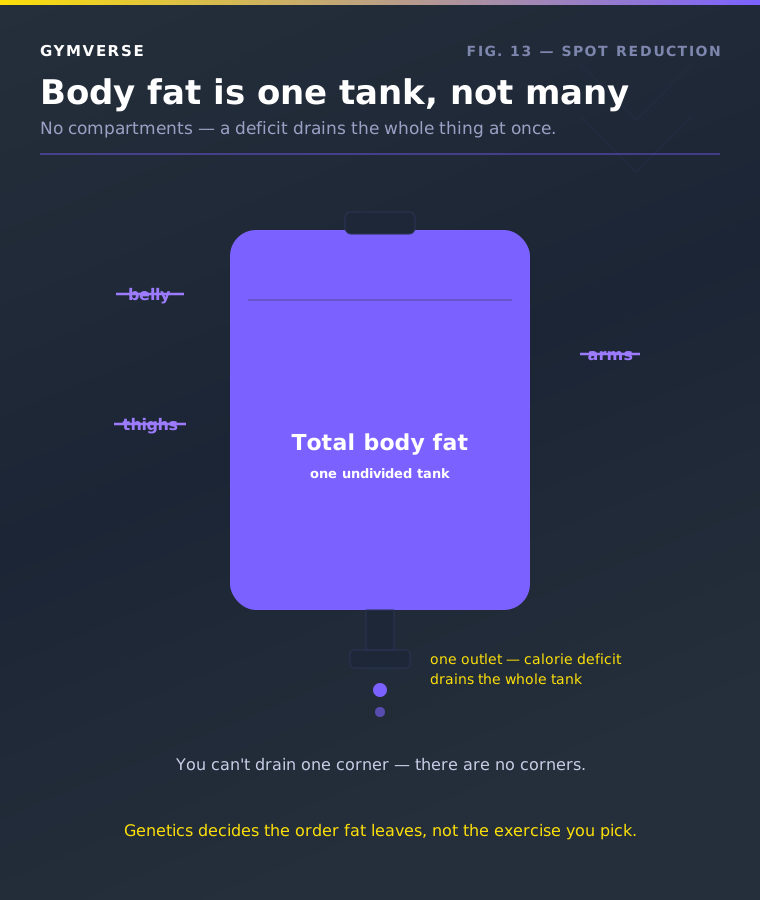
Your body fat isn’t a row of separate compartments you can drain one at a time. It’s a single fuel tank with one outlet. Training your abs no more empties the belly compartment than revving the engine drains fuel from one corner of the tank: there are no corners. A deficit drains the whole tank; genetics decides the order.
The belief that training a specific body part reduces fat in that area: hundreds of sit-ups to lose belly fat, inner thigh exercises to slim the legs, is not supported by evidence. Fat loss occurs systemically. When the body is in a calorie deficit, it draws from fat stores throughout the body according to genetic predisposition.
Abdominal exercises strengthen the core muscles, but they do not preferentially remove fat from the abdomen. Fat loss in any specific area requires a calorie deficit applied consistently over time.
Myth 3: Muscle Turns Into Fat When You Stop Training
Muscle and fat are physiologically distinct tissues. One cannot convert into the other.
What actually happens when someone stops training: muscle mass decreases (atrophy) from disuse, and if calorie intake remains the same, body fat increases because energy expenditure has decreased. The simultaneous loss of muscle and gain of fat creates the visual impression of one converting to the other.
Preventing this is straightforward: if training volume decreases significantly, reduce calorie intake proportionally.
Myth 4: You Need Cardio to Lose Fat
Fat loss requires a calorie deficit. Cardio is one method of increasing calorie expenditure, but it is not required.
A calorie deficit created entirely through dietary adjustment will produce fat loss without any cardiovascular exercise. Cardio improves cardiovascular health and contributes to the deficit, but it is not a prerequisite for fat loss.
The most effective approach combines a dietary deficit with resistance training, which preserves muscle during the cut, and adds cardio as an optional additional tool.
Myth 5: More Sets and Longer Workouts Are Always Better
There is a dose-response relationship between training volume and muscle growth, up to a point. Beyond that point, additional volume does not produce more growth and may impair recovery, reducing the quality of subsequent sessions.
Most beginners benefit from 10–12 sets per muscle group per week. Doubling this does not double the results. It increases fatigue, extends recovery time, and often reduces training quality.
Longer workouts are not more productive if the additional time is spent on low-value sets performed in a fatigued state. A focused 50-minute session consistently outperforms an unfocused 90-minute one, the feels-true tax, paid in time.
Frequently asked questions
If I'm not sore after a workout, did I train hard enough?
Not necessarily. Consistent trainees experience less soreness as muscles adapt. Lack of soreness does not mean the training was ineffective.
Can I target fat loss in a specific area?
No. When researchers have tested this properly, training one limb and comparing it against the other, the pooled result is no difference at all. A calorie deficit reduces fat systemically.
How do I avoid gaining fat when I stop training?
Reduce calorie intake in proportion to the reduction in training volume. Fat gain from detraining is primarily a result of unchanged eating habits with decreased expenditure.
Sources & further reading
- Cheung, Hume & Maxwell (2003), Sports Med — soreness is not a progress marker
- Schoenfeld, Ogborn & Krieger (2017), J Sports Sci — diminishing returns on volume
- Ramírez-Campillo et al. (2022), Hum Mov — spot reduction meta-analysis
All Gymverse articles are reviewed against current research. See our full References & Research page.
Turn what you just learned into a training plan that works for you. Personalized structure. AI coaching. Real progress.
START TRAINING →