How Many Sets and Reps Should You Do Per Workout?
How many sets and reps do you need to build muscle? Learn what the research says about optimal training volume, rep ranges, and how to structure your sets for hypertrophy.
 By Amnon V. ·
TL;DR

Rep Ranges for Each Goal
Most people agonize over reps and ignore the number that actually decides whether they grow: total weekly sets. Reps matter, but they’re a detail of execution, not the foundation. Get the foundation right and a surprisingly wide range of rep schemes all work.
| Goal | Rep Range | Load (% of 1RM) | Rest Between Sets |
|---|---|---|---|
| Maximum strength | 1–5 | 85–100% | 3–5 minutes |
| Muscle growth (hypertrophy) | 6–12 | 65–85% | 2–3 minutes |
| Muscular endurance | 15–30 | 40–65% | 30–90 seconds |
The budget-and-spend model: weekly sets per muscle are your budget, rep range is how you spend it, and load is the price tag. You can spend the same budget in heavy, low-rep chunks or lighter, higher-rep ones and end up in a similar place, as long as the sets are taken close to failure. That last condition is the one people quietly skip.
Research shows that muscle growth occurs across a wide rep range, from 5 to 30+ reps, provided sets are taken close to failure. The 6–12 range remains the most practical for most people because it balances load, fatigue, and time efficiency.
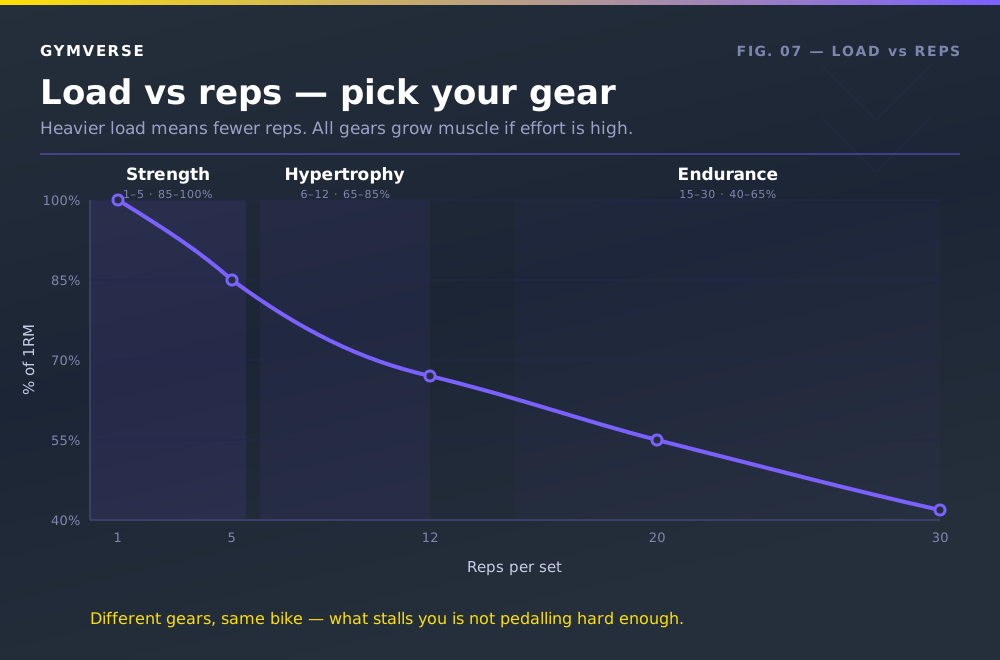
Rep ranges are gears, not destinations. A low gear (heavy, 3–5 reps) and a high gear (lighter, 15+) both move the bike forward. What stalls you isn’t the gear, it’s not pedalling hard enough to begin with.
How Many Sets Per Muscle Group Per Week
Total weekly sets per muscle group is the more important variable than sets per session.
- Beginners: 10–12 sets per muscle per week
- Intermediate: 12–16 sets per muscle per week
- Advanced: 16–20+ sets per muscle per week
These are working sets: sets taken close to failure. Warm-up sets do not count toward this total.
These tiers are practical starting points rather than research findings. The studies do not actually show that experienced lifters need more volume than beginners, and individual differences are large. What the research does support: somewhere around four hard sets per muscle per week is enough to grow, more generally does more up to a point, and the returns shrink as you add. Start lower than you think you need and add only while you are still recovering well.
More sets produce more growth up to a point, after which recovery becomes the limiting factor and additional volume stops producing returns. Starting at the lower end and adding volume gradually as recovery capacity increases is the most sensible approach.
Sets Per Session
For a muscle group trained 2–3 times per week, 4–6 working sets per session is appropriate for most people. Spreading volume across multiple sessions is more effective than cramming it all into one long session.
Example for chest trained twice per week: 5 sets on Monday + 5 sets on Thursday = 10 sets per week.
Recommendations by Experience Level
- Beginners (0–12 months): 2–3 sets per exercise, 8–12 reps, 3 sessions per week. Prioritize learning movement patterns over maximizing volume. Response to training is high at this stage; more is not needed.
- Intermediate (1–3 years): 3–4 sets per exercise, 6–12 reps, 4 sessions per week. Begin tracking weekly volume per muscle group and increase gradually.
- Advanced (3+ years): Volume and intensity become more individualized. Periodization, planned variation in volume and load, becomes increasingly important.
Frequently asked questions
Is 3 sets of 10 enough to build muscle?
Yes, particularly for beginners. 3 sets of 10 per exercise, applied consistently with progressive overload, is sufficient for muscle growth.
Can too many sets be counterproductive?
Yes. Excessive volume without adequate recovery leads to accumulated fatigue and stalled progress. More is not always better.
Do I need to go to failure on every set?
No. Most sets should stop 1–3 reps before failure. Failure on every set increases fatigue significantly without proportional benefit.
Sources & further reading
- Schoenfeld, Ogborn & Krieger (2017), J Sports Sci — volume dose-response
- ACSM (2009), Med Sci Sports Exerc — rep ranges & progression
- Pelland et al. (2025), Sports Med — volume dose-response
All Gymverse articles are reviewed against current research. See our full References & Research page.
Turn what you just learned into a training plan that works for you. Personalized structure. AI coaching. Real progress.
START TRAINING →