Push Day Workout: The Best Exercises, Sets & Sample Routines
A complete guide to exercise ordering, muscle activation, and sample routines for chest, shoulders, and triceps.
 By Amnon V. ·
TL;DR
Push Day Workout: The Best Exercises, Sets & Sample Routines
Most lifters treat push day as a set of chest, shoulder, and triceps workouts. They grab whatever bench is open, run a few sets, and head home. And that’s precisely the reason their chest and shoulders stall.
There are two decisions that do the real work: which exercises you pick and the order you run them in. If you get those right, you’ll grow. Get them wrong and you’ll just get tired.
So look at your last push session. Was it built carefully, or did you improvise it on the way to the rack?
In this guide we cover what a push day trains, how to order it, the best exercises ranked by effectiveness, how many sets and reps to run, ready-to-use sample routines, and how often to train it.
What Is a Push Day Workout?
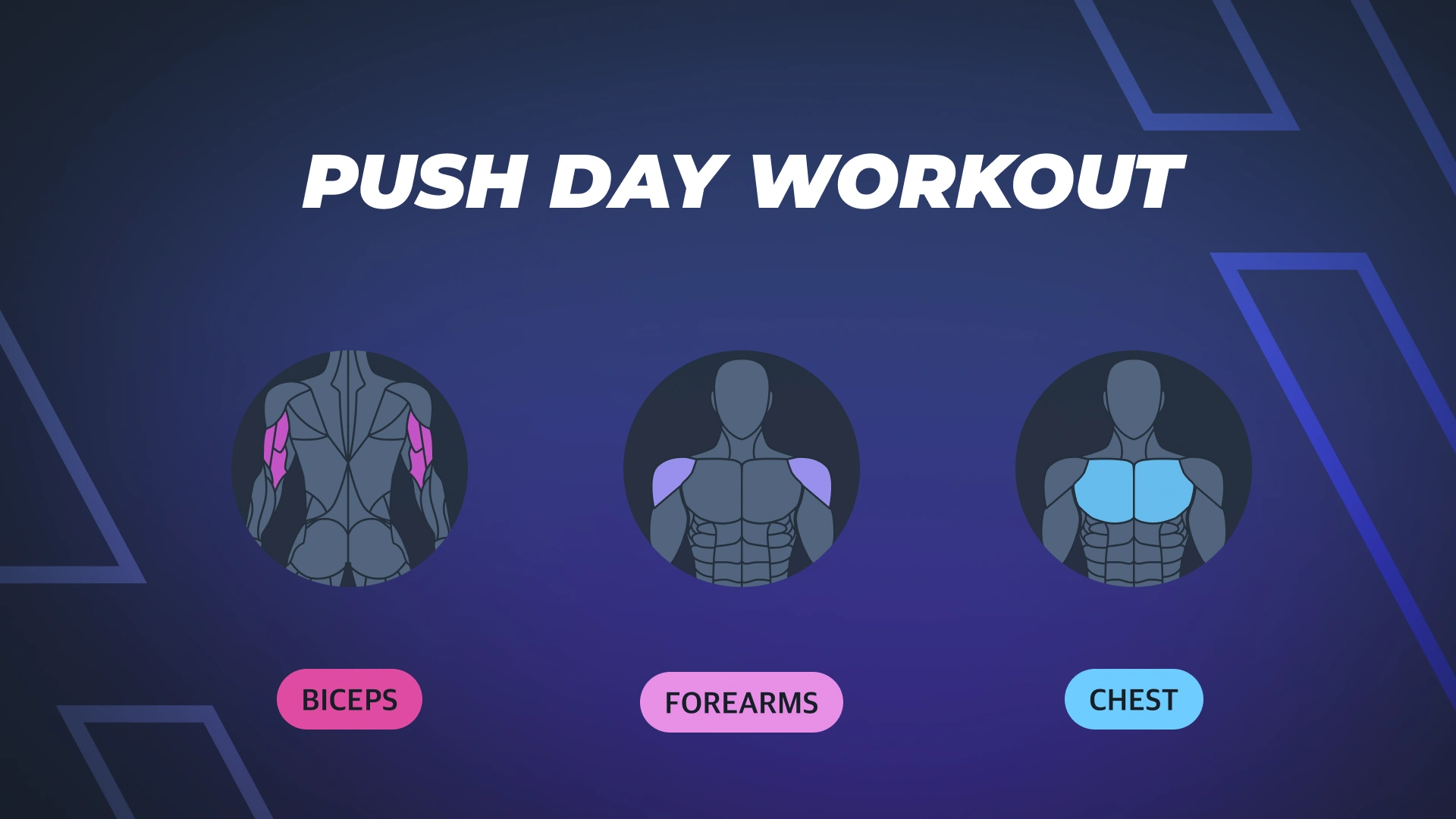
A push day is a single session that trains every muscle involved in pushing a weight away from your body. That means the chest (pectoralis major), the front and side shoulders (anterior and lateral deltoids), and the triceps (triceps brachii).
How to Order Your Push Day Exercises
The order in which you do your exercises should not be random. Here’s the sequence you should follow:
- Start with a heavy compound press (barbell or dumbbell) while you’re fresh. It moves the most weight and recruits the most muscle.
- Follow with a second pressing angle (incline or overhead) to hit the chest and shoulders from a different line of pull.
- Finish with isolation work (flyes, lateral raises, triceps extensions), it’s when fatigue matters less.
Why does compound-first matter?
A meta-analysis on exercise order found that strength gains are largest in the exercises you place at the start of a session, while lifts at the end lose reps to fatigue. So put the movement tied to your main goal at the front, before your energy drops.
The Best Push Day Exercises, Ranked by Effectiveness
Here are the exercises we reach for first, grouped by the muscle they build. For each one you get what it is, the muscle it targets, a form cue or two, and the ranking we chose focuses on muscle-activation data.
Chest (Pectoralis Major)
- Barbell bench press: the primary mass builder for the pectoralis major, with heavy carryover to the anterior deltoids and triceps. EMG research ranks the pectoralis major as the prime mover here, ahead of the front delt and triceps. Cue: control the bar to mid-chest and drive through your whole foot.
- Incline dumbbell press: biases the upper (clavicular) chest that most lifters under-develop, and the dumbbells give you a deeper stretch than a barbell. Activation data shows the incline angle raises clavicular pec recruitment. Cue: set the bench to about 30° and keep your elbows from flaring.
- Weighted dip (chest-forward lean): loads the lower pectoralis and triceps through a long range. Cue: lean your torso forward and stop when your shoulders reach elbow height.
- Cable fly or pec-deck: an isolation move that keeps constant tension on the chest and loads the stretched position, which research ties to muscle growth. Cue: let the chest stretch fully at the bottom without dumping tension.
Shoulders (Anterior and Lateral Deltoids)
- Overhead press (barbell or dumbbell): the top strength builder for the anterior deltoids, with the triceps as a strong assistant. EMG data places the dumbbell shoulder press at the top for front-delt activation. Cue: brace your core, press in a straight line, and don’t lean back.
- Lateral raise (dumbbell or cable): the move that builds the lateral deltoids and the visual width of your shoulders, and the one most lifters skip or rush. The same data shows the lateral raise leading middle-delt activation. Cue: lead with your elbows and control the lowering phase.
Your rear deltoids are a pulling muscle, so they belong on pull day. We leave them out here to keep push and pull from overlapping.
Triceps (Triceps Brachii)
- Close-grip bench press or dips: a heavy compound that loads all three triceps heads at once. Cue: keep your elbows tucked.
- Overhead triceps extension: emphasizes the long head through a stretched position that supports growth. Cue: keep your elbows pointed forward and still.
- Rope pushdown: an isolation finisher for the lateral and medial heads. Cue: pin your upper arms to your sides.
How Many Sets and Reps Should You Do on Push Day?
A push day usually runs 5 to 7 exercises and roughly 16 to 22 total working sets. That covers your chest, shoulders, and triceps.
All you have to do is match your rep range to the job. For example, press your heavy compounds in the 6-8 range for strength and mechanical tension, and run isolation work in the 10-15 range. Research on load and rep ranges shows hypertrophy happens across a wide rep range when you take sets close to failure, while heavier loads are much better for pure strength.
So make sure to not overbuild one session. Aim for about 10 to 20 hard sets per muscle group per week, spread across your push days.
Sample Push Day Routines
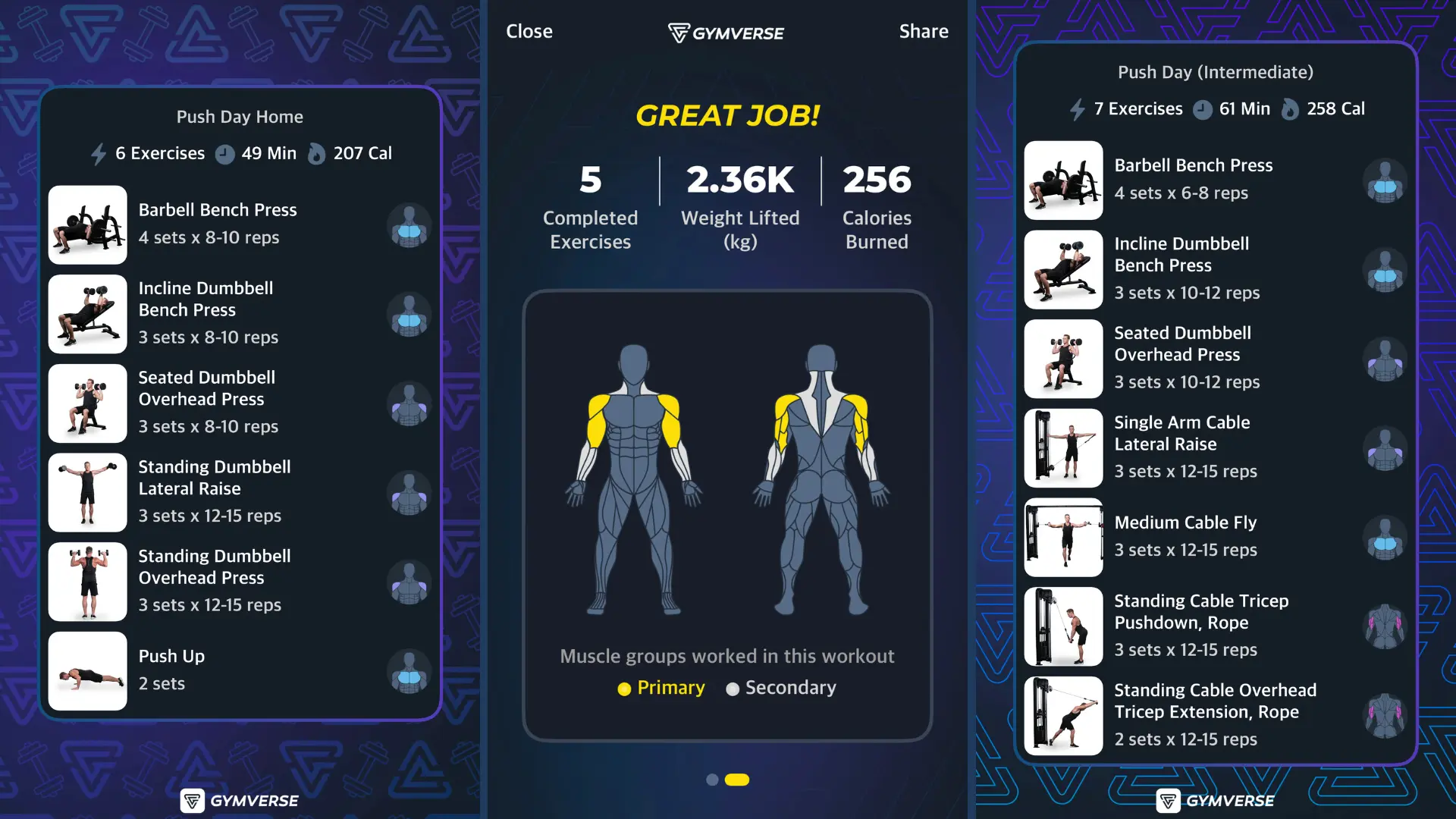
You can copy these straight into your next session. We built one for each setup: a full gym, a beginner start, and a home or dumbbell-only day.
Intermediate / Hypertrophy Push Day (Full Gym)
| Exercise | Sets | Reps | Rest |
|---|---|---|---|
| Barbell bench press | 4 | 6 – 8 | 2-3 min |
| Incline dumbbell press | 3 | 8 – 12 | 90 sec |
| Seated dumbbell shoulder press | 3 | 8 – 12 | 90 sec |
| Cable lateral raise | 3 | 12 – 15 | 60 sec |
| Pec-deck or cable fly | 3 | 12 – 15 | 60 sec |
| Rope triceps pushdown | 3 | 12 – 15 | 60 sec |
| Overhead triceps extension | 2 | 12 – 15 | 60 sec |
Beginner Push Day (Machine-Friendly)
| Exercise | Sets | Reps | Rest |
|---|---|---|---|
| Machine chest press | 3 | 8 – 12 | 90 sec |
| Machine shoulder press | 3 | 8 – 12 | 90 sec |
| Dumbbell lateral raise | 3 | 12 – 15 | 60 sec |
| Pec deck fly | 2 | 12 – 15 | 60 sec |
| Triceps pushdown | 3 | 12 – 15 | 60 sec |
Home / Dumbbell-Only Push Day
| Exercise | Sets | Reps | Rest |
|---|---|---|---|
| Flat dumbbell floor or bench press | 4 | 8 – 12 | 90 sec |
| Incline dumbbell press (or decline push-up) | 3 | 10 – 12 | 90 sec |
| Seated dumbbell shoulder press | 3 | 8 – 12 | 90 sec |
| Dumbbell lateral raise | 3 | 12 – 15 | 60 sec |
| Dumbbell overhead triceps extension | 3 | 12 – 15 | 60 sec |
| Push-ups (burnout) | 2 | To failure | 60 sec |
Note: A beginner can hold the same weight for a few weeks, then add load once the top of the rep range feels easy. That small, steady jump is progressive overload, and it’s what helps you get results.
How Often Should You Train Push Day?
Once a week works, but twice a week grows muscle faster when your weekly volume stays the same. A frequency meta-analysis found that a muscle trained twice per week beats the same volume crammed into a single session.
So go ahead and set it up around your schedule. On a six-day push/pull/legs plan, you should hit push day twice. On a three-day version, you should rotate through it once and still cover everything.
What would your chest and shoulders look like with a push day built around your goal, your gym, and your schedule?
Gymverse builds exactly that. It picks your push exercises, sets, and rep ranges for the equipment you actually have, shows you a video for every movement, then adds weight as you get stronger, week after week. And something we love, you can swap any exercise, edit the rep ranges, or start from scratch when needed.
Start free for 7 days and run your first personalized push day this week. Find the app on both iOS and Android.
Conclusion
A good push day is not a pile of chest, shoulder, and triceps exercises. It’s an actual plan. To get the best results, lead with a heavy compound press while you’re fresh, add a second angle, then finish with isolation work for the pectoralis major, the anterior and lateral deltoids, and the triceps brachii.
Do that for a few months and your pressing strength and shoulder width will certainly climb. If you’d rather have the plan built for you than guess at it, let Gymverse handle the details. Your first personalized push day is one free trial away.
Frequently asked questions
What is a push day workout?
A push day workout is a training session that targets every muscle involved in pressing weight away from your body: the chest, front and side shoulders, and triceps.
What muscles does a push day work?
It targets the pectoralis major (chest), anterior and lateral deltoids (front and side shoulders), and triceps brachii.
How many exercises should you do on push day?
Most push days consist of 5 to 7 exercises and approximately 16 to 22 total working sets.
How long should a push day workout take?
Between 45 to 75 minutes, depending on your set count and rest intervals (2–3 minutes for compounds, 60–90 seconds for isolation).
How many times a week should you train push day?
While once a week works, training push day twice per week optimizes muscle growth while maintaining total weekly volume.
What is the difference between push day and pull day?
Push day trains pressing muscles (chest, shoulders, triceps), whereas pull day trains pulling muscles (back, biceps, rear deltoids).
Can you do push and pull on the same day?
Yes, an upper-body routine combining push and pull exercises works well for lower-frequency training schedules.
Sources & further reading
All Gymverse articles are reviewed against current research. See our full References & Research page.
Turn what you just learned into a training plan that works for you. Personalized structure. AI coaching. Real progress.
START TRAINING →