3 Muscle-Building Mistakes to Avoid (Why You’re Not Gaining Muscle)
Why are you not gaining muscle despite training consistently? Learn the three most common mistakes and what to fix in your program and nutrition.
 By Amnon V. ·
TL;DR

Muscle Gain Requires More Than Just Working Out
Muscle is the most expensive thing your body can build, and it refuses to spend the money unless you force three separate issues at the same time. Train for months while missing any one of them and you’ll get the same frustrating result: real effort, no growth, and a quiet suspicion it’s your genetics. It’s almost never your genetics.
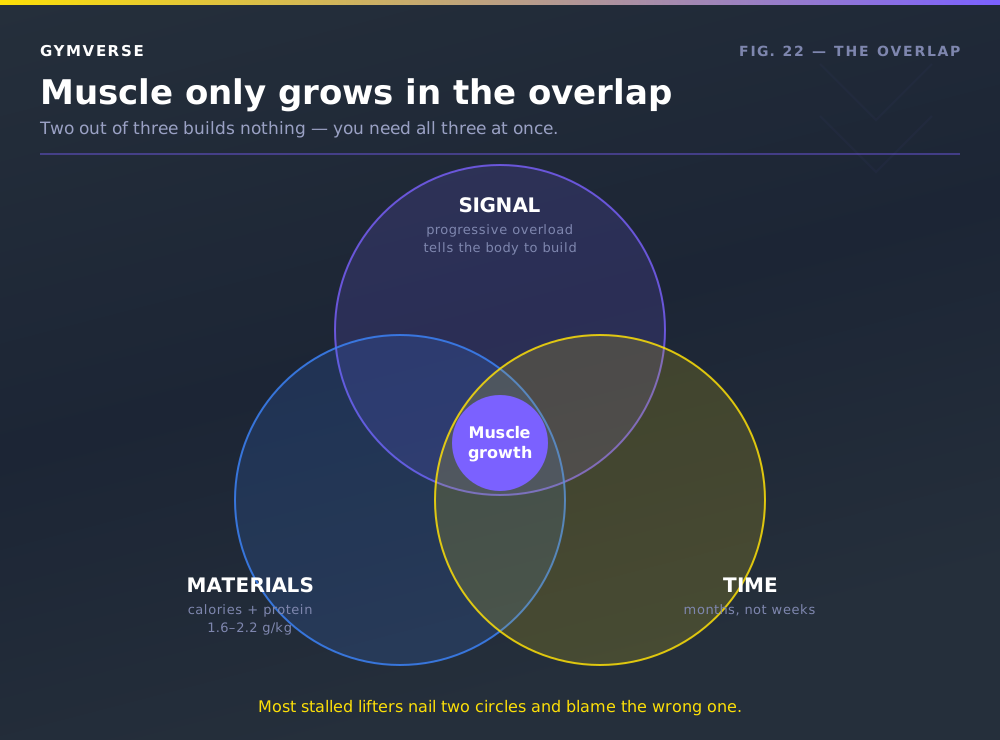
Muscle only grows in the overlap. Three things have to be true at once: a signal (progressive overload telling the body to build), materials (enough calories and protein to build with), and time (months, not weeks). Picture three circles. Growth happens only where all three overlap, not where two of them do. Most stalled lifters are nailing two circles and blaming the wrong one.
 GYMVERSE
FIG. 22 — THE OVERLAP
Muscle only grows in the overlap
Two out of three builds nothing — you need all three at once.
Muscle
growth
SIGNAL
progressive overload
tells the body to build
MATERIALS
calories + protein
1.6–2.2 g/kg
TIME
months, not weeks
Most stalled lifters nail two circles and blame the wrong one.
Progressive overload is the building permit: the signal that construction is allowed. Calories and protein are the bricks. Time is the build schedule. A permit and a schedule with no bricks builds nothing. So does a brick pile with no permit. You need all three on site.
Mistake 1: Not Eating Enough
This is the materials problem. Building muscle requires extra energy: a realistic target is maintenance calories plus approximately 300 per day.
Example:
Maintenance: 2,400 kcal
Muscle gain target: approximately 2,700 kcal
Protein also matters: 1.6–2.2g per kg of bodyweight.
Mistake 2: No Progressive Overload
This is the signal. Muscles grow by adapting to increasing stress. That means consistently doing more over time:
More weight
More reps
Better control
Improved performance
Mistake 3: Not Giving It Enough Time
This is the time. Typical timeline:
Strength gains: 2–4 weeks
Visible muscle: 6–8 weeks
Significant change: 3–6 months
Consistency beats short-term intensity every time.
Frequently asked questions
Why can't I gain weight no matter how much I eat?
Most people underestimate calorie intake. Track accurately for one week — the gap is usually larger than expected.
Do I need to eat every 2–3 hours?
No. Total daily calories and protein matter more than meal frequency.
Can beginners build muscle without bulking?
Yes, but progress is slower. Beginners respond to training strongly enough to build muscle near maintenance calories.
Sources & further reading
- Schoenfeld, Ogborn & Krieger (2017), J Sports Sci — volume & overload
- Morton et al. (2018), Br J Sports Med — protein
- Mifflin & St Jeor et al. (1990), Am J Clin Nutr — calorie needs
All Gymverse articles are reviewed against current research. See our full References & Research page.
Turn what you just learned into a training plan that works for you. Personalized structure. AI coaching. Real progress.
START TRAINING →