Best Core Exercises for a Stronger, More Functional Midsection
 By Amnon V. ·
TL;DR
- Train your core for function, not just six-pack aesthetics.
- Focus on anti-extension, anti-rotation, anti-lateral flexion, and loaded flexion.
- Top exercises include planks, dead bugs, bird dogs, Pallof presses, ab wheel rollouts, side planks, and suitcase carries.
- Train your core 2–3 times per week with 3 sets per exercise.
- Choose one exercise from each movement category and progressively add reps, time, or weight.
Most “core” workouts bury you in endless crunches and promises of a six-pack by summer. Meanwhile, the muscles that actually protect your spine and help you move real weight barely get trained. As a result, you end up chasing a look but your foundation stays weak.
The biggest mistake is that you train your abs when you really need to train your core. Ab definition is largely made in the kitchen. Your core is about function, including deep bracing, anti-rotation, and stability that help you squat, deadlift, run, and carry weight without putting unnecessary stress on your lower back.
That’s why in this blog post, you’ll learn what your core really is, why functional strength matters more than chasing a six-pack, how we ranked these movements, the 10 best core exercises with exact sets and reps, and how to turn them into a routine you’ll actually stick to.
What Counts As Your Core?
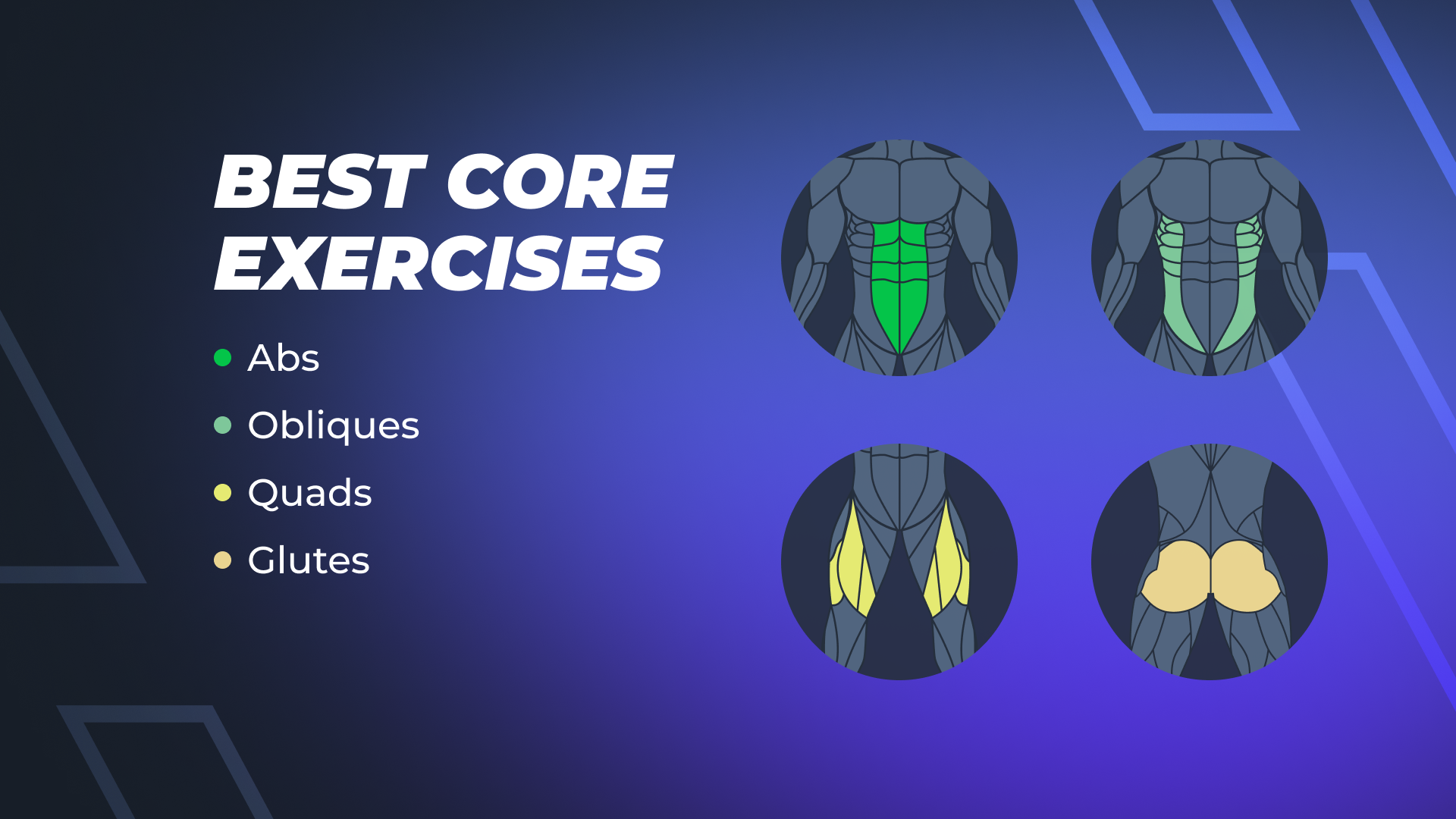
Your core wraps around your entire midsection, including the rectus abdominis (the six-pack muscle), the internal and external obliques along your sides, and the transverse abdominis. Along your back, you have the spinal stabilizers, including the erector spinae, multifidus, and quadratus lumborum.
These muscles all work together. They resist unwanted movement, keep your spine stable, and transfer force between your upper and lower body when you lift, throw, or carry.
That’s why core strength is all about how well you can keep your body stable under load.
Why Functional Core Strength Beats Chasing a Six-Pack Every Time
A six-pack looks good and it’s a fantastic goal to have, but working out won’t necessarily help you get it. What will is your nutrition. In fact, a science-based nutrition plan for a six-pack requires a sustainable daily calorie deficit of 300 to 500 calories paired with high protein intake to lose fat, but keep muscle.
To have a fully visible 6-pack, you need the following body fat percentage:
| Gender | Percentage | Description |
|---|---|---|
| Male | 5-9% | This range puts you in the genetic elite, or competition bodybuilder level. Visually you’ll see every muscle in your body and likely individual muscle strands in certain parts. |
| Male | 10-14% | This range of body fat is lean so your abs will be visible. And it’s much healthier than the 5-9% range. |
| Male | 15-19% | While still considered healthy, it’s less likely that you will see much muscle definition in this range. |
| Male | 20-24% | Your abs won’t be visible and there’s a good chance you will be soft around the middle. |
| Male | 25-29% | You won’t see your abs at all. This level is considered obese in men. |
| Male | 30-34% | You won’t see your abs at all. Interventions may be necessary. This isn’t a healthy body fat range for a male. |
| Male | 35-39% | You won’t see your abs at all. This range is a warning sign for health complications. |
| Female | 5-9% | Your abs will be visible. However, this is a very low, likely dangerous, body fat range for a female. |
| Female | 10-14% | Your abs will be visible. However, if you’re aiming for low body fat levels, this is about as low as you’d want to go. |
| Female | 15-19% | Definition in the lower abs starts to fade, but there is still distinct ab definition in the obliques. Females at this level typically have an athletic build, with great shape and very little body fat. |
| Female | 20-24% | This is considered to be a low to low-average level of body fat. However, you won’t be able to see your abs. |
| Female | 25-29% | Your definition may be minimal and your body may start to have a softer look. |
| Female | 30-34% | You won’t see your abs at all. You’re heading toward obesity. |
| Female | 35-39% | You won’t see your abs at all. This is a red flag for weight loss intervention. |
Note: This is just guidance. There are many factors that go into how visible your abs are like your body fat percentage, genetics, and workout (just to name a few).
Here’s what you need to know:
Core exercises don’t burn belly fat on their own, spot reduction simply doesn’t exist. A study by Vispute et al. (2011) in the Journal of Strength and Conditioning Research put participants through six weeks of abdominal training and found no reduction in abdominal fat or body composition compared to a control group.
So while abs become more visible through nutrition and overall training, core work builds strength, stability, and injury resistance. That’s why we ranked these movements by their functional value, not by how much ‘fat’ they burn.
How We Ranked These Core Exercises
We ranked each exercise based on its functional value. We looked at:
- How much stability or anti-movement demand it creates.
- How much muscle it recruits.
- How well it carries over to lifts and daily movement.
- How easily it can be scaled from beginner to advanced.
Note: A good core program should train anti-extension (resisting your spine arching), anti-rotation (resisting twist), anti-lateral flexion (resisting side-bend), and loaded flexion (trained, but not overused).
The following list hits all four.
The 10 Best Core Exercises, Ranked
These ten movements cover every job your core has to do, from deep bracing to resisting rotation. Copy the table for sets and reps, then read the breakdown below.
Every one of these has an HD video guide inside Gymverse, so you can check your form from multiple angles before you load up.
| # | Exercise | Core Job | Equipment | Sets & Reps |
|---|---|---|---|---|
| 1 | Plank | Anti-extension | Bodyweight | 3 sets, 20-40 sec |
| 2 | Dead Bug | Anti-extension | Bodyweight | 3 sets, 8-10 per side |
| 3 | Bird Dog | Anti-rotation / stability | Bodyweight | 3 sets, 8-10 per side |
| 4 | Pallof Press | Anti-rotation | Cable / band | 3 sets, 10-12 per side |
| 5 | Hanging Leg Raise | Loaded flexion / anti-extension | Pull-up bar | 3 sets, 8-12 |
| 6 | Kneeling Ab Wheel | Anti-extension (loaded) | Ab wheel | 3 sets, 6-10 |
| 7 | Hollow Body Hold | Anti-extension | Bodyweight | 3 sets, 15-30 sec |
| 8 | Cable Crunch | Loaded flexion (hypertrophy) | Cable | 3 sets, 10-15 |
| 9 | Side Plank | Anti-lateral flexion | Bodyweight | 3 sets, 20-40 sec per side |
| 10 | Suitcase Carry | Anti-lateral flexion / bracing | Dumbbell / kettlebell | 3 sets, 30-40 m per side |
1) Plank: Anti-extension

The plank tops the list because it’s one of the simplest ways to train a full-body brace and teach the transverse abdominis and rectus abdominis to hold a neutral spine under tension. Squeeze your glutes, brace like you’re about to take a punch, and end the set when your hips start to sag.
Do 3 sets of 20-40 seconds of quality tension, then progress to a hardstyle RKC plank when you want more.
2) Dead Bug: Anti-extension
Dead Bug Exercise For Core Stability | Pursuit Physical Therapy
The dead bug trains anti-extension while your arms and legs move (which is exactly how your core works in real life) and it stays gentle on your lower back. Press your lower back into the floor the entire time and move slowly through each rep.
Do 3 sets of 8-10 per side. It’s one of the safest starting points if you deal with lower-back issues.
3) Bird Dog: Anti-rotation / Stability
How to Do the Bird Dog Exercise: A Guide from Physical Therapists
The bird dog earns a top-three spot because it builds anti-rotation control and spinal stability by resisting the twist that wants to happen when you extend the opposite arm and leg. It’s part of Dr. Stuart McGill’s spine-sparing “big three,” backed by his decades of research on core stability and back health.
Keep a flat back, pause two seconds at the top, and complete 3 sets of 8-10 per side.
4) Pallof Press: Anti-rotation
Stand side-on to a cable or band and press straight out while your obliques and transverse abdominis fight the pull trying to rotate you. Stay square and don’t let the weight twist you.
Do 3 sets of 10-12 reps per side.
5) Hanging Leg Raise: Loaded flexion / Anti-extension

The hanging leg raise trains the rectus abdominis and hip flexors through a big range of motion. Hanging and captain’s-chair style raises rank among the highest for rectus abdominis recruitment. An ACE-commissioned EMG study at San Diego State University ranked the captain’s chair second out of 13 common ab exercises.
Start with hanging knee raises, then build up to 3 sets of 8-12 reps.
6) Kneeling Ab Wheel: Anti-extension (loaded)

The kneeling ab wheel is one of the most demanding anti-extension moves because your core has to resist your spine caving as you extend, loading the rectus abdominis and obliques under tension. Keep a slight posterior pelvic tilt and never let your lower back arch.
Start from your knees with a shorter range, then progress to 3 sets of 6-10 reps.
7) Hollow Body Hold: Anti-extension

Gymnasts swear by the hollow body hold because it creates full-body anterior tension and trains anti-extension harder than most people expect.
Press your lower back flat into the floor and hold your arms and legs off the ground. Tuck your knees to regress it, or hold the full position for 3 sets of 15-30 seconds.
8) Cable Crunch: Loaded flexion (hypertrophy)
The cable crunch is the best loaded flexion option on this list. It’s the one movement built to grow the rectus abdominis through progressive overload, which is exactly what our muscle-building audience wants. Since you can add weight over time, it’s a better option for hypertrophy than doing endless crunches.
Crunch with your abs, not your hips, for 3 sets of 10–15 reps.
9) Side Plank: Anti-lateral flexion

The side plank is the go-to for anti-lateral flexion, training the obliques and quadratus lumborum to resist side-bending and adding real stability to the sides of your torso. It’s the third of McGill’s “big three.”
Hold a straight line from head to heels for 3 sets of 20-40 seconds per side, dropping to your knees when you’re starting out.
10) Suitcase Carry: Anti-lateral flexion / Bracing
How to Perform A Suitcase Carry
Loaded carries deserve a spot because holding a heavy weight in one hand forces your entire core to brace and resist tipping sideways.
Stand tall and refuse to lean away from the weight. Walk 3 sets of 30-40 meters per side. It doubles as grip and full-body work, and it slots neatly into a full body workout at home when you just own a single dumbbell or kettlebell.
How To Build These Into a Core Routine
Doing all ten at random wastes your time. Instead, train your core 2-3 times per week and pick one movement from each job, anti-extension, anti-rotation, anti-lateral flexion, and loaded flexion, so you cover every angle in about 10-15 minutes.
Here’s a simple beginner template: plank, bird dog, side plank, and dead bug. A stronger lifter might use ab wheel rollout, Pallof press, suitcase carry, and cable crunch. Either way, apply progressive overload by adding reps, time, or load week over week.
Is your current core workout actually building function?
A personalized Gymverse plan puts these movements to work for your goals, your equipment, and your schedule. You get a free 7-day trial, a plan that adapts as you get stronger, and an HD video guide on every single exercise.
Start your plan and train a core that holds up when the weight goes on. Find the app on both iOS and Android.
Conclusion
Having a strong core is all about function (the bracing, anti-rotation, and stability that protect your spine and help you move weight). The ten movements we shared above cover every job your core has to do.
Pick one movement from each job, train it 2-3 times a week, and add reps, time, or load each week. Keep doing that consistently, and the results will follow.
Frequently asked questions
What are the best core exercises?
The best core exercises train your midsection to resist movement. Our top picks are the plank, dead bug, bird dog, Pallof press, and hanging leg raise.
What are the best core exercises for beginners?
Start with the plank, dead bug, and bird dog. They teach your core to stay stiff and stable, are gentle on your lower back, and need no equipment. They're a solid foundation before you add loaded moves.
How do you build a stronger core?
Train all four core jobs, anti-extension, anti-rotation, anti-lateral flexion, and loaded flexion, 2-3 times per week. Apply progressive overload by adding reps, time, or load to build your core strength over time.
Do core exercises burn belly fat?
No, spot reduction is a myth. A Vispute et al. (2011) study found that six weeks of abdominal training alone produced no reduction in abdominal fat. You make your abs more visible through nutrition and overall training, not by doing more crunches.
Can you do core exercises every day?
Yes, for low-intensity stability work like planks, dead bugs, and bird dogs. Heavy loaded core moves like ab wheel rollouts and weighted cable crunches need recovery, so space those out like any other resistance training.
Do you need equipment for a strong core?
No, the plank, dead bug, bird dog, hollow body hold, and side plank are all bodyweight exercises. However, if you can invest in equipment like a cable, ab wheel, or a single dumbbell, you'll open up more options, like the Pallof press, cable crunch, and suitcase carry.
Are planks better than crunches?
They do different jobs. Planks train anti-extension (bracing), while crunches train loaded flexion (spinal movement). You want to do both: bracing for stability and strength, and loaded flexion for building the rectus abdominis.
Sources & further reading
All Gymverse articles are reviewed against current research. See our full References & Research page.
Turn what you just learned into a training plan that works for you. Personalized structure. AI coaching. Real progress.
START TRAINING →