Kettlebell Goblet Squat: Benefits, Form & Why It’s the Best Beginner Squat
 By Amnon V. ·
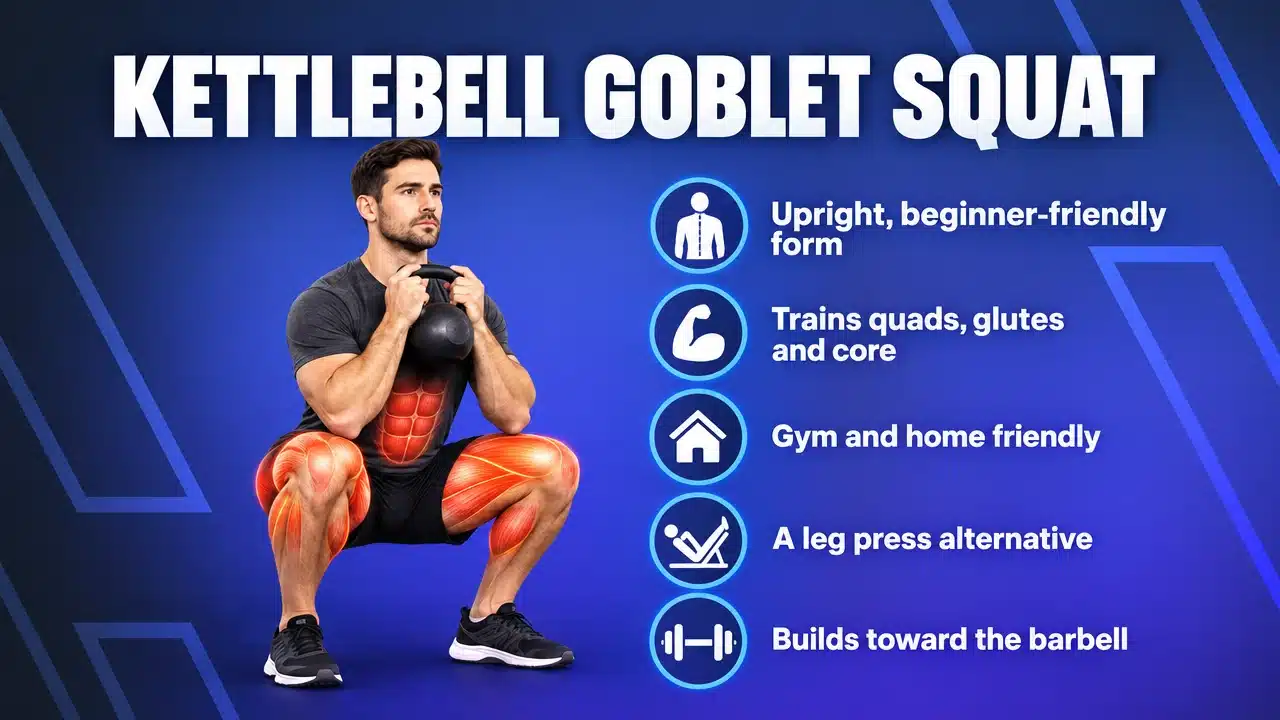
Walking up to a loaded barbell as a beginner is intimidating, and most people’s squat form falls apart the moment the weight gets heavy. The kettlebell goblet squat fixes that. You hold one weight against your chest, sit down between your hips, and stand back up. The load in front does something clever. It pulls you into a better position instead of letting you round forward. That makes the goblet squat the best entry-point squat for anyone learning to train, a real leg press alternative when you have no machine, and a cornerstone of a full-body workout at home. This guide covers what it trains, why it works, and how to move from the kettlebell to the barbell when you’re ready.
Key takeaways
- What it is: a squat holding a kettlebell at your chest, built by coach Dan John to teach clean form.
- Muscles worked: the quads and glutes lead, with the core and back assisting.
- The benefits: the front load keeps you upright, braces your core, and spares your knees and lower back.
- Good for beginners: yes, because the weight in front self-corrects your squat as you learn it.
- How to do it: weight at your chest, stance slightly wide, sit straight down, drive through your whole foot.
- Goblet squat vs back squat: goblet wins on form and joint comfort; the barbell wins on load.
- Progress to the barbell: when the kettlebell stops challenging your legs, add barbell work and progressive overload.
What is a kettlebell goblet squat?
The kettlebell goblet squat is a squat where you hold a single kettlebell or dumbbell vertically against your chest, cupped in both hands. The name comes from how you hold it, like a large goblet. Strength coach Dan John created the movement to teach lifters to squat with clean mechanics, and it has been a staple of kettlebell training ever since. The setup is simple, but the front-loaded position changes how the squat feels. Instead of balancing a bar across your back and hoping your torso stays upright, you counterbalance the weight in front. That pulls your chest up and lets you sit straight down.
Goblet squat – muscles worked
The goblet squat is a compound lower-body move, so it trains several muscles at once, led by the quadriceps and glutes. Holding the weight in front also brings your core and upper back into the work. Here is what does the lifting:
- Quadriceps: the front-thigh muscles that straighten your knees and the primary driver out of the bottom.
- Glutes: the hip extensors that power you back to standing.
- Hamstrings and adductors: the posterior chain and inner thigh that support depth and hip stability.
- Core: your abs and spinal erectors brace to hold the load and keep your spine stacked.
- Upper back and shoulders: your mid-back and front delts hold the kettlebell against your chest through every rep.
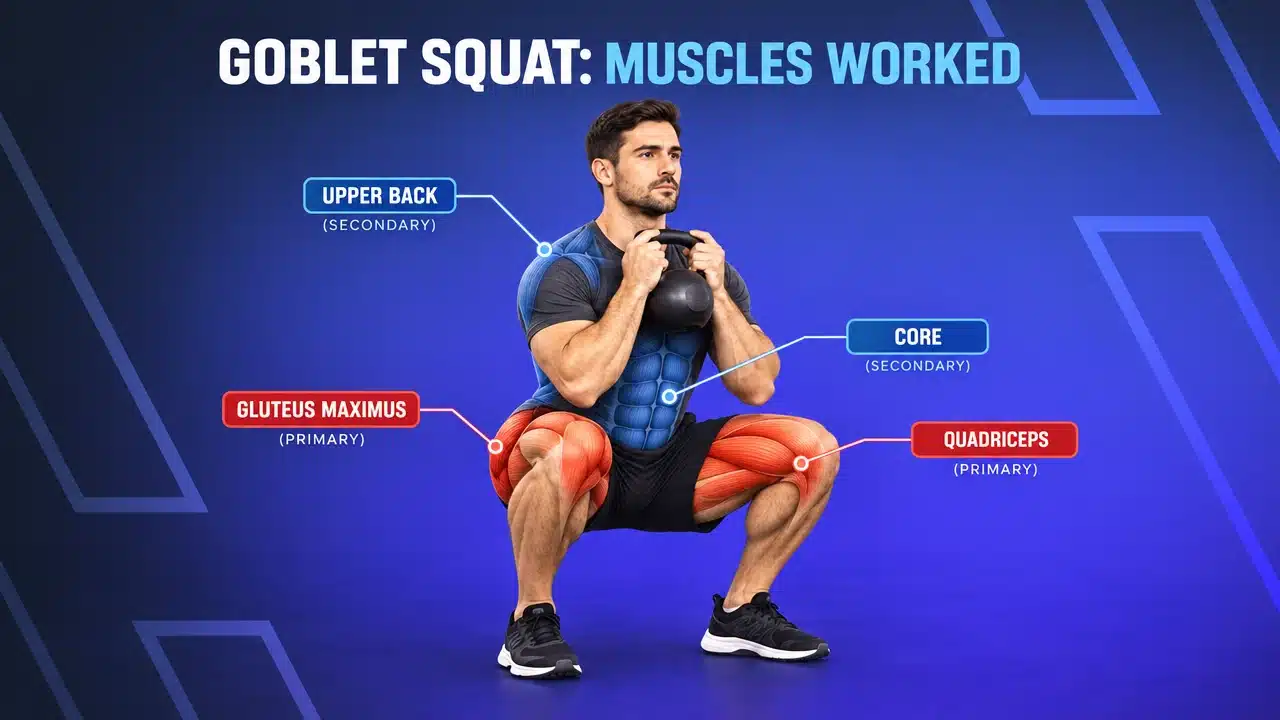
[IMAGE 54B: Front-facing anatomy figure in a mid-depth goblet squat holding a kettlebell at the chest, with the quadriceps and gluteus maximus highlighted in bold color and the core and upper back shaded as secondary, on the Gymverse purple-to-blue gradient, labeled “GOBLET SQUAT: MUSCLES WORKED”]
What are the benefits of the kettlebell goblet squat?
The biggest benefit of the goblet squat is that it makes good form almost automatic, which is rare for a squat. The weight sits in front of your center of mass and acts as a counterbalance. That lets you keep an upright torso and sit into a deeper squat than most people manage with a bar on their back. Research on front-loaded squatting backs this up. In a biomechanics study, the barbell back squat produced significantly higher knee compressive forces than the front squat, which shares the goblet squat’s anterior-load position. Three more benefits follow from that position:
- Your core works hard. Holding the load in front forces your abs and spinal erectors to brace on every rep, so you train your trunk without a separate exercise.
- It is easier on the joints. The upright torso keeps shear off your lower back, which helps if barbell squats bother your knees or spine.
- It travels. All you need is one kettlebell or dumbbell, so it drops straight into a full body workout at home or a hotel gym.
The goblet squat doesn’t just let you squat heavier. It teaches you how to squat at all.
Is the goblet squat good for beginners?
Yes, the goblet squat is one of the best squats for beginners, and that was the whole point of it. Dan John built the movement to fix the sloppy squatting he kept seeing, because the front load quietly corrects your position for you. When you hold a weight at your chest and squat, a few things happen on their own. You brace your core to stop the weight pulling you forward. You sit down instead of tipping over, and your elbows track between your knees, which teaches you to push your knees out and reach depth. You get that feedback every rep with no coach watching. Start light. Dan John’s own program starts light for the first couple of weeks, drilling the pattern before the weight climbs. If you’re brand new to training, pair goblet squats with the rest of a simple routine.
How to do a goblet squat, and the mobility it demands
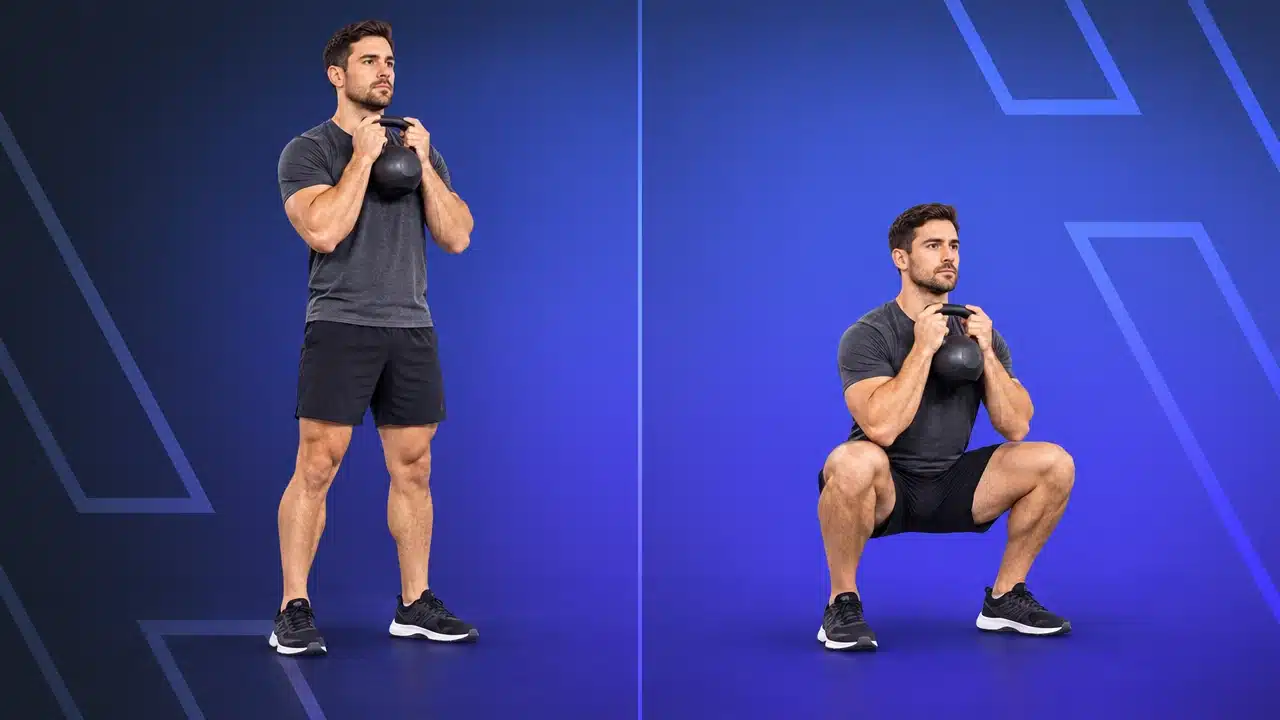
Here is how to do a goblet squat with good form. Stand with your feet a little wider than your hips and your toes turned out slightly. Cup one end of a kettlebell or dumbbell in both hands and hold it against your chest with your elbows pointing down. Take a breath and brace your core. Sit straight down as if lowering into a chair, keeping your chest tall and your heels planted. Go as deep as you can while staying upright, ideally until your thighs reach at least parallel, then drive through your whole foot to stand.
Depth depends partly on your mobility, and ankle range of motion matters more than most people expect. When researchers restricted ankle dorsiflexion during a squat, lifters showed more knee caving and less quad activation. If your heels lift or your knees collapse inward, work on ankle and hip mobility, or raise your heels slightly on a small plate to squat deeper while you build range.
Goblet squat vs back squat, and as a leg press alternative
So how does the goblet squat compare to the barbell back squat, and can it stand in for a leg press? The goblet squat wins on form, core demand, and joint comfort. It also needs almost no equipment. The back squat wins on the one thing that matters most for long-term strength, which is load. A bar on your back lets you pile on far more weight than you can ever hold at your chest, so it is the better tool once your legs outgrow a kettlebell. That same load ceiling shapes how the goblet squat works as a leg press alternative. Train at home with no machine and the goblet squat trains the same quads and glutes the leg press hits, which makes it a strong substitute. The honest limit is load again. A leg press supports your torso and lets you go heavy, while the goblet squat caps out at what your hands and upper back can hold. For form and moderate loads it is a great swap. For maximal leg loading, a machine or barbell still wins.
How to progress from the goblet squat to the barbell
The goblet squat is where you start, not where you stop. Because the weight is capped by what you can hold, you will reach a point where your legs can handle more than your arms can carry. That is your cue to progress. Get more out of the kettlebell first by adding reps, slowing the lowering phase, and pushing each set closer to failure. Strength comes from progressive overload, the steady rise in stress your muscles have to adapt to over time. You can manage that effort with reps in reserve, stopping each set one to three reps short of failure, a method validated in strength research. When the kettlebell truly runs out of road, move to the barbell front squat and then the back squat. Keep the weekly volume that builds muscle. Training each muscle group across roughly 10 or more hard sets a week drives better results than doing less. This is the logic Gymverse plans run on. Every plan applies progressive overload, calibrated volume, and RIR-based intensity for you, with 500+ exercise videos showing the form for each move, from the goblet squat to the barbell.
Frequently asked questions
How much weight should I use for a goblet squat?
Start with a light kettlebell or dumbbell you can control through clean reps, then add load only once your form holds at depth. The right weight is whatever lets you hit good depth with one to three reps left in the tank. Progress gradually. If you have any injury or health condition, check with a doctor or coach before loading up.
How many sets and reps of goblet squats should I do?
Most strength and muscle plans use a few moderate-rep sets per exercise, stopping a rep or two short of failure rather than grinding to it. Your weekly training volume matters more than any single session, so spread your leg work across the week instead of cramming it into one day.
Goblet squat vs back squat, which is better for beginners?
The goblet squat is better for beginners because the front load teaches upright, deep form with almost no coaching, while the back squat suits heavier loading once your technique is solid. Most lifters use the goblet squat to learn the pattern, then add the barbell later.
Can goblet squats replace the leg press?
For home training, yes, the goblet squat trains the same quads and glutes as the leg press and needs no machine. The trade-off is load, since a leg press supports your body and lets you go heavier, so it wins for maximal leg strength while the goblet squat wins for form and convenience.
Sources & further reading
- What a goblet squat is and the muscles it works: WebMD, How to Do a Goblet Squat.
- The goblet squat was created by strength coach Dan John to teach squat mechanics: Fitness Volt.
- Front-loaded squats produce lower knee compressive forces than back squats: Gullett et al., 2009, Journal of Strength and Conditioning Research.
- Restricted ankle dorsiflexion alters squat mechanics and reduces quadriceps activation: Macrum et al., 2012, Journal of Sport Rehabilitation.
- Reps in reserve as an intensity framework: Zourdos et al., 2016, Journal of Strength and Conditioning Research.
- Weekly training volume and muscle growth, about 10 or more sets per muscle: Schoenfeld et al., 2017, Journal of Sports Sciences.
- Gymverse training method and 500+ exercise videos: Gymverse.
- The studies behind our training guides: Gymverse References and Research.
All Gymverse articles are reviewed against current research. See our full References & Research page.
Turn what you just learned into a training plan that works for you. Personalized structure. AI coaching. Real progress.
START TRAINING →