Bicep Workouts with Dumbbells: Best Exercises for Peak & Width
 By Amnon V. ·
TL;DR
- Peak and width come from different heads. The outer long head drives the peak, while the inner short head and the brachialis build width.
- These are the 8 best dumbbell bicep exercises, ranked by whether they bias peak or width.
- Grip and elbow angle set the emphasis. Supinate hard, and move your elbow behind or in front of you on purpose.
- Run the dumbbell bicep finisher to add clean volume at the end of a session.
- Build bigger biceps with 10 to 20 hard sets a week, split over two days, taken close to failure.
You can curl three times a week for a year and still end up with arms that look flat from the side. The problem usually isn’t effort. It’s that most bicep workouts with dumbbells hammer one angle with one grip, so part of the muscle grows and the rest lags behind. Your biceps has two heads, plus a muscle underneath, and each one answers to a different arm position. Get the angles right and you build both the height people call the peak and the width that fills out the front of the arm. This guide ranks 8 dumbbell exercises by what they actually bias. You get supination cues, set and rep targets, and a finisher to close out arm day.
What actually shapes a bicep peak and width
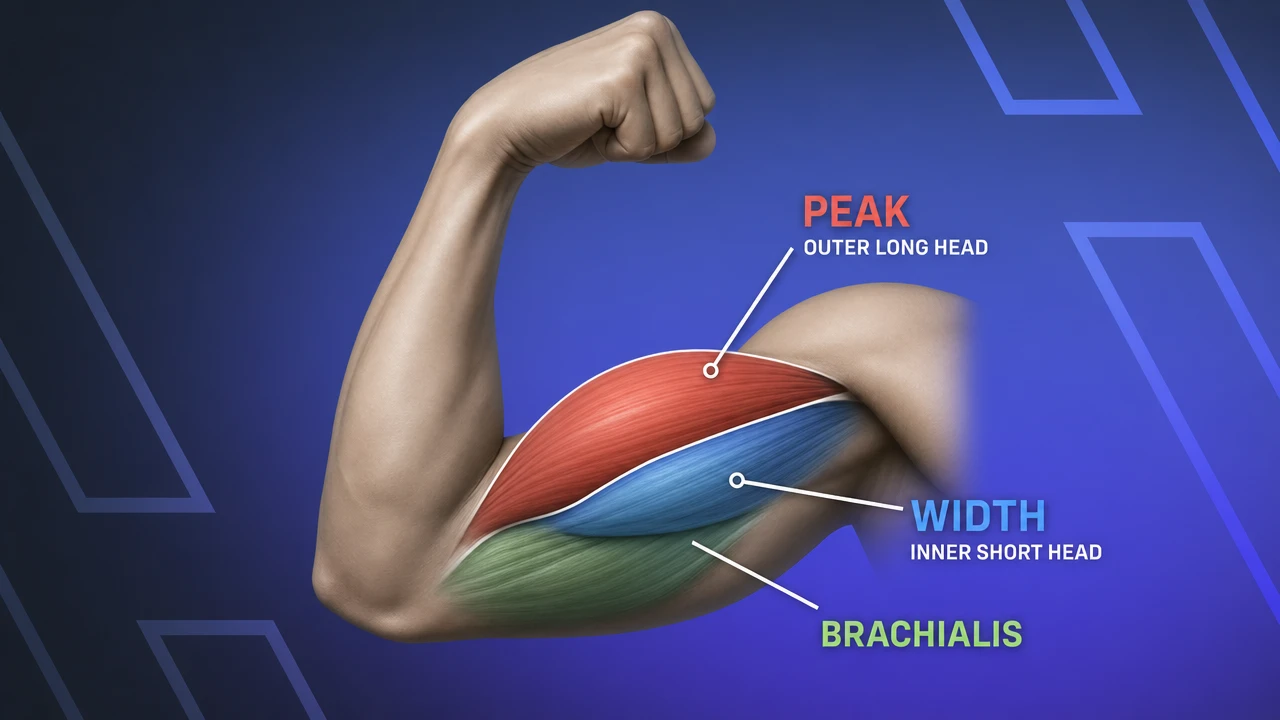
Your biceps brachii has two heads. The long head sits on the outer side of the arm and forms most of the bump you see when you flex, the part lifters call the peak. The short head sits on the inner side and adds width when you look at the arm head on. Underneath both runs the brachialis, and building it pushes the biceps up so the whole arm looks thicker. Those points come straight from the anatomy. The long head is the lateral head, the short head is medial, and the biceps is the forearm’s strongest supinator once the elbow bends (StatPearls).
Two things decide which part gets the work: your grip and where your elbow sits. Turning the palm up, called supination, drives the biceps hardest, so a full twist at the top of every rep counts. Drawing your elbow behind your body stretches the long head and leans the work toward the upper, peak region. Bracing your elbow in front shifts it to the lower region and the brachialis. One honest caveat. How tall your peak can get is partly down to the length of your muscle belly and where its tendon attaches, and that is set by genetics. Training fills the muscle out. It doesn’t move the insertion.
What are the best dumbbell bicep exercises?
The best dumbbell bicep exercises are the ones that let you supinate fully and control the elbow angle. Here are 8, ordered from peak bias to width bias. The tag tells you what each move leans toward. None of them is magic alone, since total work across the week is what grows the arm, but together they cover every part of the muscle.
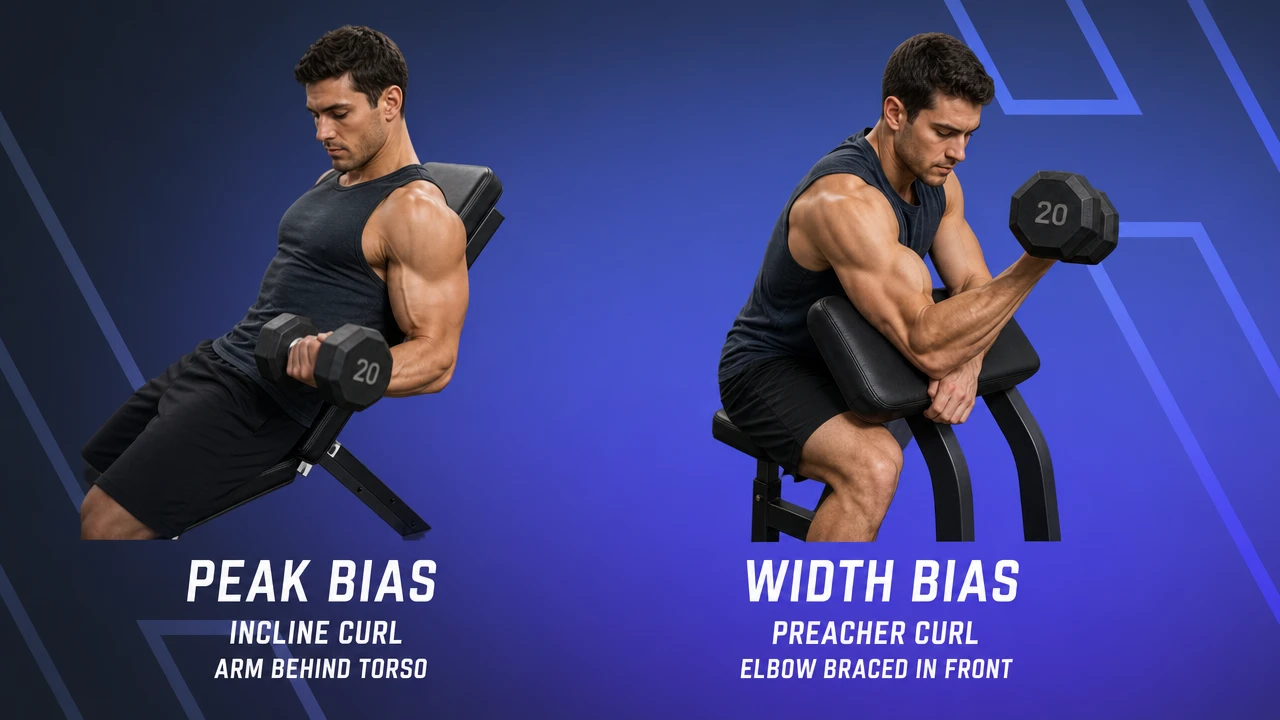
- Incline dumbbell curl. Peak. Sit back on an incline bench so your arms hang behind your torso. That shoulder-extended position stretches the long head and biases growth toward the upper, proximal part of the elbow flexors (Kassiano 2025). Supinate fully. 3 sets of 8 to 12 reps.
- Concentration curl. Contraction and inner. Sit, brace your elbow against your inner thigh, and curl with no swing. The braced arm kills momentum and forces a hard peak contraction with the shoulder slightly flexed. 3 sets of 10 to 15 reps.
- Spider curl. Peak contraction. Lie chest down on an incline bench with your arm hanging straight toward the floor. Tension stays high through the top, and the elbow-forward position drives a strong contraction. 3 sets of 10 to 15 reps.
- Standing dumbbell curl. Both heads. This is the foundation. Start with the palm neutral and rotate to full supination as you lift, because the biceps both bends the elbow and turns the forearm (Coratella 2023). 3 sets of 8 to 12 reps.
- Alternating dumbbell curl. Both heads. Same movement, one arm at a time, so you can load a little heavier and keep form clean. Curl slow, lower slower. 3 sets of 8 to 12 reps per arm.
- Preacher curl. Width and lower. Rest the back of your arm on a bench pad so the elbow sits in front of you. That position loads the lower, distal part of the elbow flexors, the opposite of what an incline curl does (Kassiano 2025). 3 sets of 8 to 12 reps.
- Hammer curl. Width and thickness. Hold the dumbbells with palms facing each other and curl without rotating. The neutral grip shifts work toward the brachialis and forearm, which adds thickness beside and under the biceps. 3 sets of 8 to 12 reps.
- Zottman curl. Arms and forearms. Curl up with the palm supinated, rotate to palm down at the top, then lower pronated. You train the biceps on the way up and the forearm on the way down. 3 sets of 10 to 12 reps.
Grip and elbow angle: the best bicep curl variations
The best bicep curl variations aren’t really different exercises. They are the same curl done with a different grip or elbow position, and three grips cover it. A supinated grip with the palm up puts the most load on the biceps, so it’s your default for size (Coratella 2023). A neutral grip with the palm facing in shifts work to the brachialis and brachioradialis, so it builds arm and forearm thickness. A pronated grip with the palm down pulls the biceps back and hits the forearm instead.
Elbow position does the rest. Behind your body, as in an incline curl, the long head stretches and the peak region takes more of the load. In front of your body, as in a preacher or spider curl, the lower biceps and the brachialis take over. Rotate through all of it across a week and no part of the arm gets skipped. Our method inside the app runs this same logic for you, and every one of the 500+ exercise videos shows the grip and angle for the move (the Gymverse Method).
A sample dumbbell bicep finisher
Run this at the end of a pull day or arm day, after your main curls, when the biceps is already warm. It stacks a peak move into a width move with no rest between, which pushes total volume up fast without adding much time.
- Incline dumbbell curl, 1 set of 10 to 12 reps, stopping 1 to 2 reps short of failure.
- Straight into hammer curls, 1 set to the same effort.
- Rest 90 seconds, then repeat the pair twice more, for 3 rounds total.
Keep the weight honest. If your form breaks or the dumbbells start swinging, the set is done. A finisher is there to add clean volume, not to grind you into the floor. If your elbows or shoulders ache during any curl, stop and get it checked by a doctor or physical therapist before you load it again.
How to build bigger biceps with dumbbells
To build bigger biceps with dumbbells, do enough hard weekly work and add a little over time. The research shows a dose response. More challenging sets per muscle each week means more growth, with gains climbing clearly out to around 10 or more weekly sets (Schoenfeld 2017). For most people, 10 to 20 hard sets a week for the biceps is a sensible range.
Split that across two sessions rather than one. When weekly volume is matched, training a muscle twice or once a week barely changes growth, so the split is just about fitting the work in (Schoenfeld 2019). Take most sets to within 1 to 3 reps of failure. Grinding all the way to failure adds only a trivial amount over stopping a couple of reps short, so you don’t need to redline every set (Refalo 2023). Rep ranges from about 8 to 15 suit curls well. The one rule that never changes is progressive overload, so add a rep or a little weight once a set starts to feel easy. Recovery differs from person to person, so tune the volume to what you can actually bounce back from. Prefer to skip the guesswork? Build your plan and the app handles the sets, load, and progression from there.
Frequently asked questions
What are the best dumbbell bicep exercises?
The incline dumbbell curl, concentration curl, and standing dumbbell curl rank among the best. They let you supinate fully and control the elbow angle to reach both heads.
How do you build bigger biceps with dumbbells?
Train the biceps with 10 to 20 hard sets a week, split over two sessions. Take most sets to within 1 to 3 reps of failure, and add weight or reps over time.
What are the best bicep curl variations?
The most useful variations change grip and elbow position. Supinated curls hit the biceps, hammer curls hit the brachialis and forearm, and incline curls shift the work toward the peak region while preacher curls shift it to the lower arm.
Is the dumbbell squeeze press a bicep exercise?
No. The dumbbell squeeze press is a chest move that works the pecs, front delts, and triceps by pressing two dumbbells together. The squeeze idea still helps on curls, so hold and squeeze hard for a second at the top of each rep.
How often should you train biceps with dumbbells?
About twice a week suits most people, as long as your total weekly sets land in the 10 to 20 range and you leave a day or so between sessions to recover.
Sources & further reading
- Anatomy of the biceps brachii, its two heads, and its role as the main forearm supinator: StatPearls, Anatomy, Shoulder and Upper Limb, Biceps Muscle
- A supinated grip produces greater biceps activation than neutral or pronated grips: Coratella et al., Sports (Basel), 2023
- Incline curls (shoulder extended) produced greater proximal, upper elbow flexor growth, while preacher curls produced greater distal, lower growth: Kassiano et al., International Journal of Sports Medicine, 2025
- Weekly training volume drives hypertrophy in a dose response, with gains rising out to roughly 10 or more sets per muscle per week: Schoenfeld, Ogborn, and Krieger, Journal of Sports Sciences, 2017
- Training frequency does not meaningfully change hypertrophy when weekly volume is matched: Schoenfeld, Grgic, and Krieger, Journal of Sports Sciences, 2019
- Training to failure holds only a trivial hypertrophy advantage over stopping short of it: Refalo et al., Sports Medicine, 2023
- The dumbbell squeeze press is a chest and triceps press, not a biceps exercise: Muscle and Strength, close grip dumbbell press
- For the full list of studies behind our training method, see the Gymverse References and Research page
All Gymverse articles are reviewed against current research. See our full References & Research page.
Turn what you just learned into a training plan that works for you. Personalized structure. AI coaching. Real progress.
START TRAINING →