Best Workout Apps for Beginners (2026): no overwhelm, just progress
 By Amnon V. ·
TL;DR
- The best beginner app makes the decisions a new lifter shouldn't have to make yet.
- Judge an app on three things. Does it tell you what to do, show you the form, and adjust when you miss a session.
- Our five picks run from adaptive planners to free trackers to real coaching.
- Gymverse builds and adapts the plan for you, so you never have to design one.
- Free picks exist, and so does real human coaching if you want it.
- Where Gymverse is weaker. No live human coach, and it's strength-first rather than class variety.
- Start with two strength days a week and keep the sessions short. The habit comes before the gains.
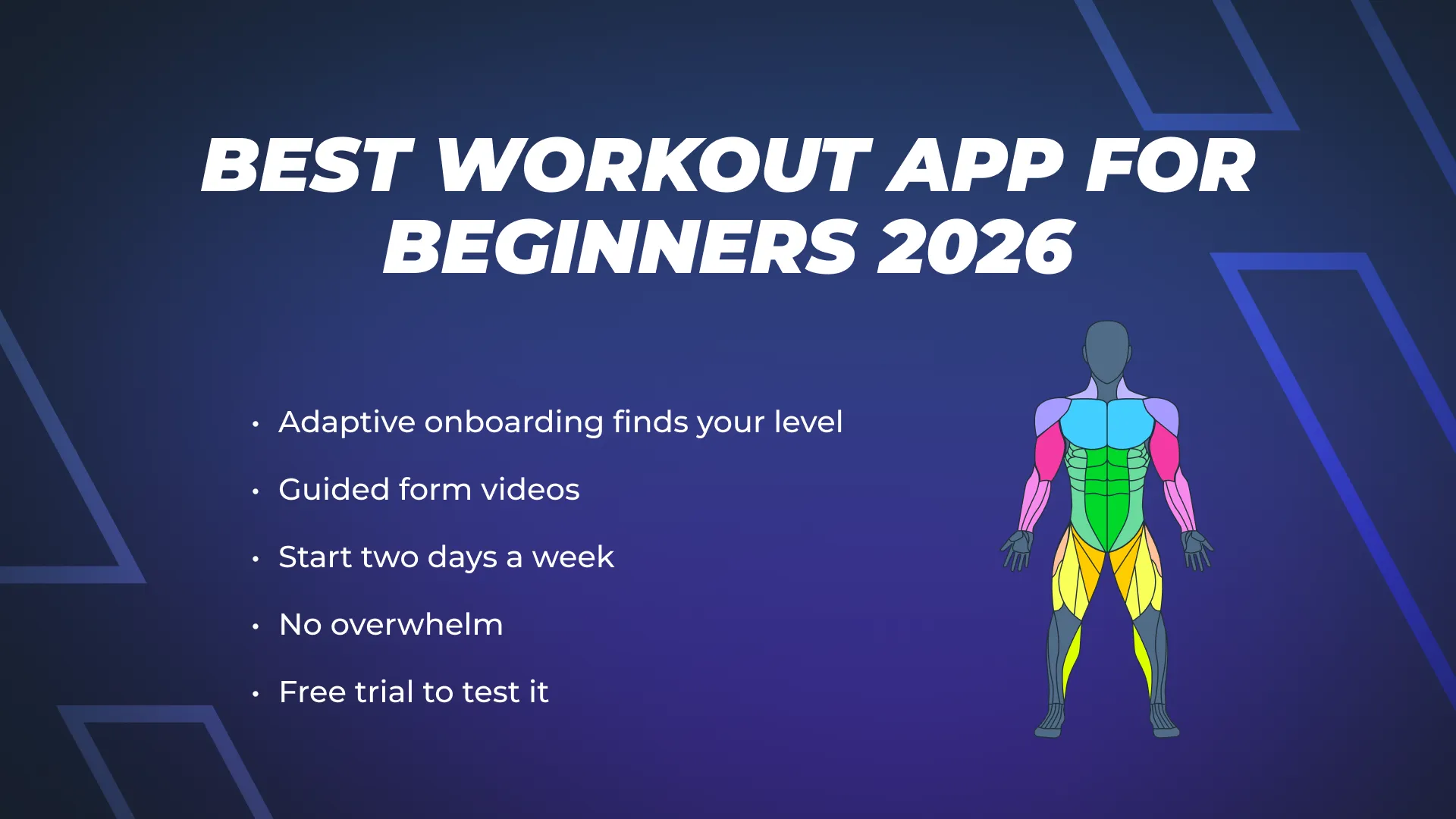
Walking into a gym for the first time is mostly a decision problem. Which machine? How many sets? How much weight? Is this enough, or far too much? The best workout app for beginners in 2026 doesn’t hand you a textbook and wish you luck. It answers those questions for you, one session at a time, so you can focus on showing up. This guide compares the beginner gym apps worth your time. It names what each one does well and where it falls short, so you can pick a beginner fitness app you’ll actually keep using past week two.
What a beginner actually needs from an app
Most people don’t quit in the first month because they’re lazy. They quit because they’re guessing, and guessing is exhausting. You stand between two machines, unsure which to use, unsure how heavy to go, unsure if any of it is working. That uncertainty is the real barrier, and it’s the thing a good beginner app is supposed to remove.
A beginner fitness app earns its place by doing three jobs well. The first is telling you exactly what to do today: the sets, the reps, and a starting weight for each session, so you’re not deciding on the spot. The second is showing you the form before you load the bar, usually with a short video and a few cues, so your first reps are safe ones.
The third is flexing when life gets in the way, re-sequencing the week when you miss a session instead of leaving you stranded mid-plan.
Here’s the reassuring part. You don’t need much to start. The US Physical Activity Guidelines for Americans recommend that adults do muscle-strengthening activity at least 2 days a week, alongside some weekly aerobic activity. That’s the whole starting bar. Two sessions a week, done consistently, already puts you ahead of most people. You also don’t need a big training load at the start. Much of the research that points to higher weekly volumes was done on trained lifters, so starting light and adding work as you adapt is the right call, not a shortcut.
You don’t need to become your own coach in week one. You need an app that makes the calls until you can.
How we compared these apps
We judged each app on what matters for someone new, not for an experienced lifter chasing a personal record. Does it decide the workout for you, or hand you a blank screen. Does it teach the movements with clear form guidance. Does it adapt when you miss a day. Is it honest about cost, including what’s locked behind a subscription. And does it teach you a little as you go, so you lean on it less over time.
We checked each app’s current features on its own pages, app store listings, and recent reviews in October 2026. Apps change fast, and prices vary by country and platform, so confirm the details at the paywall before you commit.
The best workout apps for beginners in 2026
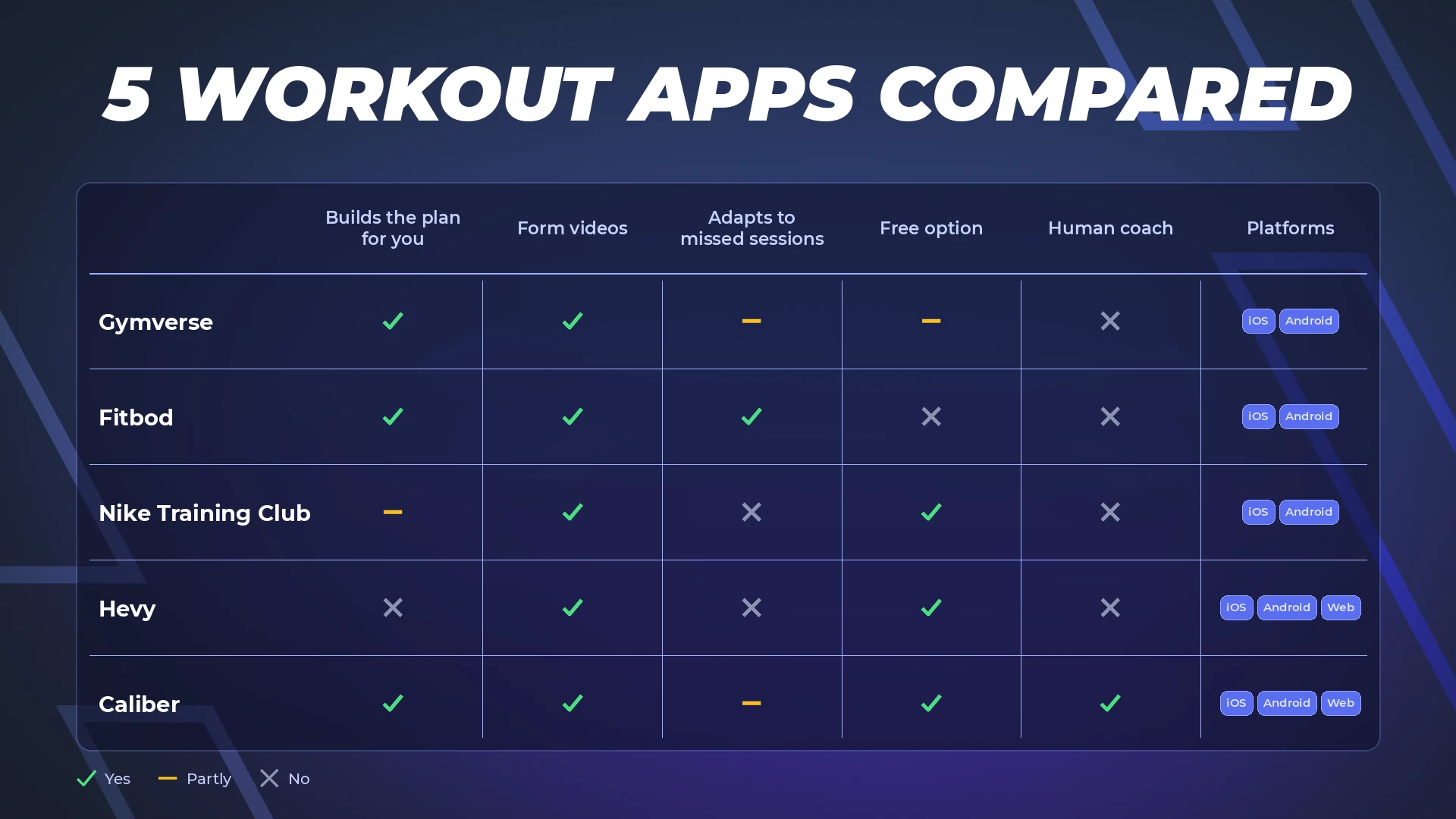
There’s no single best app for everyone, because a nervous first-timer and a self-directed beginner want different things. Here are five strong options, each with an honest note on where it’s weaker.
Gymverse: best for an adaptive plan that finds your level
Gymverse builds you a multi-week strength plan around your goal, schedule, and equipment, then adapts it as you go. This is the adaptive onboarding part that matters most for beginners. The app works out your starting point so you don’t have to, instead of dropping you into a generic routine. Every movement comes with one of 500+ professional exercise videos and form cues, so you can learn each rep before you add weight. As you log sets, its AI-optimized load management nudges the weight up when you’re ready, and if you miss a few sessions it re-sequences the week rather than breaking your progression.
The programming isn’t guesswork. Gymverse is grounded in the same exercise-science principles a good coach uses. That means progressive overload, training each muscle about twice a week across 10 to 20 hard sets, and stopping most sets 1 to 3 reps short of failure. The method is built for beginners and casual gym-goers who want results without the guesswork. It runs on iOS and Android with a free 7-day trial, and the whole pitch is that it’s built by real trainers, not an algorithm left to its own devices. For a gentler on-ramp, the Getting Started guides walk through the basics before your first session.
Honest trade-off: it’s paid after the trial, and it’s strength-first. If you want a big yoga or class library, this isn’t that app.
Fitbod: best AI-driven alternative
Fitbod is the other heavyweight in adaptive strength training. It generates a fresh workout each session based on your equipment, your goals, and which muscles are recovered. Its progress tracking is strong too. If you like a data-driven app and you’re comfortable letting an algorithm steer, Fitbod is a strong pick that scales with you for years.
Honest trade-off: it has beginner settings, but it leans on its algorithm and video library rather than a human in your corner. A true first-timer who’s anxious about squat and deadlift form gets less hand-holding here than from a coaching-focused app.
Nike Training Club: best free option
Nike Training Club is completely free with a Nike account, and the quality is high. Every session is led on screen by a Nike Master Trainer, and the workouts are labeled by difficulty, so complete beginners and trained users both have a level. It runs on iOS and Android, so most people can get going at zero cost.
Honest trade-off: it offers multi-week programs, but it doesn’t track your lifts and raise the weight for you week to week. It’s excellent for building the habit and for variety, less so for systematic strength progression where the weight climbs on a schedule.
Hevy: best free tracker if you already have a plan
Hevy is a clean, free workout logger with a large exercise library and exercise videos. It has progress charts and a community feed, and it runs on iOS and Android, with Apple Watch and web apps too. If you already have a plan from a coach, a book, or another app, Hevy is a great place to log it.
Honest trade-off: it logs the plan you bring. It doesn’t decide your program for you, so a beginner who doesn’t yet know what to do gets less direction than from an app that writes the plan.
Caliber: best if you want a real human coach
Caliber is a science-based strength app. The free tier includes personalized workouts and form videos, plus an optional upgrade to one-on-one coaching from a personal trainer who guides your training and reviews your progress. For a beginner who wants real human guidance and can budget for it, that accountability is worth a lot.
Honest trade-off: the human coaching that sets Caliber apart is a premium upgrade, so the feature you’re really there for costs more than an algorithm-driven app.
Where Gymverse falls short
We’d rather you pick the right app than the one we work on, so here’s where Gymverse isn’t the answer.
It doesn’t give you a live human coach. Caliber and other coaching apps put a real trainer in your corner. Gymverse gives you a program and the science behind it, not a person texting you back. If accountability from a human is the thing that keeps you going, that’s a real gap.
It’s strength-first. If you mainly want class-style variety and a mix of workout types, Nike Training Club is the better fit.
It’s paid after the 7-day trial. If free is non-negotiable, Nike Training Club or Hevy’s core logger are the honest answers, not Gymverse.
And no app can do everything. Gymverse won’t lift for you, and it can’t watch your form in real time the way a coach in the room can. The form videos help a lot, but they aren’t a set of eyes on your technique.
How to start without overwhelm
Pick one app and start small. The best app for beginners is the one you keep opening, and a short plan you repeat beats a perfect plan you abandon.
Open the app you’re thinking about and tick every question you can answer yes to.
0 of 5 ticked
Your ready-to-start summary appears here as you go.
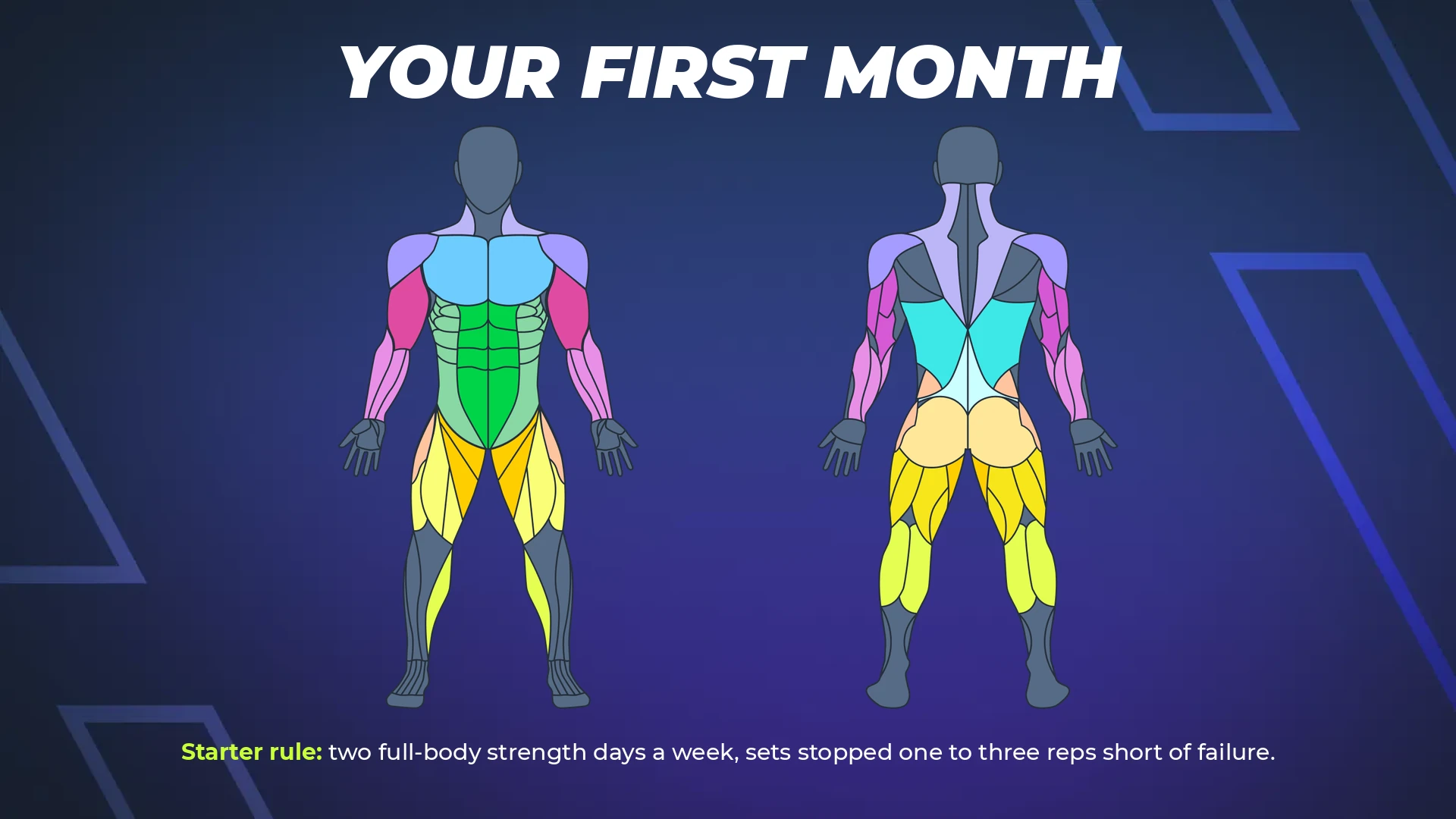
Here’s a sane first month. Train two strength days a week to start, which meets the muscle-strengthening guideline, and keep each session short. Twenty to forty minutes of focused work is plenty at the beginning. Go full-body so every session counts, and stop each set 1 to 3 reps before failure rather than grinding to a stop. When a weight starts to feel easy, add a little load or one more rep. Let the app handle the set math so you don’t have to track it in your head. If you want a confidence-building first movement, the kettlebell goblet squat is one of the friendliest ways to learn to squat well.
How fast you see change depends on your effort, your sleep, and your nutrition, so give it a few weeks before you judge it. And if you have an injury or a health condition, check with a doctor or a qualified professional before you start.
If you want the decisions handled from day one, that’s the whole point of Gymverse. Its adaptive onboarding reads your goal, your schedule, and your equipment. Then it builds a plan that fits and keeps adjusting as you improve. You focus on showing up. We handle the plan. Get your plan and start the free 7-day trial to see your first weeks mapped out for you.
Frequently asked questions
What's the best workout app for beginners in 2026?
For most beginners, the best workout app in 2026 is one that builds and adapts the plan for you instead of handing you a blank screen. Gymverse does that with adaptive onboarding, Nike Training Club is the strongest free option, and Caliber is best if you want a real human coach.
I'm new to the gym. What app should I use?
If you're new to the gym, use an app that tells you exactly what to do each session and shows you the form, rather than a blank logger you have to fill in yourself. An adaptive planner like Gymverse or a guided free app like Nike Training Club both fit that need.
Are workout apps good for beginners?
Yes. A good workout app removes the guesswork that makes most beginners quit. It programs your sets, shows you form, and adjusts the plan when you miss sessions. The key is choosing one that decides the workout for you rather than one that assumes you already know what to do.
What's the best free workout app for beginners?
Nike Training Club is the strongest free option, with trainer-led workouts labeled by difficulty, free with a Nike account. Hevy is free too if you mainly want to track a plan you already have, though it won't write the plan for you.
Is Gymverse good for beginners?
Yes. Gymverse is built for beginners and casual gym-goers. Its adaptive onboarding figures out your starting point. It then builds a plan around your goal, schedule, and equipment, with 500+ exercise videos so you can learn each movement before you load the weight.
How many days a week should a beginner work out?
Start with at least two strength sessions a week, which meets the US Physical Activity Guidelines for muscle-strengthening activity, and build up only once that's a settled habit. Two consistent sessions beat five you can't sustain.
Sources & further reading
- Adults need muscle-strengthening activity on at least 2 days a week, plus 150 to 300 minutes of moderate aerobic activity each week. Office of Disease Prevention and Health Promotion, Physical Activity Guidelines for Americans, Top 10 Things to Know.
- More weekly sets produced more muscle growth in a graded dose-response. Schoenfeld BJ, Ogborn D, Krieger JW. Dose-response relationship between weekly resistance training volume and increases in muscle mass. Journal of Sports Sciences, 2017.
- Once weekly volume is matched, training frequency adds little on its own, so twice a week mainly helps spread sets across quality sessions. Schoenfeld BJ, Grgic J, Krieger J. How many times per week should a muscle be trained to maximize muscle hypertrophy? Journal of Sports Sciences, 2019.
- A range of 12 to 20 weekly sets per muscle may be an optimum standard for young, trained men. Baz-Valle E, Balsalobre-Fernandez C, Alix-Fages C, Santos-Concejero J. A Systematic Review of the Effects of Different Resistance Training Volumes on Muscle Hypertrophy. Journal of Human Kinetics, 2022.
- Sets stopped a few reps short of failure build similar muscle to sets taken to failure, so beginners don't need to grind every set out. Refalo MC, Helms ER, Trexler ET, Hamilton DL, Fyfe JJ. Influence of Resistance Training Proximity-to-Failure on Skeletal Muscle Hypertrophy. Sports Medicine, 2023.
- Gymverse builds an adaptive multi-week plan and offers 500+ professional exercise videos. It runs on iOS and Android with a free 7-day trial, and programs 10 to 20 sets per muscle, about twice a week, at 1 to 3 reps in reserve. Gymverse.
- Fitbod generates adaptive strength workouts each session from your equipment, goals, and recovery. Fitbod.
- Nike Training Club is completely free with a Nike account and offers trainer-led workouts labeled by difficulty. WhistleOut, Nike Training Club review.
- Hevy is a free workout logger with a large exercise library and exercise videos, plus progress charts and a community feed. Hevy.
- Caliber is a science-based strength app with a free tier and an optional upgrade to one-on-one coaching from a personal trainer. Caliber on the App Store.
- Full reference list behind our guides. Gymverse References and Research.
All Gymverse articles are reviewed against current research. See our full References & Research page.
Turn what you just learned into a training plan that works for you. Personalized structure. AI coaching. Real progress.
START TRAINING →