How Many Exercises Per Muscle Group? The Science-Backed Answer
 By Amnon V. ·
TL;DR
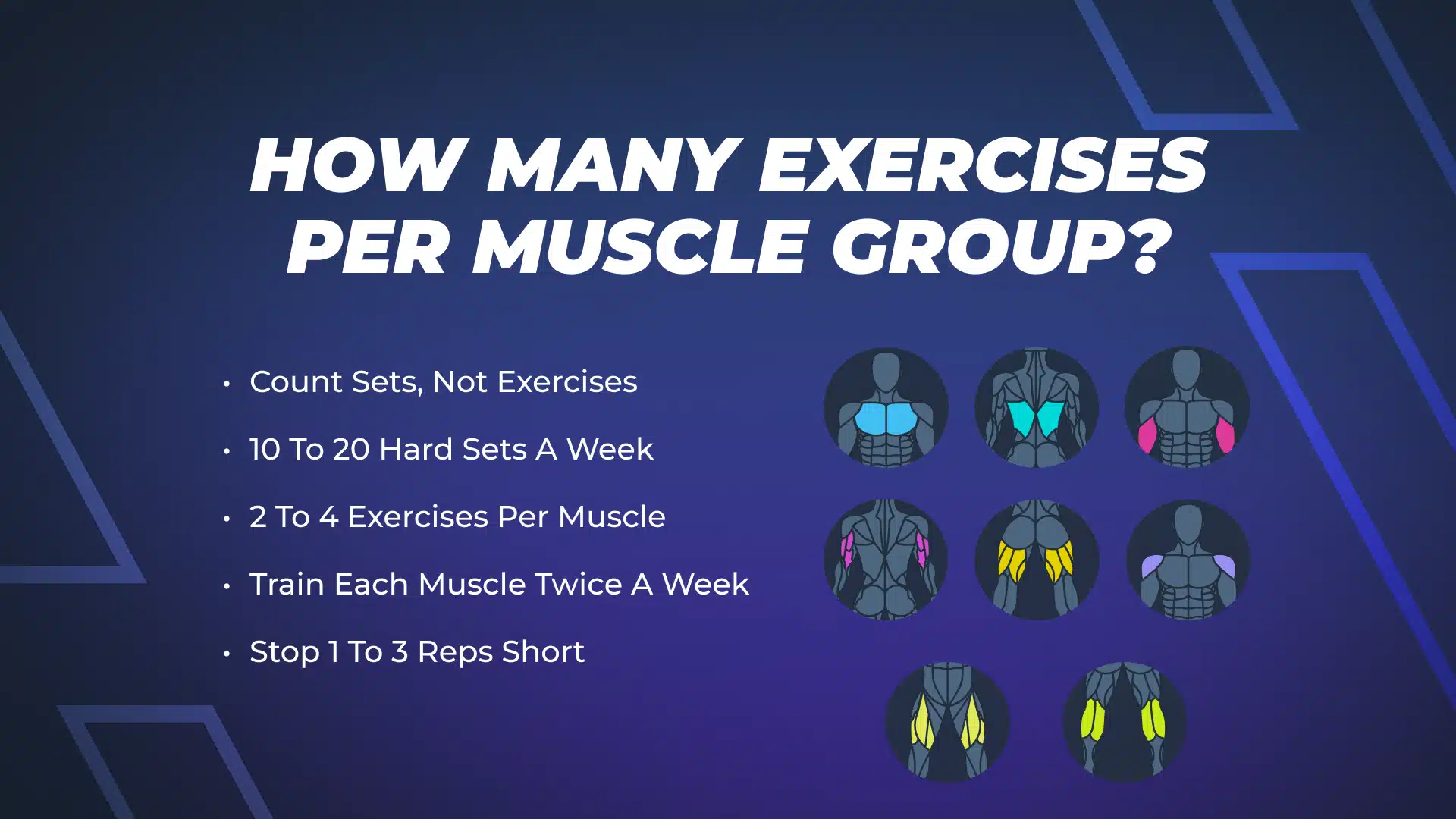
- Count weekly hard sets per muscle, not the number of exercises.
- Most muscles grow well on about 10 to 20 hard sets per week.
- That usually works out to 2 to 4 exercises per muscle across your week.
- Beginners need less volume. Advanced lifters need more.
- Spread those sets over about two sessions per muscle each week.
- Junk volume and skipped recovery stall more lifters than low volume does.
- A good workout planner sets your volume for you.
You count your exercises. Three for chest. Two for back. One for biceps. Then you wonder if that’s enough, too much, or the wrong split. Here’s the honest answer. The number of exercises is the wrong thing to count. What builds muscle is your weekly hard sets per muscle group, and most people either fall short of that number or bury it under junk volume. This guide breaks down how many exercises per muscle group you actually need, what the research on optimal training volume really says, and how the answer shifts from beginner to advanced.
Why weekly sets matter more than exercise count
The number of exercises per muscle group matters far less than your total weekly sets. You can train the same chest with two exercises or five. What decides growth is how many hard sets you do per muscle each week, how close to failure they get, and whether you add load over time.Volume is the driver. A meta-analysis by Schoenfeld and colleagues found a graded dose-response between weekly sets and muscle growth. Groups doing fewer than 5 weekly sets gained about 5.4 percent in muscle size. Groups doing 5 to 9 sets gained 6.6 percent. Groups doing 10 or more sets gained 9.8 percent. Each added weekly set was tied to a small extra gain. Exercises are just the containers you pour those sets into. Choose two movements or four. The sets are what your muscles register.
How many sets per muscle per week?
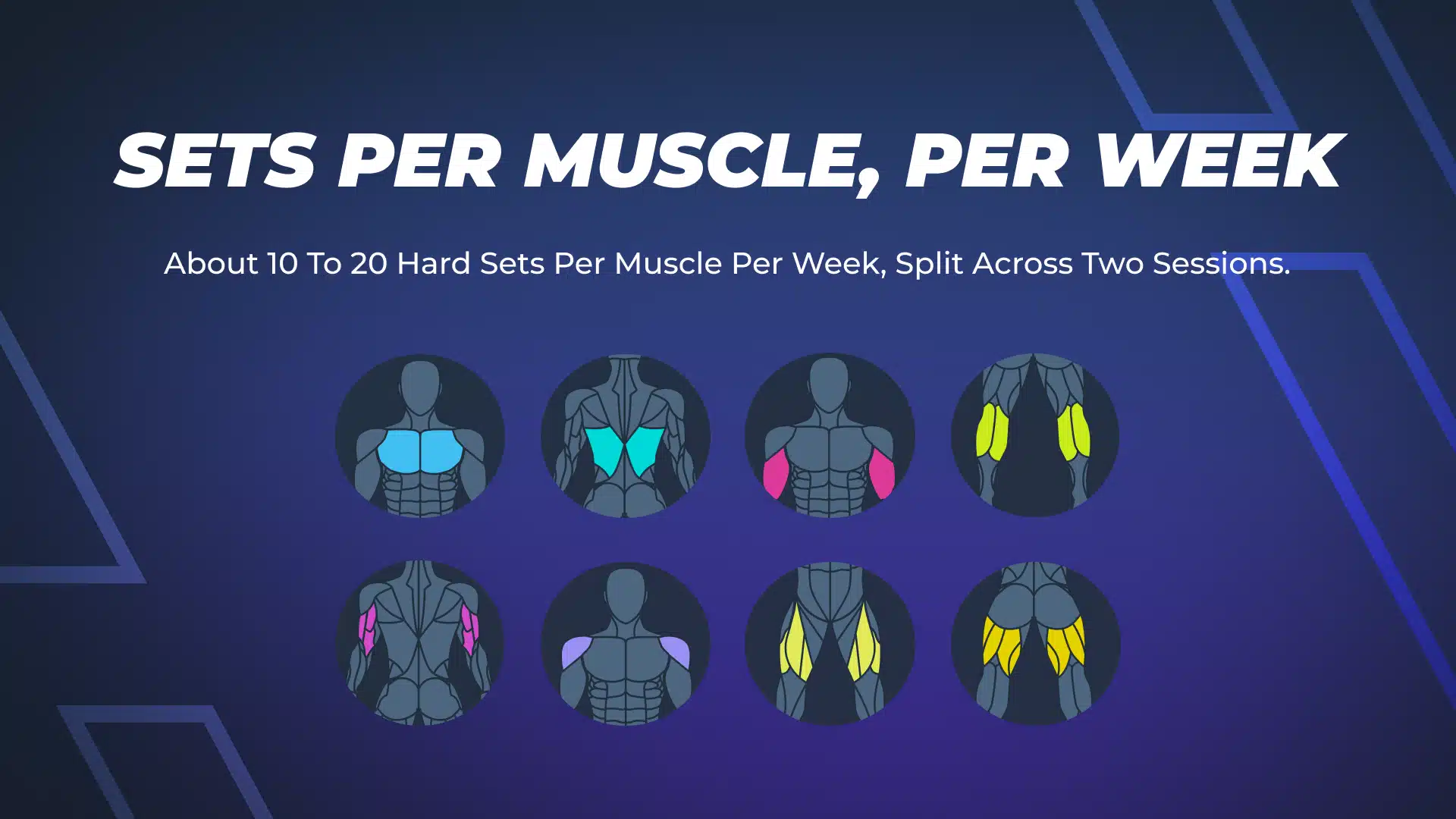
For most people, about 10 to 20 hard sets per muscle group per week is the productive range for building muscle. Beginners sit near the bottom. Trained lifters sit near the top. Below roughly 10 sets you leave growth on the table. Far above 20 you mostly add fatigue.
An umbrella review of hypertrophy research concluded that at least 10 weekly sets per muscle is a sound target for growth. A 2022 systematic review by Baz-Valle and colleagues found that 12 to 20 weekly sets per muscle may be an optimal standard for young, trained men. Most of this research is on younger, trained men. Treat the numbers as starting points and adjust for your own age, experience, and recovery.
One point that trips people up is how compound lifts count. A row trains your back and your biceps at once, so it adds to the weekly total for both. Count that shared work as you tally sets, or you will overshoot without meaning to.
Two cautions come with those numbers. A hard set means a working set taken close to failure, not a warm-up and not a half-effort set. And more is not always better. The dose-response curve bends, so extra sets buy less growth and cost more recovery the higher you climb.
How many exercises should you do per muscle group?
Once you know your weekly set target, the exercise count follows. At 3 to 4 sets per exercise, most muscles need about 2 to 4 exercises across the week to reach 10 to 20 weekly sets. Small muscles like biceps or calves can need only 1 to 2. Large muscles like back or quads often want 3 to 4.
Do the math instead of guessing. Say your target is 12 sets a week for chest. That is two exercises at three sets each, done twice a week. Or three exercises at four sets in a single harder session. Both reach the target. Variety still helps, because different movements emphasize a muscle differently. Two to four exercises per large muscle develops it more fully than hammering one bench press over and over. Our 500+ exercise video library exists for exactly that, to give you enough quality options to fill your sets without repeating the same movement every session. For a worked example that pairs sets and reps by goal, see our guide to how many sets and reps to do per workout.
Beginner vs advanced training volume
Beginners grow on less volume than advanced lifters. If you are new, around 10 sets per muscle per week is plenty to start, often from just one or two exercises. As you adapt, you add sets and exercises over time. Advanced lifters usually sit near the upper end, closer to 15 to 20 sets, to keep progressing.
This is progressive overload applied to volume, not only to weight. Beginners respond to almost any well-run stimulus, so piling on sets early wastes recovery you could spend elsewhere. Start near the bottom of the range, around 10 sets, and add volume only when your progress stalls. Trained lifters often need the higher end, in the 12 to 20 range Baz-Valle and colleagues describe, to keep making gains.
One honest caveat. The direct evidence that trained lifters need more volume than beginners is limited, and individual differences are large. Treat the beginner and advanced numbers as sensible starting points, not fixed rules, and let your own recovery and progress set the pace.
How to spread sets across the week: frequency and splits
Split your weekly sets across about two sessions per muscle rather than one marathon workout. Training each muscle twice a week lets you do more quality sets with better effort on each one. A push pull legs routine or an upper-lower split both make that easy to organize.
The research on frequency is honest and a little boring. An earlier meta-analysis found training a muscle twice a week beat once a week. A later, larger review found no clear advantage for higher frequency once weekly volume was matched. So frequency is mostly a tool to fit your sets in with good quality, not a magic lever on its own. If 16 weekly sets for back feels brutal crammed into one day, two sessions of eight will almost always be more productive. A push pull legs routine spreads large-muscle work across the week without turning any single session into a grind.
Common overtraining and undertraining mistakes
Most lifters do not fail because their volume is too low. They fail because their sets are too easy, too many, or never get any harder. Here are the errors that quietly stall progress, and the fix for each.
- Junk volume. Lots of easy sets that never approach failure add fatigue and time without much of the stimulus that drives growth. Fix: take working sets to within 1 to 3 reps of failure. Research on proximity to failure shows that sets stopped a few reps short build similar muscle to sets taken all the way to failure. You don’t need to grind to failure to make a set count.
- Chasing exercise count. Adding a fifth and sixth chest movement instead of making your existing sets count. Fix: cap your exercises, hit your weekly set target, then add load.
- Grinding every set to true failure. This spikes fatigue and drops the quality of every set after it. Fix: leave 1 to 2 reps in reserve on most sets, and save true failure for the last set of a movement.
- No progression. Same weight and same reps, month after month. Fix: add a rep or a little load most weeks so the stress keeps rising.
- Skipping recovery. Stacking sets with no lighter weeks and poor sleep backfires. Fix: build in deload weeks and let recovery absorb the work you put in.
Check with a doctor or a qualified professional before making big changes to your training or nutrition, especially with an injury or a health condition.
How Gymverse builds your volume for you
Gymverse sets your weekly volume, frequency, and effort automatically, so you never guess at sets in the gym. It builds a plan around your goal, schedule, and equipment. Then it adjusts your load week to week with AI-optimized suggestions that keep each set in the productive range.
This is where an AI-powered workout planner earns its place. Gymverse programs the volume principles above for you. It spreads your sets across sessions, holds them near the right proximity to failure, and tracks every set and personal record. Progression is built in rather than left to memory. When life gets busy, it re-sequences the week instead of punishing you for a missed session. It won’t lift for you, and it can’t replace a coach’s eyes on your form, but it will handle the set math so you don’t have to. You focus on the lifting. We handle the set count. Get your plan and start a free 7-day trial to see your volume programmed for your body and your week.
Sources & further reading
- Weekly sets drive muscle growth in a graded dose-response. Reported category gains ran from about 5.4 percent under 5 sets to 9.8 percent at 10 or more weekly sets. Schoenfeld BJ, Ogborn D, Krieger JW. Dose-response relationship between weekly resistance training volume and increases in muscle mass. Journal of Sports Sciences, 2017, 35(11), 1073 to 1082.
- At least 10 weekly sets per muscle is a sound target for growth. Bernardez-Vazquez R, Raya-Gonzalez J, Castillo D, Beato M. Resistance Training Variables for Optimization of Muscle Hypertrophy, An Umbrella Review. Frontiers in Sports and Active Living, 2022.
- 12 to 20 weekly sets per muscle may be an optimal standard for young, trained men. Baz-Valle E, Balsalobre-Fernandez C, Alix-Fages C, Santos-Concejero J. A Systematic Review of the Effects of Different Resistance Training Volumes on Muscle Hypertrophy. Journal of Human Kinetics, 2022, 81, 199 to 210.
- Training a muscle twice a week beat once a week. Schoenfeld BJ, Ogborn D, Krieger JW. Effects of Resistance Training Frequency on Measures of Muscle Hypertrophy. Sports Medicine, 2016, 46(11), 1689 to 1697.
- Training frequency does not meaningfully change hypertrophy once weekly volume is matched. Schoenfeld BJ, Grgic J, Krieger J. How many times per week should a muscle be trained to maximize muscle hypertrophy. Journal of Sports Sciences, 2019, 37(11), 1286 to 1295.
- Training to failure holds only a trivial hypertrophy edge over stopping a few reps short. Refalo MC, Helms ER, Trexler ET, Hamilton DL, Fyfe JJ. Influence of Resistance Training Proximity-to-Failure on Skeletal Muscle Hypertrophy. Sports Medicine, 2023, 53(3), 649 to 665.
- Gymverse Method, plus the 500+ exercise videos and the twice-weekly 10 to 20 set framing at 1 to 3 RIR. Gymverse.
- Full reference list behind our guides. Gymverse References and Research.
All Gymverse articles are reviewed against current research. See our full References & Research page.
Turn what you just learned into a training plan that works for you. Personalized structure. AI coaching. Real progress.
START TRAINING →