7 Push Pull Legs Mistakes That Are Stalling Your Gains
 By Amnon V. ·
TL;DR
- Running too much volume buries your best sets under junk sets.
- The wrong frequency trains each muscle too seldom to grow it.
- A push-heavy split leaves your back and rear delts undertrained.
- Short-changing leg day costs you your biggest muscles and your frame.
- Grinding every set to failure spikes fatigue and drops set quality.
- No progressive overload means the same weight month after month.
- Skipping recovery and deloads lets fatigue swallow your progress.
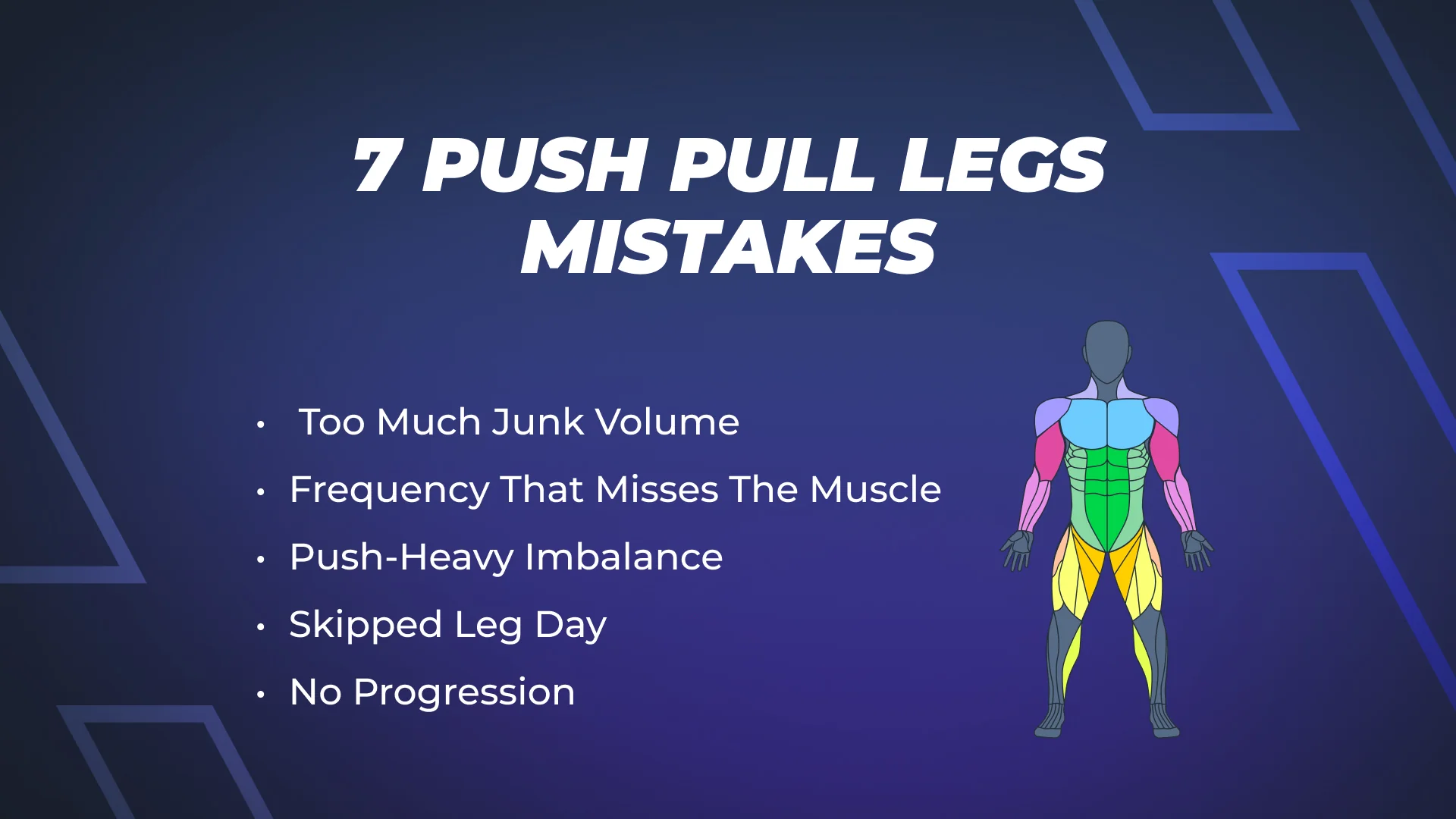
You train hard. You run a push pull legs routine most lifters would respect. The push day workout feels brutal, pull day leaves your back fried, and leg day still ruins your week. So why hasn’t the mirror changed in months? A push pull legs split is one of the best templates there is for building muscle. It almost never fails because the template is broken. It fails because of how you run it. These are the 7 push pull legs mistakes that quietly stall gains. Fix these PPL workout errors and the split starts working again.
You’re running too much volume
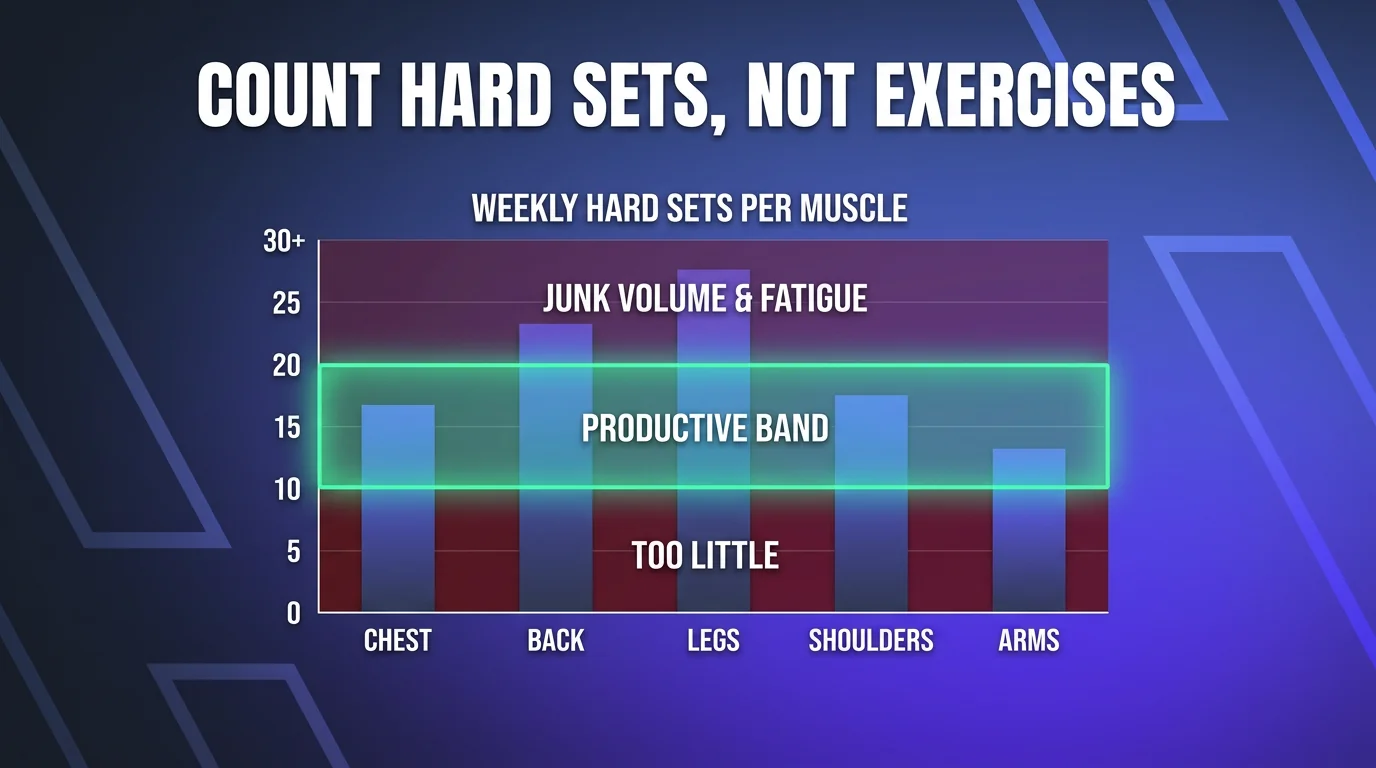
More sets feels like more progress. It usually is not. Past a point, extra sets add fatigue and junk volume without much extra muscle. A 2017 dose-response meta-analysis by Schoenfeld and colleagues found more weekly sets drove more growth, but each added set bought a smaller return. The productive range for most muscles sits around 10 to 20 hard sets per week. An umbrella review of hypertrophy research by Bernardez-Vazquez and colleagues put at least 10 weekly sets as a sound target.
Trained lifters tend to need the upper end, and a systematic review by Baz-Valle and colleagues put 12 to 20 weekly sets as a reasonable standard for them. Most of this research is on trained young men, so treat the numbers as a starting point. Adjust them for your own age, experience, and recovery. On a six-day PPL, it is easy to blow past that range with five chest movements on push day alone.
The fix: count your hard sets per muscle per week, not your exercises. Aim for about 10 to 20, lean toward the lower end if you are newer, and spread them across the week. A couple of movements at 3 to 4 sets each, done twice, gets most muscles there. See how many sets and reps you actually need.
Your frequency doesn’t match your split
Frequency is not about training more often for its own sake. It is about hitting each muscle often enough to grow it. Train a muscle once a week and every session has to carry a huge load of sets, which drops the quality of the later ones. An earlier meta-analysis found that training a muscle twice a week beat once a week when weekly sets were equal. A larger review later found that once weekly volume is matched, frequency itself stops mattering much. So frequency is a tool to fit your sets in with good effort, not a magic lever.
Here is where PPL trips people up. A classic three-day PPL hits each muscle only once a week. A six-day PPL hits it twice, which most lifters recover from and grow on. The fix: run PPL six days if you can recover from it, or add an upper or lower day so each muscle gets trained about twice. If three days is all you have, a full-body or upper-lower split may beat a once-a-week PPL.
Your pulling can’t keep up with your pressing
Walk any gym and you will see it. Big benchers with no back, rounded shoulders, and a chest that overpowers everything behind it. PPL makes this easy to do by accident. Push day is fun and visible, so it gets the energy and the heavy days. Pull day gets whatever is left.
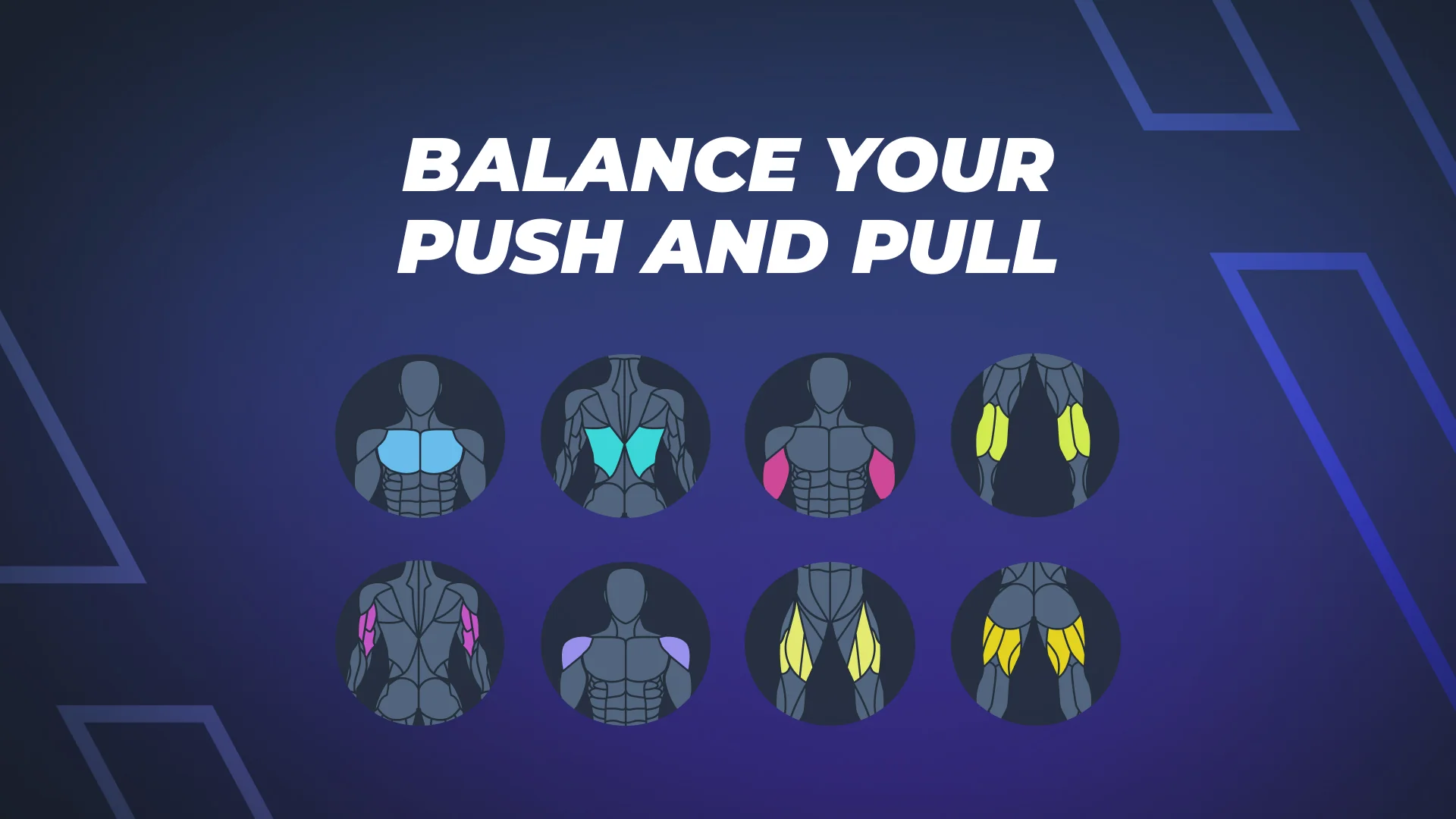
The problem is not just looks. Your back and rear delts need their own 10 to 20 hard sets a week, same as your chest. Short them and you leave size on the table and set up nagging shoulder issues. The fix: give pulling at least as much volume as pressing, and treat your pull day workout with the same focus you give your push day workout. Train rows and vertical pulls hard, and hit rear delts directly, since pressing barely touches them. If a joint already hurts, see a qualified professional before you push through it.
You’re short-changing leg day
Everyone jokes about skipping leg day. Plenty of people do a softer version of it. They show up, but push day and pull day get the real effort, while legs get a few half-hearted sets before they leave. Your quads, hamstrings, and glutes are the biggest muscles you have. Train them like an afterthought and you cap your whole frame, your strength, and a big share of your training payoff.
Legs respond to the same rules as everything else. They need their 10 to 20 hard sets a week, taken close to failure, with load that climbs over time. The fix: give leg day its own real session, not the scraps of your week. Squat or press, hinge for your hamstrings, and add calves, which most people ignore. If leg day keeps getting skipped because you are wiped, that is usually a recovery problem, covered below.
You grind every set to failure
Going to failure on everything feels hardcore. It mostly just makes you more tired. Training very close to failure helps, but the last rep or two adds a lot of fatigue for a small return. A 2023 review by Refalo and colleagues found that training closer to failure gave only a trivial edge in muscle growth over stopping a few reps short. On a high-volume PPL, grinding every set to true failure wrecks the quality of every set after it.
The fix: leave 1 to 3 reps in reserve on most sets. That is the proximity-to-failure idea, and it is how we program effort inside the app. Save true failure for the last set of a movement, if at all. You will keep more quality across the session and recover faster for the next one. Should you train to failure? breaks down when it earns its place.
You’re not adding load over time
This one hides in plain sight. Your form looks good, your sessions feel hard, and the weight on the bar has not moved since spring. Muscle grows when the stress keeps rising. That is progressive overload, and it is the engine under every good program. The 2017 dose-response data only works if the sets actually get harder over time.
The fix: push for a little more most weeks. Add a rep, add a small amount of weight, or take a set slightly closer to failure. Write it down so you are competing with last week, not guessing. Progress is not always linear, so expect slower weeks and keep the trend pointed up. Plateaus happen. A stuck bar usually points to volume, effort, or recovery, not the split itself.
You skip recovery and never deload
You can only grow from training you actually recover from. Stack hard PPL sessions with poor sleep and no easier weeks, and fatigue piles up faster than fitness. The work only turns into muscle during rest. Skip the rest and you are just accumulating fatigue and calling it dedication.
The fix: protect sleep, eat enough to support the training, and take a lighter deload week when your lifts stall or you feel run down. Build real rest days into the week instead of training through everything. If your hard-earned sessions keep going nowhere, our guide on why you are not gaining muscle is a good place to look next. For a nagging injury or a medical concern, talk to a doctor or a qualified professional.
How Gymverse runs your push pull legs split for you
Most of these mistakes come from one thing. You are managing volume, frequency, and recovery all at once, on top of actually training. That is a lot to track. Gymverse does the tracking part for you. It builds a plan around your goal, your schedule, and your equipment. You can run it as a push pull legs split, a full-body plan, or a custom split you shape yourself. Then it holds your weekly volume in range, keeps each muscle on a sensible frequency, and nudges your load up with AI-optimized suggestions. Our 500+ exercise video library gives you enough quality options to fill every slot and keep pulling balanced with pressing.
It will not lift for you, and it cannot watch your form the way a good coach can. What it does is handle the set math and the sequencing so you stop guessing. Miss a session and it re-sequences the week instead of punishing you for it. You bring the effort. We handle the structure. The whole method is laid out in the Gymverse Method. Get your plan and start a free 7-day trial to see your push pull legs routine built around your body and your week.
Frequently asked questions
Why isn't my PPL working?
A push pull legs split that stalls almost always comes down to how it is run, not the split itself. The usual culprits are too much junk volume and a frequency that trains each muscle too seldom. Add push-heavy imbalance, skipped legs, and failure on every set. Those cover most of them. Fix the few that apply to you and the split works.
What are the most common push pull legs mistakes?
The most common mistakes on a PPL split are too much volume, the wrong frequency, and a push-heavy imbalance. The rest are skipped legs, training every set to failure, and no progression over time. Each one quietly stalls gains, and each has a simple fix.
How do I fix my push pull legs routine?
Fix a push pull legs routine by counting hard sets per muscle, around 10 to 20 a week, and training each muscle about twice. Balance your pulling volume with your pressing, give legs a real session, and leave 1 to 3 reps in reserve. Add a little load most weeks, and build in recovery so the work turns into muscle.
How many days a week should I run push pull legs?
Run push pull legs six days a week if you recover well, so each muscle is trained twice. Three days a week is a lighter option that hits each muscle once. If you only have three days, an upper-lower or full-body split often beats a once-weekly PPL for growth.
Sources & further reading
- Weekly sets drive muscle growth in a graded dose-response, with each added set giving a smaller return: Schoenfeld BJ, Ogborn D, Krieger JW. Dose-response relationship between weekly resistance training volume and increases in muscle mass. Journal of Sports Sciences, 2017
- At least 10 weekly sets per muscle is a sound target for maximizing growth: Bernardez-Vazquez R, Raya-Gonzalez J, Castillo D, Beato M. Resistance Training Variables for Optimization of Muscle Hypertrophy: An Umbrella Review. Frontiers in Sports and Active Living, 2022
- About 12 to 20 weekly sets per muscle may be an optimal standard for young, trained men: Baz-Valle E, Balsalobre-Fernandez C, Alix-Fages C, Santos-Concejero J. A Systematic Review of the Effects of Different Resistance Training Volumes on Muscle Hypertrophy. Journal of Human Kinetics, 2022
- Training a muscle twice a week beat once a week when weekly volume was equal: Schoenfeld BJ, Ogborn D, Krieger JW. Effects of Resistance Training Frequency on Measures of Muscle Hypertrophy. Sports Medicine, 2016
- Frequency stops mattering much once weekly volume is matched: Schoenfeld BJ, Grgic J, Krieger J. How many times per week should a muscle be trained to maximize muscle hypertrophy. Journal of Sports Sciences, 2019
- Training closer to failure gave only a trivial edge in hypertrophy over stopping a few reps short: Refalo MC, Helms ER, Trexler ET, Hamilton DL, Fyfe JJ. Influence of Resistance Training Proximity-to-Failure on Skeletal Muscle Hypertrophy. Sports Medicine, 2023
- Calibrated volume near 10 to 20 sets per muscle, twice-weekly frequency and a 1 to 3 reps-in-reserve effort target: Gymverse
- The method behind the 500+ exercise video library and the training principles in this article: The Gymverse Method
All Gymverse articles are reviewed against current research. See our full References & Research page.
Turn what you just learned into a training plan that works for you. Personalized structure. AI coaching. Real progress.
START TRAINING →