Cable Lateral Raise: How to Do It Right for Boulder Shoulders
 By Amnon V. ·
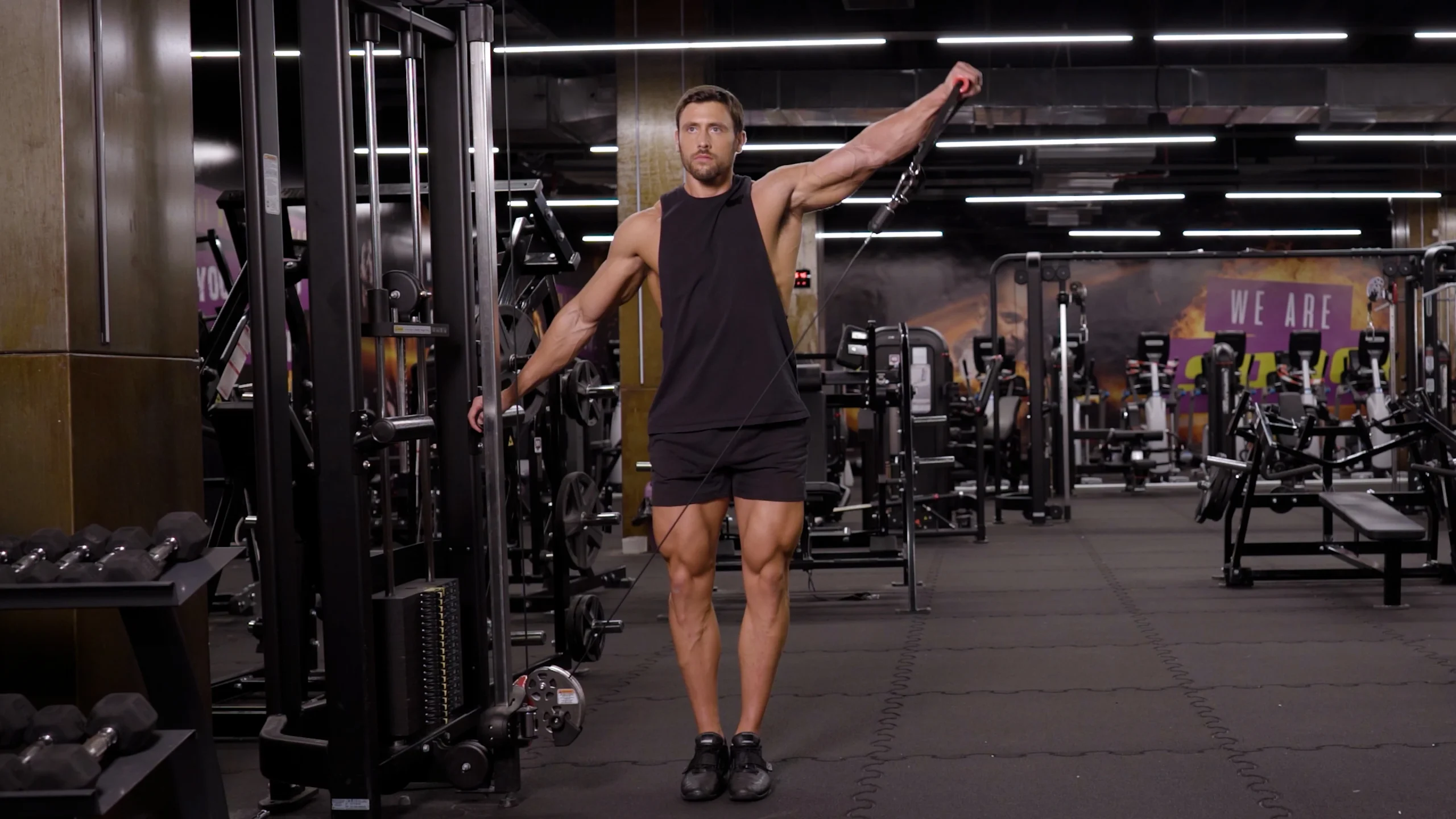
The side delt is a small muscle with one job. And the problem is that most lifters never let it do that job. They load the bar, swing the weight, and wonder why their shoulders look the same in October as they did in April.
The cable lateral raise gives you constant tension the dumbbell version often can’t match. That is exactly why sloppy form costs you so much on this exercise. When you shrug, swing, or stand in the wrong spot, the traps and front delts absorb the work and your shoulders stay the same width month after month.
That’s why we’ll cover what a cable lateral raise is, how it stacks up against the dumbbell version, the five most common form mistakes with a fix for each, a step-by-step guide for two variations, and a sample shoulder circuit you can run at your next session.
What Is A Cable Lateral Raise?
How To Do Cable Lateral Raises
A cable lateral raise is a single-joint exercise that trains the lateral head of the deltoid (the side of your shoulder that gives you width when you’re viewed from the front).
The pulley pulls at an angle across the full rep, so the side delt stays loaded at the bottom, where the dumbbell version goes nearly weightless. You can run this exercise on any adjustable pulley, including one side of a cable crossover station.
Cable vs Dumbbell Lateral Raise: Which One Builds Wider Shoulders?
Both belong in your training. They load the muscle in different places, which is why picking one and abandoning the other leaves gains on the table.
| Factor | Cable Lateral Raise | Dumbbell Lateral Raise |
|---|---|---|
| Tension at the bottom | High — the pulley keeps pulling from the first inch | Almost none — gravity gives you a free bottom half |
| Peak tension point | Spread across the full range | Only near the top, at shoulder height |
| Loading increments | Small jumps on most stacks | Limited by the dumbbells your gym owns |
| Cheating risk | Lower, the cable exposes swing | Higher, momentum hides easily |
| Best used for | Slow, high-quality work and finishers | Heavier top sets and drop sets |
Here’s our take: We program the cable version when the goal is quality tension, and the dumbbell version when the goal is load. You don’t have to choose one forever. Rotate them across your training and let each variation do what it does best.
5 Most Common Cable Lateral Raise Mistakes (And How To Fix Each One)
We see the same five errors in almost every gym. Each one has a fix you can apply on your very next set:
1) Your Traps Take Over The Rep
When the upper traps take the load, the shoulder shrugs toward the ear and the side delt barely contracts. As a result, you feel a burn at the top of your neck instead of the side of your shoulder, and the rep looks more like a shrug than a raise.
The fix: Think about pushing your hand away from your body rather than lifting it up. Keep the shoulder pressed down through the whole rep, and the tension will stay where you want it.
2) You Are Lifting Too Heavy
The side delt is a small muscle group that gets overpowered fast. Heavy loads force the body to lean, bounce, and swing the weight up. Because of that, momentum finishes reps your delt was supposed to finish.
The fix: Cut the weight until you can pause for a second at the top without leaning. We would rather see you at a lower weight for 15 clean reps than at a heavier one for 8 sloppy reps.
3) You Bend Your Elbow Mid-Rep
Bending the elbow as fatigue builds shortens the lever and turns the movement into an upright row. That shifts the work to the traps and rips it away from the side delt.
The fix: Lock a slight bend in the elbow at the start and hold that exact angle to the top and back down. If the elbow angle changes, the exercise changes.
4) You Set Up In The Wrong Spot
Pulley height and body position decide the direction of the resistance. A pulley set too high kills the tension at the bottom. Also, consider that standing too close to the tower lets the cable go slack halfway through the rep.
The fix: Set the pulley at the lowest setting, stand far enough away that the cable stays tight at the bottom, and keep your working shoulder facing away from the stack.
5) You Raise Too High Or Cut The Rep Short
Going past shoulder height rotates the shoulder blade and hands the rep to the traps. And stopping short of shoulder height leaves growth on the table.
The fix: Stop when your arm reaches shoulder height, hold, then lower slowly and resist the stack on the way down.
How To Properly Do A Cable Lateral Raise
Proper form depends on the variation. Here’s how we would coach a single-arm cable lateral raise:

- Slightly rotate your arm, having your thumb point down and your pinky finger leading the movement.
- Raise your arm at a 30-degree angle from your torso, slightly in front of your body.
- Raise your arms at least until they are parallel to the floor.
- Return to the starting position.
- Avoid using momentum.
Another example is the cable crossover lateral raise, done with both arms at once.
[add video]
To do it properly:
- Set both pulleys to the lowest position and attach a handle to each side.
- Stand in the middle of the cable crossover station and grab the left handle with your right hand and the right handle with your left hand, so the cables cross in front of you.
- Start with your arms crossed over your hips and your elbows slightly bent.
- Raise both arms out and up until they reach shoulder height.
- Lower both arms at the same speed, staying in control the whole way down.
Keep your torso still on both variations. If your body rocks to move the handle, the weight is too heavy.
Sample Shoulder Circuit You Can Run Today
Here’s how we would build a session around the cable lateral raise:
| Order | Exercise | Sets x Reps | Why It’s Here |
|---|---|---|---|
| 1 | Seated dumbbell shoulder press | 3 x 6-8 | Heavy pressing while you are fresh |
| 2 | Single-arm cable lateral raise | 3 x 12-15 per side | Constant tension on the side delt |
| 3 | Rear delt fly (machine or cable) | 3 x 12-15 | Balances the rear head and protects posture |
| 4 | Cable crossover lateral raise | 2 x 15-20 | Finisher with short rest |
Note: Rest 60 to 90 seconds on the raises and up to two minutes on the press. Adding a small amount of weight or one clean rep each week is what drives growth.
Are You Ready to Stop Guessing and Start Building?
The cable lateral raise rewards precision, and precision is easier when you can see the movement from every angle before you touch the stack. Gymverse gives you a shoulder workout plan built by professional trainers, with 1,000+ exercises backed by step-by-step video guides so you can watch the cable lateral raise from multiple angles instead of guessing which cue matters.
Start your free 7-day trial and get a plan that adapts to the equipment you have (full gym, home rack, or a single cable stack tucked in the corner of your building’s gym). Browse the full exercise library and see every angle before your next set.
Conclusion
The side delt gets one job. Wider shoulders come from letting it do that job without traps, momentum, or a bad setup stealing the work. The cable lateral raise gives you the tool for that, and the five fixes above turn a wasted set into a productive one.
That said, pair the cable version with the dumbbell one, run them inside a session that trains the shoulder from every angle, and add a rep or a plate every week. That is how boulder shoulders get built (one clean, controlled rep at a time).
Frequently asked questions
How do you do a cable lateral raise?
Set the pulley to the lowest position, stand side-on to the tower with your working arm crossed over your body, brace your core, lock a slight bend in your elbow, and raise your arm out to the side until it reaches shoulder height. Hold for a beat, then lower slowly and resist the stack on the way down.
Is the cable lateral raise better than the dumbbell version?
Neither is strictly better. The cable keeps tension on the side delt through the full rep, while the dumbbell version lets you load heavier at the top. We program both across a training block.
What is the best lateral raise for shoulder width?
The cable lateral raise wins for constant tension and clean form, which is what drives growth in the side delt. Pair it with heavier dumbbell top sets for the biggest jump in width.
How many sets and reps should you do?
Three sets of 12 to 15 reps per side is a solid starting point on the single-arm cable version. Rest 60 to 90 seconds between sets and add a small amount of weight or one clean rep each week.
Where should the pulley be set?
The lowest setting on the stack. A low pulley keeps the cable pulling against your arm from the first inch of the rep. A pulley set too high kills the tension at the bottom and cuts the effective range in half.
Why do you feel cable lateral raises in your traps?
Your upper traps take over when you shrug, lift too heavy, or raise past shoulder height. Push your hand away from your body instead of up, keep the shoulder pressed down, and stop the rep when your arm reaches shoulder height.
Sources & further reading
All Gymverse articles are reviewed against current research. See our full References & Research page.
Turn what you just learned into a training plan that works for you. Personalized structure. AI coaching. Real progress.
START TRAINING →