Decline Push Up: Benefits, Muscles Worked & Progressions to Try
Decline push-ups load 74% of your bodyweight onto your upper chest. Master the form, skip 4 mistakes, and build a defined chest at home.
 By Amnon V. ·
TL;DR
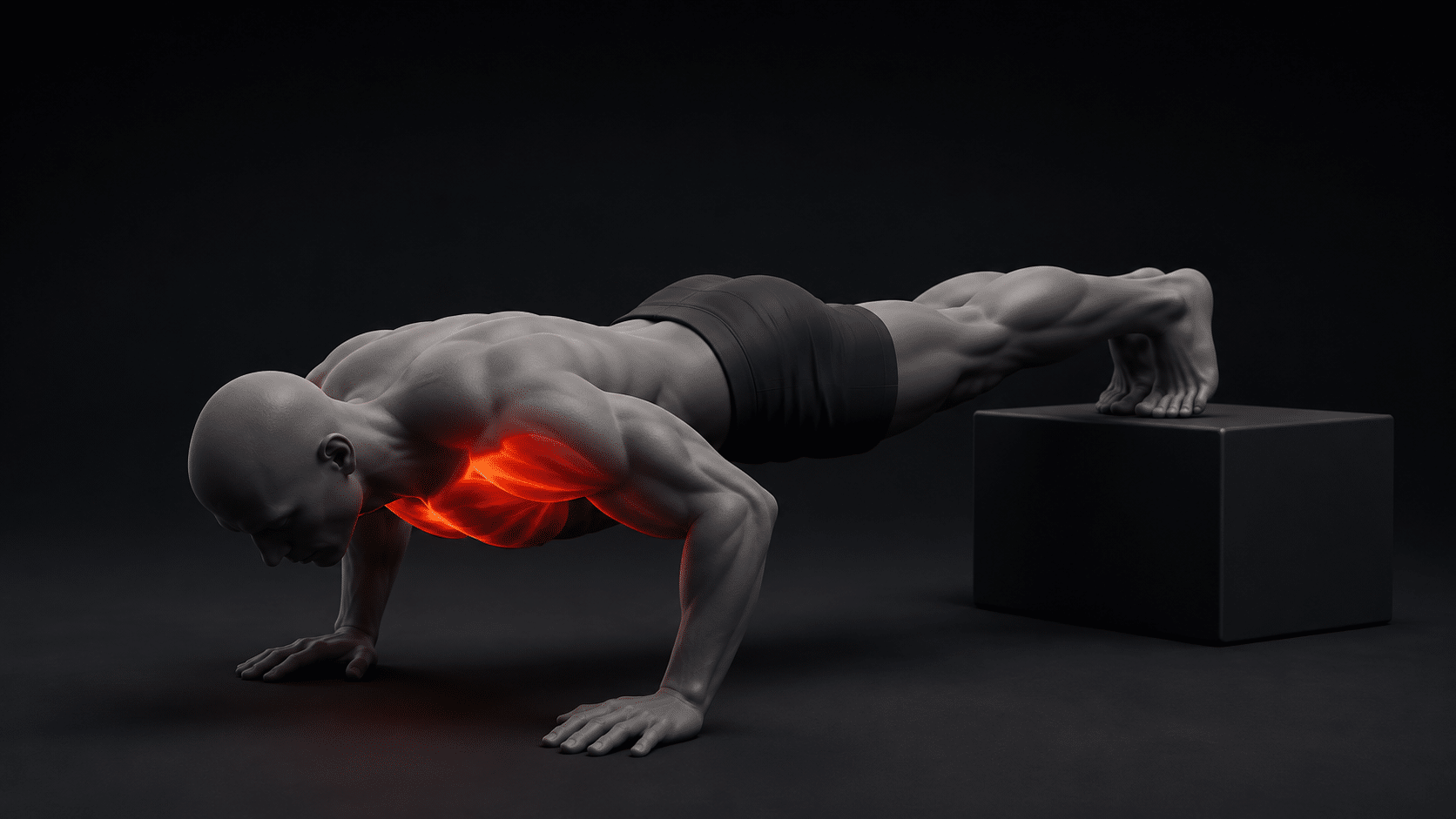
A lot of people think that the decline push up is nothing more than a harder version of the regular push-up. However, that framing misses the point. In a decline push up you raise your feet to change the angle of the press, which shifts the work onto your upper chest, front shoulders, and triceps instead of the middle of your chest.
What Is a Decline Push-Up?
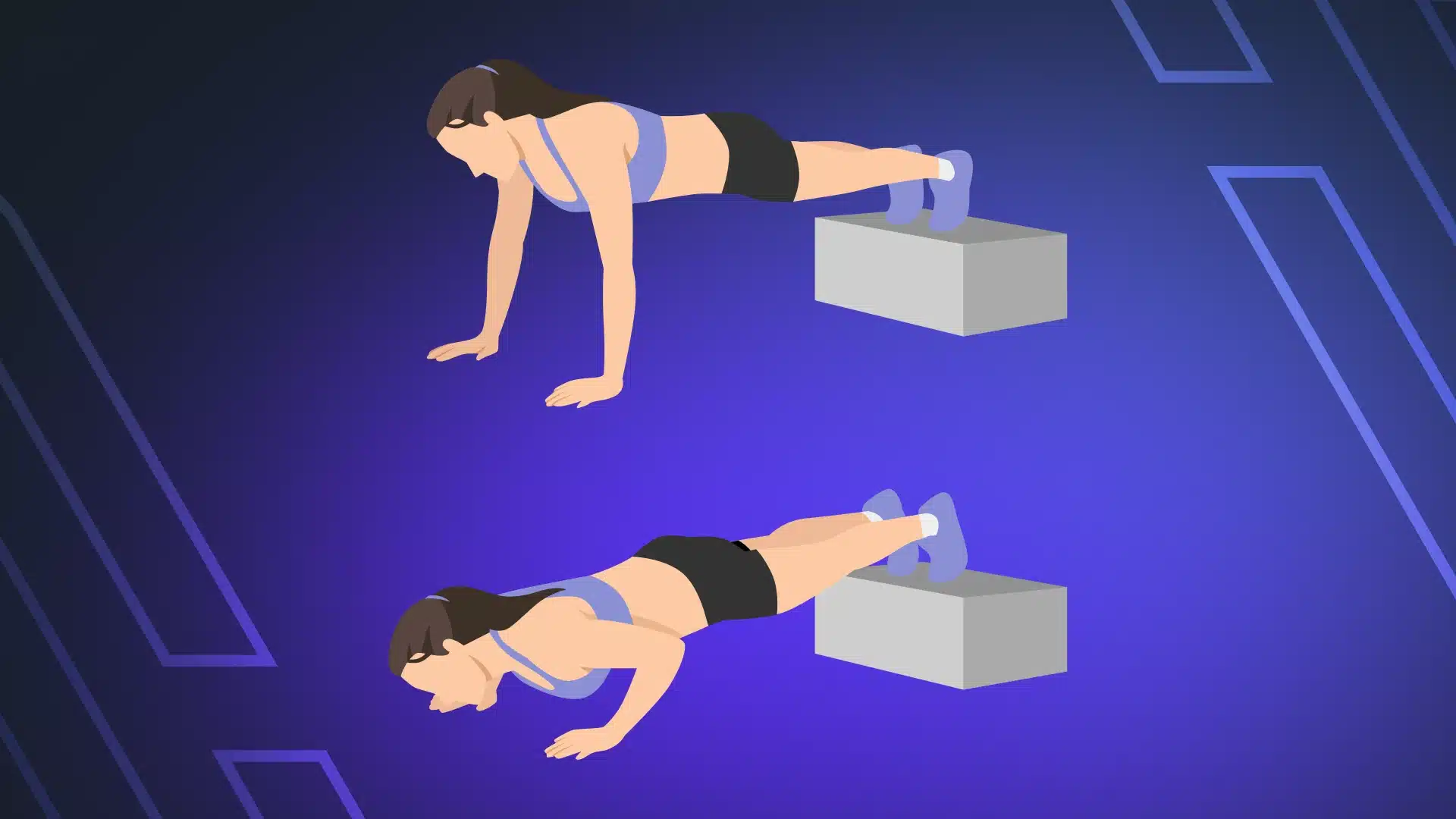
A decline push-up is a bodyweight chest exercise performed with your feet elevated on a bench, box, chair, or step while your hands rest flat on the floor.
Because your feet are higher than your hands, your body slopes downward toward your shoulders. This angle forces you to press at an incline relative to your torso, targeting the upper portion of the pectoralis major (the clavicular head).
What Muscles Does a Decline Push-Up Work?
- Upper Chest (Clavicular Head of Pectoralis Major): Primary target due to the inverted angle.
- Front Shoulders (Anterior Deltoids): Acts as a primary mover alongside the upper chest.
- Triceps: Works hard to extend the elbows at the top of each rep.
- Core & Glutes: Isometric contraction to keep your body in a straight line.
Is a Decline Push-Up Harder Than a Regular Push-Up?
Yes. Elevating your feet transfers more of your total body weight onto your upper body and arms. In a standard push-up, you press roughly 64% of your body weight. In a decline push-up, that number increases to around 70%–74%, depending on the height of your feet.
Benefits of Decline Push-Ups
- Targets the Upper Chest at Home: No incline bench press or cables required.
- Increases Strength & Load: Adds natural resistance without extra weights.
- Improves Core Stability: Requires strong abdominal and glute engagement to prevent hip sagging.
- Shoulder Health: Teaches proper scapular movement under higher loads.
Most Common Mistakes People Make
Your Hips Sag or Pike
Letting your hips drop or shoot up breaks the straight line from your head to your heels. This dumps tension out of your chest and into your lower back, and it shortens the range you actually train. Squeeze your glutes and brace your core to hold one solid line.
You Set Your Feet Too High Too Soon
Jumping to a high box before you own a lower height wrecks your form and turns the movement into a near-vertical grind. As a result, you lose control on the way down and stall out on the way up. Instead, raise the height gradually as you get stronger.
You Flare Your Elbows Wide
Flaring your elbows to 90° stresses the shoulder joint and pulls work off your chest. Cue your elbows tucked to roughly 45° from your torso. Your shoulders will thank you, and your chest will do more of the work.
You Cut the Range Short
Stopping halfway keeps you from the upper-chest stretch and contraction that make this exercise worth doing. Lower until your chest is near the floor, then press all the way to a full lockout.
How to Do a Decline Push-Up With Proper Form
- Place your feet on a stable, elevated surface (start around knee height) and set your hands on the floor slightly wider than your shoulders.
- Brace your core and squeeze your glutes so your body forms one straight line from head to heels.
- Keep your elbows tucked to about 45° as you lower your chest toward the floor under control.
- Push firmly through your palms to return to the starting position.
How to Progress the Decline Push-Up: Beginner to Advanced
- 1) Beginner: Start with feet on a low step (4–6 inches) to build control.
- 2) Intermediate: Use a standard bench or chair (12–18 inches) for optimal upper chest activation.
- 3) Advanced: Increase feet height further, add a weight vest, or perform slow eccentric reps.
Sample Home Push Workout
- Decline Push-Ups: 3 sets × 8–12 reps
- Flat Push-Ups: 3 sets × 10–15 reps
- Incline Push-Ups: 2 sets × 12–15 reps
- Plank Hold: 3 sets × 45 seconds
Conclusion
The decline push-up is one of the most effective bodyweight movements for developing your upper chest and shoulders. Focus on maintaining a tight core, tucked elbows, and full range of motion before increasing the height of your elevation.
Frequently asked questions
What muscles does a decline push-up work?
It mainly targets the upper chest, front shoulders (anterior deltoids), and triceps.
Is a decline push-up harder than a regular push-up?
Yes, because raising your feet places up to 74% of your bodyweight on your upper body.
Do decline push-ups build upper or lower chest?
Decline push-ups focus specifically on building the upper chest.
Sources & further reading
- ACE Fitness: Upper Chest Push-Up Biomechanics
- PubMed: Electromyographic Analysis of Push-Up Variations
All Gymverse articles are reviewed against current research. See our full References & Research page.
Turn what you just learned into a training plan that works for you. Personalized structure. AI coaching. Real progress.
START TRAINING →