Free Weights vs. Machines: Which Builds More Muscle?
Are free weights or machines better for building muscle? Learn how each affects hypertrophy, strength, and stability — and how to use both effectively in the same program.
 By Amnon V. ·
TL;DR
What the Research Shows
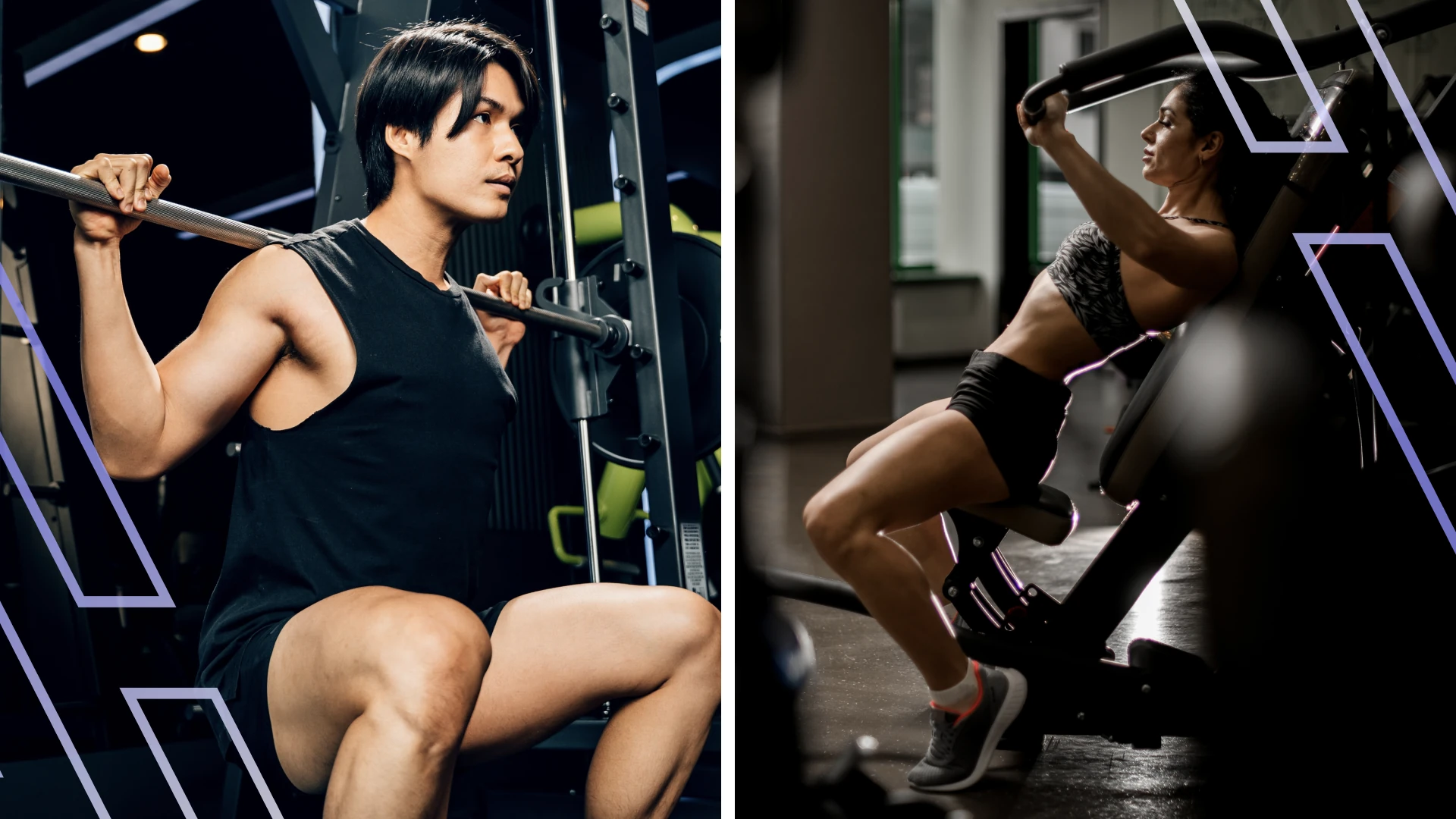
This argument has been settled for years, and the answer irritates both camps equally: for building muscle, it’s a tie. The differences are real — but they’re about how you train, not how much you grow. The principle to hold onto is that the dose makes the muscle, not the tool. Equal effort, equal sets, equal proximity to failure — equal growth, whether the load came from a barbell or a machine. So the real question isn’t which is superior. It’s which lets you train hard and consistently right now.
For strength specific to a movement pattern, free weight training tends to produce greater transfer to real-world performance. For isolated muscle development and controlled loading, machines are equally or more effective.
The Practical Differences
Free weights and machines are manual and automatic transmissions. Manual demands more skill and coordination; automatic lets you focus on the road. Both get you there. You pick based on where you are in learning to drive — not on which one sounds more hardcore.
| Factor | Free Weights | Machines |
|---|---|---|
| Stabiliser muscle activation | High | Low |
| Coordination required | High | Low |
| Coordination and setup demands | Higher | Lower |
| Range of motion control | Fully flexible | Fixed path |
| Isolation of target muscle | Moderate | High |
| Learning curve | Longer | Shorter |
| Progressive overload ease | High (small plates) | Moderate (fixed increments) |
The Case for Free Weights
Free weights — barbells and dumbbells — require the body to stabilize the load through the full range of motion. This recruits more muscle groups simultaneously and develops coordination alongside strength. Compound free weight movements like the squat, deadlift, and bench press are the most efficient exercises for building overall strength and muscle mass.
They also allow for finer load progression. Adding 1.25kg plates to a barbell is possible; most machines jump in larger increments, which can make progressive overload harder to manage precisely.
The Case for Machines
Machines fix the movement path, which reduces the coordination and balance demands. This makes them easier for beginners, allows more focus on the target muscle, and is useful when training around injuries or when technique on free weight movements has not been established.
No study has actually shown machines to be safer than free weights, and resistance training is a low-injury activity either way. Cable machines occupy a middle ground — they provide a fixed plane of resistance but allow more natural movement paths than plate-loaded machines, making them versatile for both compound and isolation work.
The Practical Recommendation
The most effective programs use both. A common structure is to build the session around compound free weight movements for the primary stimulus — squat, press, row — and use machines for accessory and isolation work at the end.
For complete beginners, starting with machines and progressing to free weights as technique develops is a sensible approach. For experienced lifters, free weight compounds should remain the foundation.
Frequently asked questions
Are machines good for building muscle?
Yes. Machines produce comparable muscle growth to free weights when effort is equal. They are particularly useful for isolation exercises.
Should beginners use free weights or machines?
Either works. Machines ask less of your coordination at the start. Learning free weight technique early is worthwhile — a few sessions with a trainer speeds this up significantly.
Can I build a complete physique using only machines?
Yes, though free weight compound movements provide broader stimulus and more efficient use of training time for most people.
Sources & further reading
- Haugen et al. (2023), BMC Sports Sci Med Rehabil — free weights vs machines meta-analysis
- ACSM (2009), Med Sci Sports Exerc — resistance-training prescription
All Gymverse articles are reviewed against current research. See our full References & Research page.
Turn what you just learned into a training plan that works for you. Personalized structure. AI coaching. Real progress.
START TRAINING →