The Benefits of Sleep for Muscle Growth and Recovery
How does sleep affect muscle growth and recovery? Learn what happens during sleep, how deprivation impairs results, and how much you need.
 By Amnon V. ·
TL;DR
What Happens to Muscles During Sleep
You don’t build muscle in the gym. The gym is where you tear it down. The actual building happens hours later, in the dark, while you’re doing nothing at all, which means the session you’re proudest of is worthless if you cut the part where it pays off. Cut sleep short and the building measurably slows: in one study, five nights of four hours in bed dropped the rate at which people built new muscle protein by about a fifth. Encouragingly, three hard sessions during those same five nights brought it right back, which is a useful reminder that training still counts in a bad week. Deep sleep is also when your biggest release of growth hormone happens, though the muscle benefit of sleep seems to come from the whole recovery picture rather than that one hormone.
Picture your workout as the demolition crew and the materials delivery: it clears the old structure and drops a pile of bricks on site. Sleep is the night shift that actually builds. Train hard, eat well, then short the sleep, and you’ve paid for demolition and bricks, and sent the builders home.
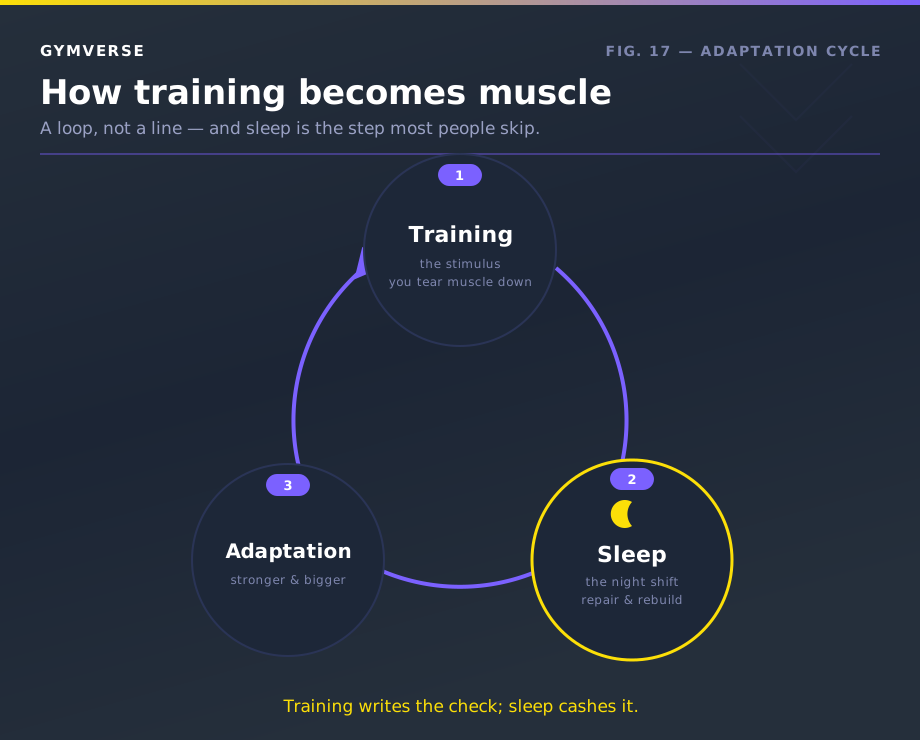
Training creates the stimulus for adaptation. Sleep is when adaptation actually occurs. Training writes the check; sleep cashes it. A great session is just a promise of adaptation, and sleep is where the body makes good on it. Skip the sleep and the check bounces, no matter how big you wrote it.
 GYMVERSE
FIG. 17 — ADAPTATION CYCLE
How training becomes muscle
A loop, not a line — and sleep is the step most people skip.
Training
the stimulus
you tear muscle down
1
Sleep
the night shift
repair & rebuild
2
Adaptation
stronger & bigger
3
Training writes the check; sleep cashes it.
The Performance Cost of Poor Sleep
Research on sleep deprivation and athletic performance shows consistent, measurable effects:
A full night of sleep deprivation cuts maximal strength by only about 3%, less than most people expect. What suffers much more is everything around it: anaerobic power drops around 6%, sets taken close to failure around 10%, and skill-based tasks around 20%
Afternoon and evening sessions take a bigger hit than morning ones
A single 6-hour night has a smaller and less consistent effect; the bigger cost of short sleep is chronic, accumulating across days and weeks
Reaction time and coordination decrease, increasing injury risk
Perceived exertion increases: the same effort feels harder
Testosterone levels drop with chronic sleep restriction, one of several hormonal and recovery factors that affect muscle synthesis
Your body builds new muscle protein more slowly, so the cost of poor sleep lands on the building side rather than on extra breakdown
Chronic short sleep doesn’t announce itself. It’s a quiet tax skimmed off every rep, every recovery, every session. Consistently sleeping 5–6 hours accumulates a performance and recovery cost over days and weeks, but because you adapt to feeling tired, you stop noticing you’re paying it.
How Much Sleep Do Active People Need?
7–9 hours per night is the evidence-based recommendation for adults engaged in regular physical training. Athletes in high-volume training periods often benefit from 9–10 hours.
Individual variation exists, but most people who believe they function well on 6 hours are underperforming relative to their potential. The belief that less sleep is manageable does not mean it is optimal.
Sleep Quality vs. Quantity
Quantity of sleep (total hours) and quality (proportion of restorative deep and REM sleep) both matter. Eight hours of frequently interrupted sleep produces worse recovery than seven hours of consolidated, uninterrupted sleep.
Practical steps to improve sleep quality:
Consistent sleep and wake times: the most effective single intervention for sleep quality
Cool sleeping environment: 16–19°C is optimal for sleep onset and deep sleep
Limit screens 30–60 minutes before bed: blue light delays melatonin release
Avoid caffeine after early afternoon: caffeine has a half-life of 5–7 hours
Training in the evening is fine: on average it slightly improves deep sleep, and only a near-maximal session finished an hour or two before bed delays sleep onset
Frequently asked questions
Can I make up for lost sleep at the weekend?
Partially. Recovery sleep restores some cognitive function, but the hormonal and performance effects of sleep debt during the week are not fully reversed by weekend catch-up sleep.
Does napping help with training recovery?
Yes. A 20–30 minute nap can improve afternoon performance and partially offset the effects of reduced overnight sleep.
Is it worse to train on poor sleep or skip the session?
Usually better to train, but reduce intensity. A lighter session on poor sleep maintains the habit and provides stimulus without overtaxing the recovery system.
Sources & further reading
- Walsh et al. (2021), Br J Sports Med — sleep & athletic recovery
- Leproult & Van Cauter (2011), JAMA — sleep restriction & testosterone
- Craven et al. (2022), Sports Med, acute sleep loss & performance
- Saner et al. (2020), J Physiol — sleep restriction & muscle protein synthesis
- Stutz, Eiholzer & Spengler (2019), Sports Med — evening exercise & sleep
All Gymverse articles are reviewed against current research. See our full References & Research page.
Turn what you just learned into a training plan that works for you. Personalized structure. AI coaching. Real progress.
START TRAINING →