Tricep Kick Backs: Are They Actually Worth Your Time? (Science-Backed Answer)
 By Amnon V. ·
Unfortunately, tricep kickbacks often get treated as a warm-up. You know the drill: 8-pound dumbbells, tacked onto the end of arm day. Most lifters either dismiss them completely or swing them with so much momentum that the triceps barely feel the load.
The answer to whether they belong in your program is more interesting than “yes” or “no.” The kickback trains your triceps in a position most of your other exercises skip, and that changes how you should think about it.
That’s why today we’ll cover:
- What a kickback actually is
- Which muscles it works
- What the research says about its effectiveness
- How it stacks up against cable extensions
- How to do it without wasting sets
- The mistakes that make it useless
- Better progressions once you outgrow it
- A sample finisher you can run on your next push day
What Is A Tricep Kickback?
A tricep kickback is a single-joint exercise where you hinge at the hips, pin your upper arm alongside your torso, and extend at the elbow until your arm is straight behind you. That’s the entire movement.
The elbow is the only joint that moves. This is what separates it from pressing movements like the bench press or shoulder press, where your chest and shoulders share the load with your triceps.
You can load the kickback with a dumbbell, a cable, or a resistance band. The loading tool changes the result more than most lifters expect, and we’ll break that down later in the article.
What Muscles Do Tricep Kickbacks Work?
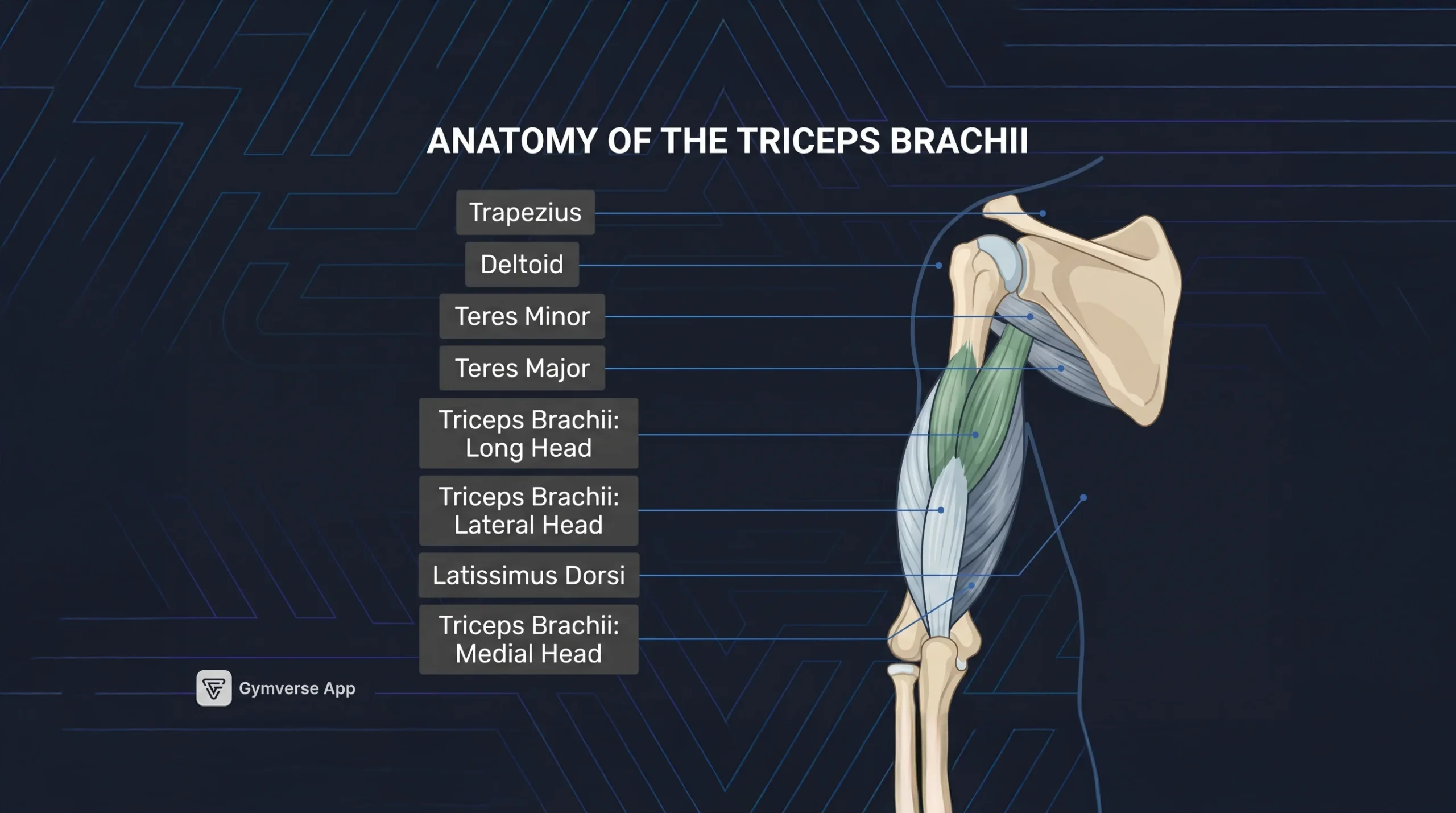
The tricep kickback trains all three heads of the triceps brachii: the long head, the lateral head, and the medial head. Every elbow extension exercise hits these three heads to some degree, but the position of your upper arm decides which head does the most work.
Since your upper arm stays locked against your side during a kickback, the long head works in its shortened position rather than its stretched position. In other words, the long head crosses both the shoulder and the elbow, so when your arm is down by your side, that muscle is already slack before the rep starts. This means the kickback trains the long head, but not in the position where it grows best.
That said, secondary muscles hold your position instead of moving the weight. For example, your rear delts, lats, spinal erectors, and core all work to keep your torso parallel to the floor and your upper arm pinned in place. They’re not the point of the exercise, but they’re what makes the setup possible.
Are Tricep Kickbacks Effective? What The Research Says
The honest answer has two halves. The research supports kickbacks in one specific way and calls out a real limitation in another. Here is what the evidence shows:
Benefits Of Kickbacks
An ACE-commissioned EMG study run at the University of Wisconsin–La Crosse ranked the dumbbell kickback second out of eight tricep exercises for muscle activation, behind only the triangle push-up (the study used a small group of trained women, so treat the exact ranking as directional rather than definitive). Among the exercises tested, the kickback matched or beat cable pushdowns, dips, and overhead extensions.
That result is the opposite of what most lifters assume. The exercise everyone treats as a warm-up out-activated the exercises everyone treats as serious tricep builders.
The reason is simple: nothing else shares the load. There’s no chest, no front delts, and no leg drive. Every ounce of that dumbbell has to move through your elbow, and your triceps are the only muscle group that can move it.
Cons Of Kickbacks
EMG activation is not the same thing as muscle growth. A muscle firing hard in a test doesn’t automatically mean it grows more over a training block, and you should not program an exercise on activation numbers alone.
The bigger issue is the resistance profile. With a dumbbell, gravity pulls straight down, so the exercise is hardest at full lockout and nearly weightless at the bottom. Your triceps get almost no tension in the stretched position, which is the position where growth signals are strongest.
Research on stretch-position training backs this up. A study by Maeo and colleagues compared overhead tricep extensions to pushdowns over a 12-week training block, with each participant training one arm on each exercise. The overhead arm built roughly 1.5 times more long-head growth than the pushdown arm, despite matched volume and effort.
This is the kickback’s real limitation. It’s not a reason to quit the movement, but it’s a reason to stop treating it as your main tricep exercise.
Tricep Kickbacks vs. Cable Extensions: Which One Should You Do?
Both exercises train the triceps through elbow extension, but they load different parts of the strength curve, and that changes what each one is good for.
| Factor | Dumbbell Kickback | Cable Kickback | Overhead Cable Extension |
|---|---|---|---|
| Hardest point of the rep | Lockout (shortened) | Even through the full rep | Bottom (stretched) |
| Long head emphasis | Low | Moderate | High |
| Tension at the bottom | Almost none | Constant | Highest |
| Setup difficulty | None, grab a dumbbell | Needs a low pulley | Needs a rope and a pulley |
| Best used as | Finisher, home training | Mid-workout volume | Primary tricep builder |
| Beginner friendly | Yes | Yes | Moderate |
The verdict: run overhead cable extensions as your main tricep builder, then use kickbacks as a finisher. These are not competing exercises. They train the same muscle in different positions, and a strong tricep program uses both.
How To Do A Tricep Kickback Properly
Proper form depends on whether you use a dumbbell or a cable. The setup for each is different, and mixing them up is how most lifters end up wasting the exercise.

Let’s start with the single-arm dumbbell kickback:
- Place one hand and the matching knee on a flat bench so your torso sits parallel to the floor.
- Hold the dumbbell in your free hand with a neutral grip, palm facing your body.
- At the starting position, raise your elbow behind your shoulder so it points at the ceiling.
- Keeping your upper arm in the same position, extend at the elbow until your arm is straight and your knuckles point at the wall behind you.
- Squeeze at the top for a full second, since this is the only point where the exercise is genuinely hard.
- Return to the starting position with a slow, controlled descent.
Note: Keep your shoulder still. If your elbow drifts backward or your torso rotates, the weight is too heavy.

Another option is the single-arm tricep cable kickback. To do it properly:
- Set the pulley to the lowest setting and attach a single handle.
- Hinge at the hips with your torso close to parallel to the floor, holding the handle in one hand.
- Pin your upper arm to your side with your elbow bent to roughly ninety degrees.
- Extend the elbow until your arm is straight, keeping the cable line in front of your body.
- Return to the start slowly, letting the cable pull your forearm forward without letting your elbow drop.
Mistakes That Make Kickbacks Useless
There are four main mistakes that turn a decent exercise into wasted sets. Here are the ones we see most often, and each one has a simple fix:
- Your elbow keeps drifting. When the upper arm swings, the rear delt and lat start moving the weight and the triceps stop working. To fix this, brace the upper arm against your ribs and treat the elbow as a fixed hinge. If you can’t hold the position, lower the weight.
- You are swinging the weight up. Momentum lets you use a heavier dumbbell while doing less work. It feels productive, but the triceps get less tension than they would with a lighter load and clean reps. If the weight travels faster on the way up than on the way down, you are throwing it, not lifting it. Every rep should be controlled at both ends.
- You are stopping short of lockout. With a dumbbell, the top of the rep is the only place with real tension. That final inch is where the resistance profile peaks and where the triceps actually work against a meaningful load. Cutting the rep short removes the entire reason to do the exercise. Extend fully, squeeze for a second, then lower.
- You are only doing kickbacks. A lifter who trains triceps exclusively with kickbacks never loads the long head in its stretched position. Over months, this shows up as a tricep that looks fine from the back but flat from the side. To fix this, pair kickbacks with an overhead movement in the same week. Overhead extensions handle the stretch, kickbacks handle the squeeze, and the whole triceps grows.
4 Tricep Kickback Progressions And Alternatives
Here are the exercises we choose once kickbacks stop challenging you (or once you want to load the triceps in positions the kickback misses):
1) Overhead Cable Tricep Extension (with Rope)

To do this right:
- Lean slightly forward, with your elbows positioned above your head.
- At the starting position, hold your arms overhead, in line with your ears, with your elbows bent back and the rope behind your head.
- Extend your elbows, bringing your arms back to an overhead position with your arms straight.
- Return to the starting position in a slow and controlled manner.
This loads the long head in the stretched position, which is exactly what the kickback misses. According to the Maeo research (mentioned above), this should be your main long-head builder.
Note: You can do this exercise with a rope or a bar.
2) Standing Cable Tricep Pushdown
https://www.youtube.com/watch?v=x2lrauZyDOM
To do this right:
- Lean slightly forward, with your elbows at the side of your body, touching your ribs.
- At the starting position, hold the rope to your chest with a neutral grip.
- Extend your elbows, bringing your forearms down towards your hips until your arms are straight.
- Return to the starting position in a slow and controlled manner.
- Avoid using momentum.
Note: The pushdown holds constant tension through the whole rep and lets you load heavier than any dumbbell kickback. Use it for volume work between your stretch-position and finisher exercises.
3) Dumbbell Skull Crusher

To do this right:
- At the starting position, hold the dumbbells over your eyes with your elbows straight.
- Bend your elbows and lower the weights slowly with a controlled descent until they touch your shoulders.
- Raise the weights by extending your elbows until they are straight.
- Keep your arms upright during the entire lift, moving only your forearms.
The skull crusher combines a stretched position with heavy loading, which makes it a strong primary tricep exercise. It hits the long head hard without needing a cable stack.
4) Diamond (Triangle) Push-Up

To do this right:
- Place your hands close together under your chest so your thumbs and index fingers form a triangle.
- Keep your feet together.
- Lift your hips until your torso and thighs are in a straight line.
- Lower yourself, aiming to bring your chest toward your hands.
- Extend your elbows and press your chest and thighs back up at the same time.
- Keep your glutes engaged throughout the entire movement to avoid arching your lower back.
This exercise needs no equipment, which makes it a good fallback for home and hotel-gym training. It ranked first in the ACE EMG study, ahead of every loaded tricep exercise in the test.
A Sample Tricep Finisher You Can Run Today
Here is how we would actually program kickbacks (as the last three to five minutes of a push day) after your pressing and your main tricep work.
- Overhead cable extension: 3 sets of 10-12 reps. Load the stretch first while you are fresh.
- Cable pushdown: 2 sets of 12-15 reps. Build volume with constant tension.
- Dumbbell kickback: 2 sets of 15-20 reps with a one-second squeeze at lockout. Finish in the shortened position.
The whole workout takes under ten minutes.
Note: Lighter loads on the kickback are precisely what we want — they are not a compromise. At this point you’ll have already trained in heavy positions; the kickback exists to finish the muscle in a position the other two exercises can’t reach.
What if every tricep exercise you did was chosen for a reason instead of habit?
Gymverse builds your plan around your goals, your equipment, and your schedule, with over 1,000 exercises in our library and video guidance for every single one. If an exercise doesn’t fit your setup or you want to swap it, tap once and replace it with another movement that hits the same muscle group.
Try Gymverse free for 7 days. No commitment, full access, and a plan built by professional trainers waiting for you inside.
Conclusion
Tricep kickbacks are not the useless warm-up they’re treated as, but they’re not the primary tricep builder EMG studies made them look like. They train the shortened position of the triceps better than almost any other exercise, but they leave the stretched position untrained, and the stretched position is where the long head grows most.
The right answer is to use kickbacks the way they work best: as a finisher after your heavy pressing and stretch-position work. Run overhead cable extensions as your main long-head builder, pushdowns for volume, and kickbacks for the last three to five minutes when you want to squeeze the muscle in its shortened position.
Program them with a purpose and they earn their spot. Swing them at the end of arm day with an 8-pound dumbbell and you get exactly what you put in.
Frequently asked questions
Are tricep kickbacks effective?
Yes, but with a caveat. An ACE-commissioned EMG study ranked them second out of eight tricep exercises for muscle activation, but the dumbbell version provides almost no tension in the stretched position. Use them as a finisher, not a primary tricep builder.
What muscles do tricep kickbacks work?
Kickbacks train all three heads of the triceps brachii: the long head, the lateral head, and the medial head. The long head works in its shortened position because your upper arm stays pinned to your side. Your rear delts, lats, spinal erectors, and core work as stabilizers to hold the hinged position.
Should I do tricep kickbacks?
Yes, if you’re using them as a finisher after heavier tricep work. No, if they’re your only tricep exercise. Pair them with an overhead movement in the same week so you train the long head in both its stretched and shortened positions.
How much weight should I use for tricep kickbacks?
Use a weight that lets you complete 12-20 clean reps with a one-second squeeze at lockout. If your elbow drifts backward or your torso rotates to move the weight, the dumbbell is too heavy. Kickbacks work better as a lighter, higher-rep finisher than as a heavy compound movement.
How many sets and reps of tricep kickbacks should I do?
Two sets of 15-20 reps per side work well as a push day finisher. If you’re programming them as your only tricep exercise for the session, three sets of 12-15 reps is the upper end. More than that is diminishing returns on a movement built for the shortened position.
Are cable kickbacks better than dumbbell kickbacks?
Cable kickbacks hold constant tension through the whole rep, while dumbbell kickbacks only load the top of the rep hard. If you have access to a low pulley, the cable version gives you more usable tension. If you’re at home with dumbbells, the standard kickback still works as long as you extend fully and squeeze at lockout.
Can I do tricep kickbacks at home without equipment?
You can do bodyweight tricep exercises at home, but kickbacks themselves need some form of resistance. If you have no dumbbells or bands, swap them for diamond (triangle) push-ups, which ranked first in the ACE EMG study and need no equipment at all.
Sources & further reading
All Gymverse articles are reviewed against current research. See our full References & Research page.
Turn what you just learned into a training plan that works for you. Personalized structure. AI coaching. Real progress.
START TRAINING →