How AI-Adaptive Workout Apps Actually Personalize Your Plan
 By Amnon V. ·
TL;DR
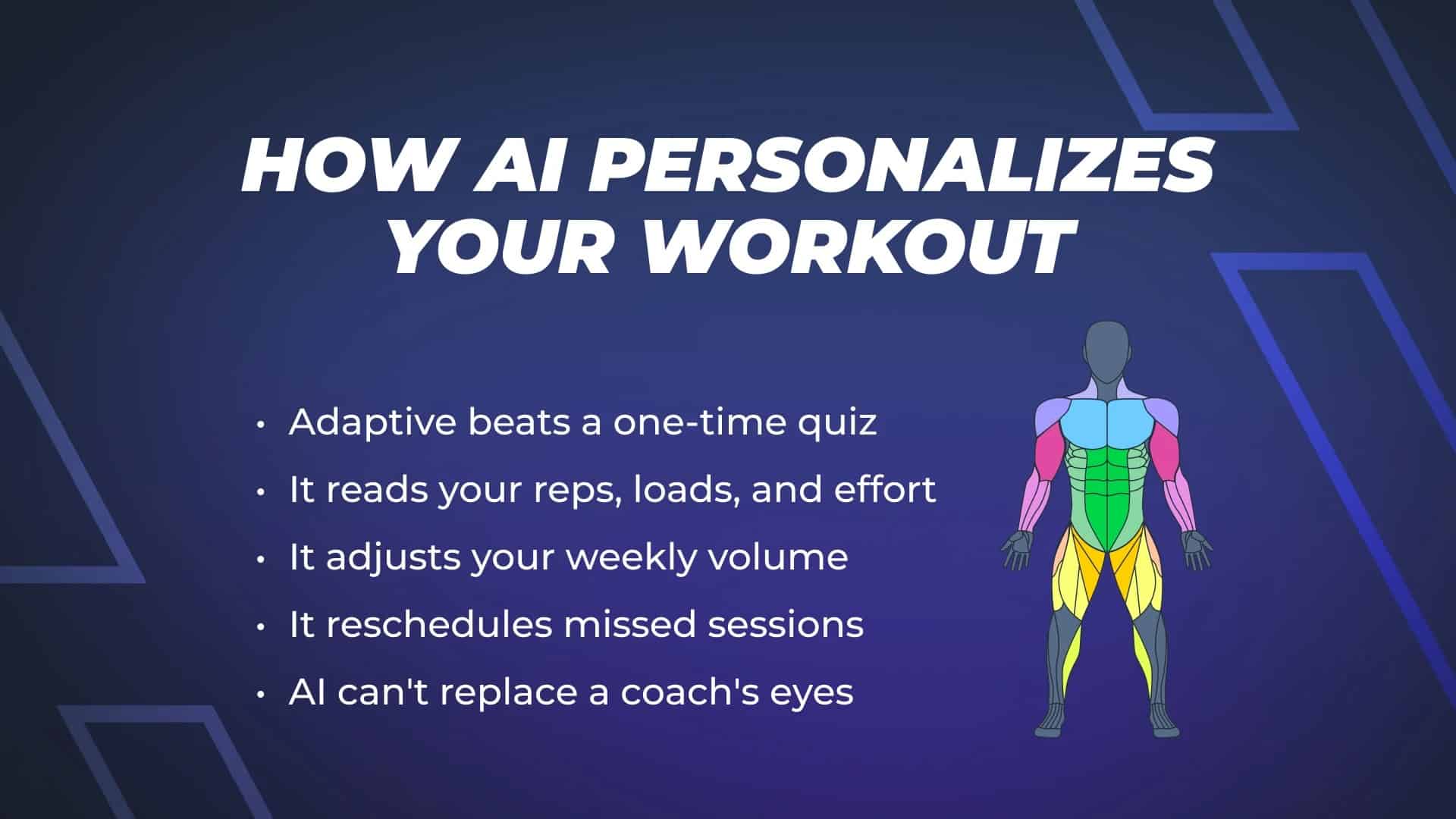
- Personalization should mean adaptive, not a sign-up quiz.
- AI apps don't invent new science. They automate proven training principles.
- The engine reads your logged signals: reps, load, and effort.
- It adjusts your weekly volume and load to keep each set productive.
- A good app reschedules your week when life gets in the way.
- AI can't see your form or feel your fatigue. It's a tool, not a coach.
Personalized is the most oversold word in fitness. Most apps ask you three questions at signup, hand you a template, and call it yours. Real personalization isn’t a one-time quiz. It’s a plan that changes as you do. That’s the promise of an AI-adaptive workout app. It’s worth knowing how the tech actually works before you hand one your training. This guide explains how AI personalizes your workout, what an adaptive fitness app reads to build and adjust your plan, and where an AI gym plan still falls short of a good coach.
What personalization should actually mean
Most workout apps personalize exactly once. You tap through a quiz about your goal, your schedule, and your equipment. The app spits out a plan, and that plan is personalized to the person you were on signup day. It doesn’t know your bench stalled for three weeks, that you slept badly, or that you missed Tuesday. A static plan can’t react to any of it.
A truly adaptive fitness app treats your plan as a starting point, not a verdict. It watches what you actually do in the gym and changes the plan based on that. That’s the real line between personalized as a marketing word and personalization that holds up week after week.
A one-time quiz personalizes your plan once. An adaptive app personalizes it every time you train.
The science an AI workout app runs on
Here’s the part the marketing skips. AI doesn’t discover a secret way to build muscle. The science of getting stronger is well established, and a good AI workout app just runs that science on your numbers so you don’t have to. The principles are the same ones any decent coach uses, and they’re worth knowing so you can tell a real plan from a dressed-up guess. You can see them laid out in the Gymverse Method.
- Progressive overload. Muscle grows when you ask it to do a little more over time. That more can come from load, reps, or effort.
- Volume. Most muscles grow well on about 10 to 20 hard sets per week. A meta-analysis by Schoenfeld and colleagues found that more weekly sets drove more growth. A 2022 review by Baz-Valle and colleagues put the productive range for trained lifters at roughly 12 to 20 sets per muscle.
- Proximity to failure. Sets should come close to failure to count, but you don’t need to grind every one to the bitter end. Research by Refalo and colleagues found only a trivial muscle-growth advantage to training all the way to failure, so stopping a rep or two short still drives nearly all the gains.
- Frequency. Training each muscle about twice a week lets you fit quality sets in without cramming them into one session.
None of this is new. What’s new is an app doing the bookkeeping for you, every single session.
What signals an adaptive app reads
An adaptive app can only personalize from what it can see, which is the data you log. The honest version of AI personalization is pattern-reading on your training record. These are the signals that matter most.
- The reps and load you complete. Hit the top of your rep target with clean form and the app reads room to add weight. Miss the bottom and it reads too much.
- Your effort on the set. Many apps ask how hard a set felt, often as reps in reserve, meaning how many reps you had left. An RPE scale built on reps in reserve lets a number stand in for proximity to failure. The app then knows whether you left too much in the tank or none at all.
- Your consistency. Which sessions you finished, which you skipped, and how long since you trained a muscle.
The quality of the personalization rises and falls with the quality of what you feed it. Log honestly and the plan fits. Fudge your numbers and you’re training the app to misread you.
How an AI gym plan adjusts week to week
Reading the signals is half the job. The other half is changing the plan in response, which the research calls autoregulation, adjusting your training to your performance instead of a fixed script. A 2020 review by Greig and colleagues describes autoregulation as fitting load and volume to the individual. The same review notes the research is still catching up on when it beats a fixed plan. So treat it as a sound principle, not a settled miracle.
In practice, an AI workout app autoregulates in a few ways.
- Load. Clear your reps with good form and it nudges the weight up next time. Grind and miss and it holds or backs off, keeping each set near the productive range.
- Volume. If you’re recovering well and progressing, it can add a set. If your performance is sliding, it can trim volume before you dig a hole.
- Effort. It aims to keep most sets a rep or two short of failure, the range the evidence supports, rather than sending you to failure every time.
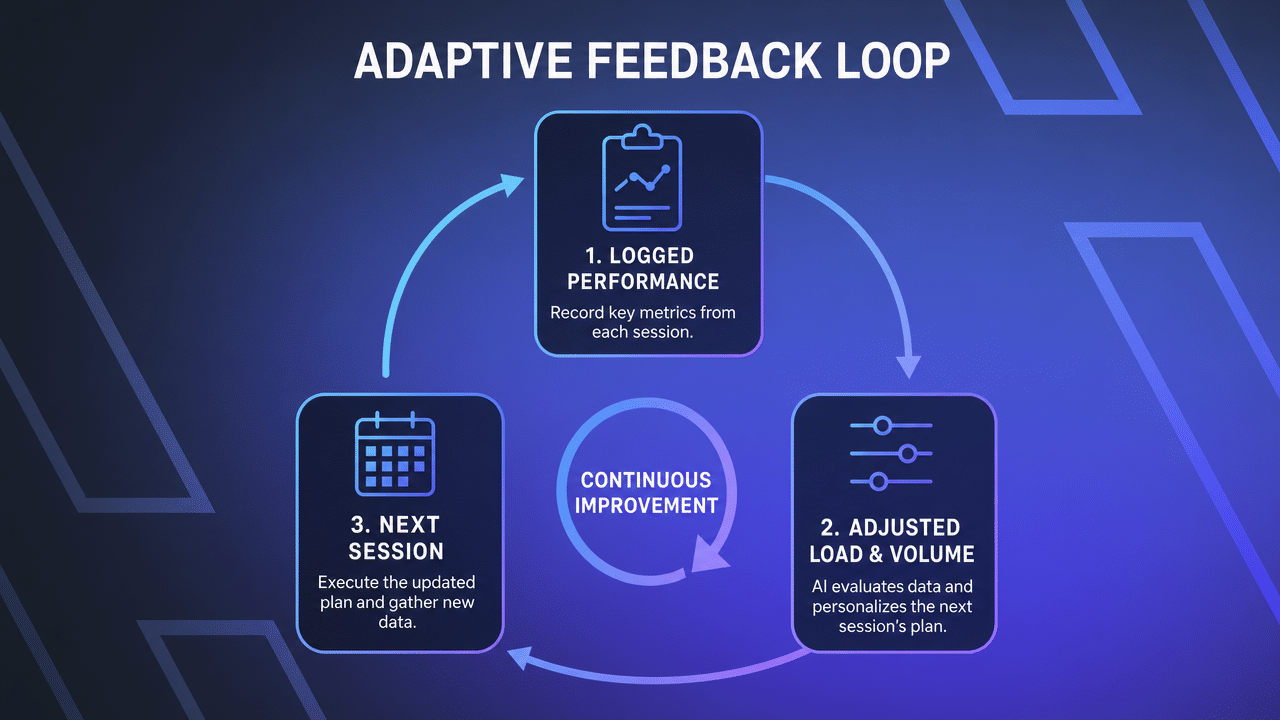
This is progressive overload applied with a feedback loop. The plan rises when you rise and eases when you stall, which is exactly what a static plan can’t do.
How a good app handles a missed session
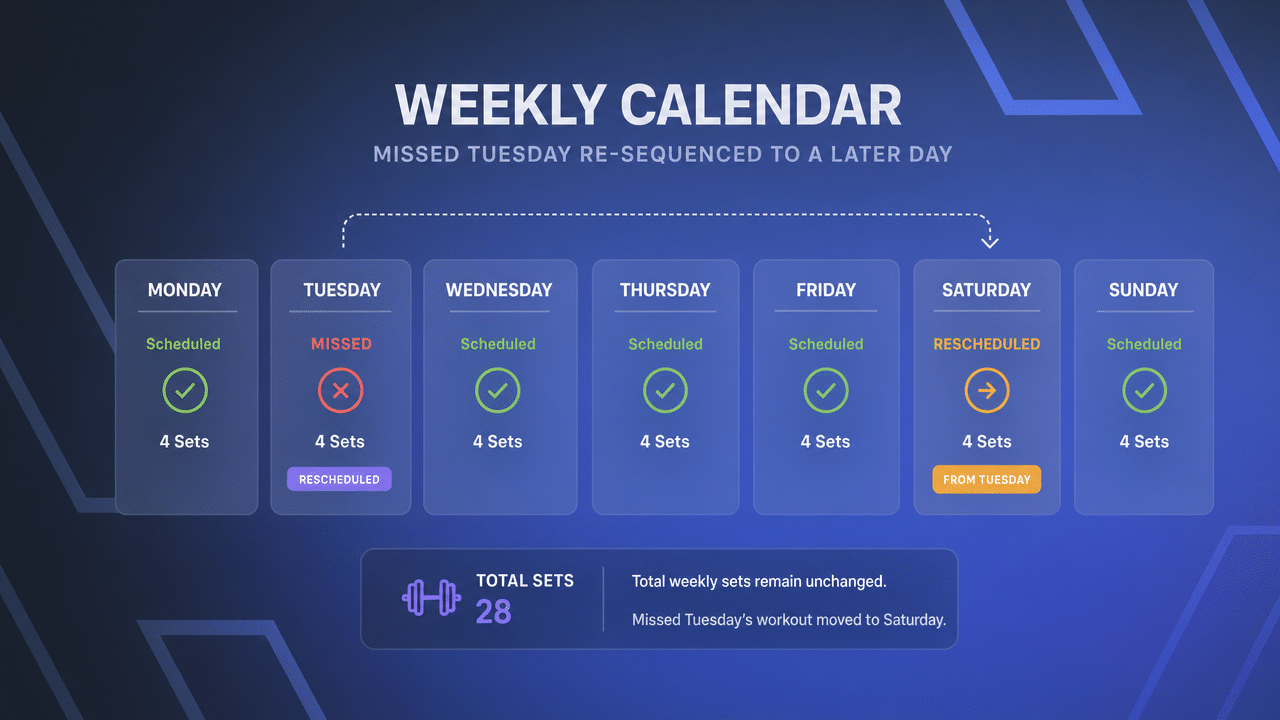
Life happens. You get sick, you travel, a Tuesday disappears. A rigid plan punishes you for that by shoving you a week behind. A good adaptive app rolls with it and re-sequences your week so you pick up where it makes sense.
The science is on the app’s side here. Weekly volume drives growth more than hitting exact days. So the frequency research means a shuffled week is rarely wasted, as long as the sets still get done. Miss a session and the app can redistribute those sets rather than deleting them or stacking them onto one brutal day.
This is where adaptive design earns its keep. You don’t need a perfect week. You need the volume to land across the week, and the app handles the reshuffle so you don’t redo the math every time your schedule moves.
What AI can’t do for your training
Here’s where the honest version matters. An AI workout app is a tool, not a trainer, and pretending otherwise sets you up for disappointment.
- It can’t see your form. The app knows you did five reps. It doesn’t know your lower back rounded on every one. Bad reps logged as good reps teach it the wrong lesson.
- It can’t feel your fatigue. Unless you tell it, it doesn’t know you slept four hours or that your knee aches. It reads the numbers you give it, nothing more.
- It can’t coach you through the hard parts. Motivation, accountability, and the judgment to pull you back from an injury are human jobs. An app can nudge. It can’t care.
So an AI gym plan is excellent at the bookkeeping, the volume math, the load progressions, the reshuffling. It’s not a replacement for learning to lift well. For anything medical or a nagging injury, a doctor or a qualified coach beats any algorithm. Use the app for what it’s good at and keep a human in the loop for the rest.
How Gymverse personalizes your plan
Gymverse is built on exactly this approach. It builds your plan around your goal, your schedule, and your equipment, then adapts it as you train. Its AI-optimized load management reads the reps, loads, and effort you log. It suggests smarter weights as you improve, keeping each set in the productive range instead of leaving you to guess. Our 500+ exercise video library gives the engine enough quality movements to fill your sets without repeating the same lift every session. The whole framework follows the volume, frequency, and effort principles above.
When you miss a session, Gymverse re-sequences the week instead of punishing you for it. It tracks every set and personal record so progression is built in, not left to memory. It won’t watch your form and it can’t replace a coach, the same limits any adaptive app has. What it does well is the structure, so you can focus on the lifting.
Gymverse is a paid app after a free 7-day trial, with every feature open during the trial. Get your plan and see your volume programmed for your body and your week.
Frequently asked questions
How does AI personalize a workout plan?
It reads the performance you log, from your reps and loads to how hard each set felt. Then it adjusts your volume, load, and schedule to keep you progressing. The AI applies known principles like progressive overload and volume targets to your own numbers instead of a fixed template.
How do adaptive fitness apps work?
An adaptive fitness app starts with a plan built from your goal, schedule, and equipment, then changes that plan based on what you actually do in the gym. It tracks your sets and effort, nudges your weights up or down, and re-sequences your week when you miss a session.
Do AI workout apps actually work?
Yes, when the science underneath them is sound and you log your training honestly. The app is only as good as the principles it follows and the data you give it, so accurate logging and a real program matter more than the AI label.
Can an AI gym plan replace a personal trainer?
No. An AI gym plan is strong at programming volume and progression. But it can't watch your form, judge your fatigue, or coach you through an injury. For technique and anything medical, a human still matters.
Sources & further reading
- Weekly training volume drives muscle growth in a dose-response, with more hard sets producing more muscle: Schoenfeld BJ, Ogborn D, Krieger JW. Dose-response relationship between weekly resistance training volume and increases in muscle mass. Journal of Sports Sciences, 2017
- For trained lifters, about 12 to 20 weekly sets per muscle is a productive standard for hypertrophy: Baz-Valle E, Balsalobre-Fernandez C, Alix-Fages C, et al. A systematic review of the effects of different resistance training volumes on muscle hypertrophy. Journal of Human Kinetics, 2022
- Training all the way to failure showed only a trivial hypertrophy advantage over stopping a rep or two short: Refalo MC, Helms ER, Trexler ET, et al. Influence of resistance training proximity-to-failure on skeletal muscle hypertrophy. Sports Medicine, 2023
- Weekly volume drives hypertrophy more than training frequency once volume is equated, so a reshuffled week still works: Schoenfeld BJ, Grgic J, Krieger J. How many times per week should a muscle be trained to maximize muscle hypertrophy. Journal of Sports Sciences, 2019
- Autoregulation means fitting load and volume to the individual's performance, with the research still developing on when it beats fixed loading: Greig L, Stephens Hemingway BH, Aspe RR, et al. Autoregulation in resistance training: addressing the inconsistencies. Sports Medicine, 2020
- A reps-in-reserve RPE scale lets lifters quantify how close a set was to failure: Zourdos MC, Klemp A, Dolan C, et al. Novel resistance training-specific rating of perceived exertion scale measuring repetitions in reserve. Journal of Strength and Conditioning Research, 2016
- Gymverse states a 500+ professional exercise video library, AI-optimized load management, and re-sequencing of your week after a missed session. It is a paid app after a free 7-day trial, with full access during the trial: Gymverse
- The Gymverse training principles (about 10 to 20 hard sets per muscle per week, training each muscle about twice a week, and sets within 1 to 3 reps of failure): The Gymverse Method
- Full reference list behind our guides: Gymverse References and Research
All Gymverse articles are reviewed against current research. See our full References & Research page.
Turn what you just learned into a training plan that works for you. Personalized structure. AI coaching. Real progress.
START TRAINING →