Progressive Overload in Workout Apps: The Science
 By Amnon V. ·
TL;DR
- Progressive overload means steadily increasing the demand on your muscles, not just adding weight.
- Apps apply it by logging every set and comparing today against your last session.
- Load and reps both work, so a smart app has more than one lever to pull.
- Volume, frequency, and effort set the dose, with real ranges from the research.
- App-based strength progression beats a static plan by adjusting to your performance.
- An app cannot watch your form or judge a bad day, so it has real limits.
- Gymverse applies progressive overload, volume, and effort for you automatically.
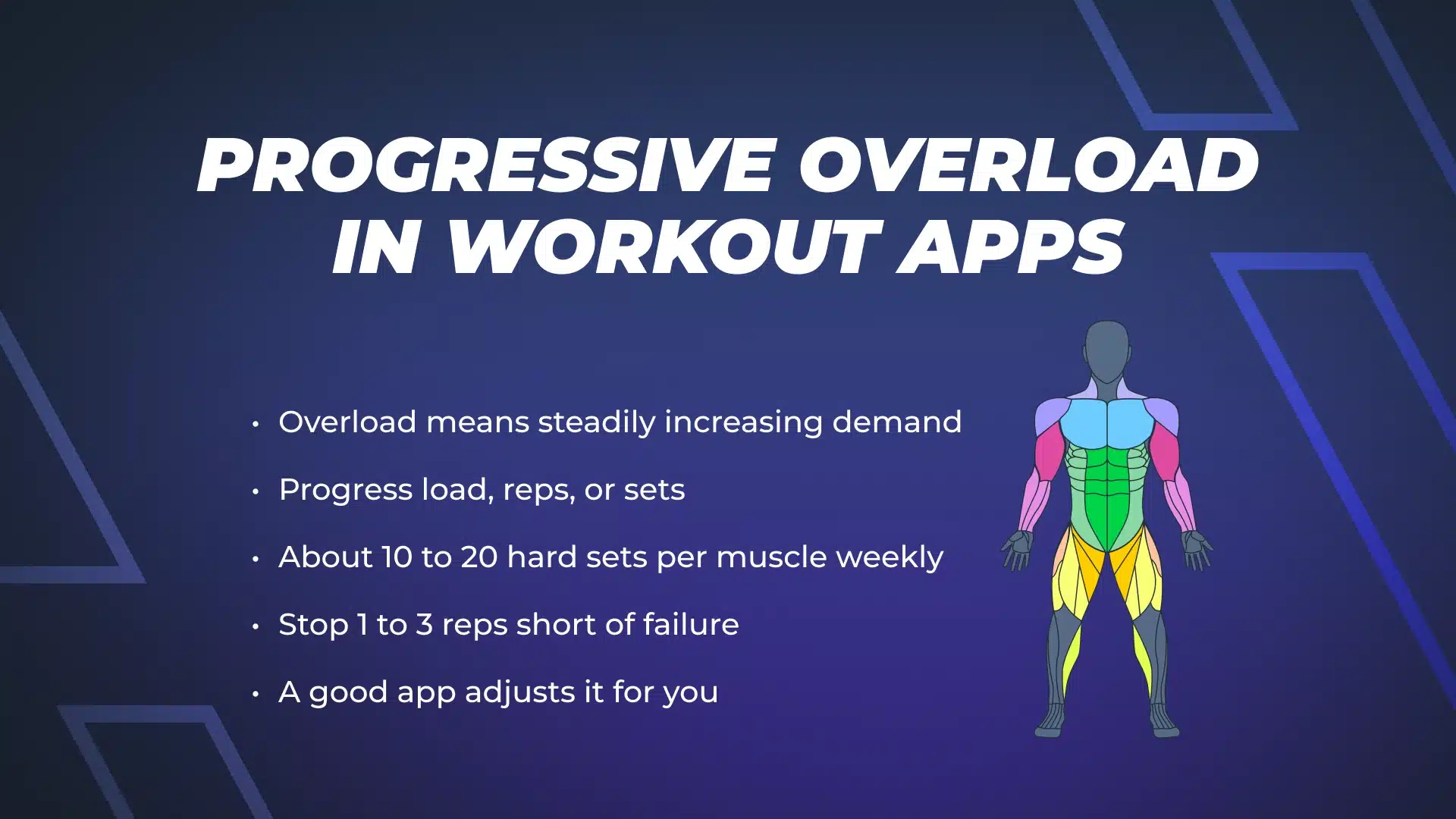
You add a rep. You add a little weight. Next week you try to do it again. That is progressive overload, and it is the one principle under every gain in strength or size you will ever make. The hard part is doing it right, week after week, without a spreadsheet and a calculator at the rack. That is the pitch behind progressive overload in workout apps. The app watches your numbers and decides the next step for you. This guide covers how apps track progressive overload, what the research supports, and how to tell real app-based strength progression from a dumb counter that nudges the weight up.
What progressive overload actually is
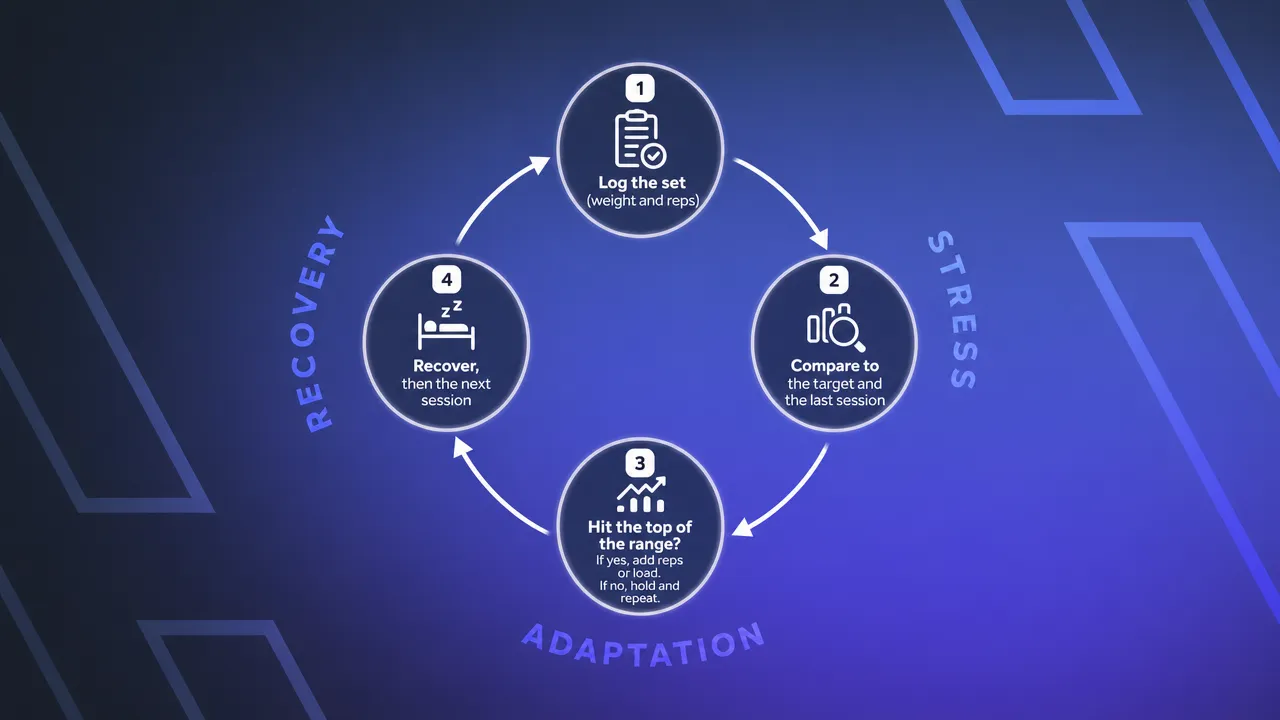
Progressive overload is the gradual increase of stress placed on your body during training. Your muscles treat size as expensive. They only keep what they are forced to use. Give them the same workload every week and they stop investing, because nothing is asking for more. What progressive overload means in practice is simple. The demand has to keep rising, so the body keeps a reason to adapt. The cycle is stress, then recovery, then adaptation. That is the engine under every result, and it is why a position stand from the American College of Sports Medicine puts systematic progression at the center of program design.
Skip it and gains do not stop dead. They slow sharply. A 2026 trial by Kassiano and colleagues found that lifters who kept the same weights and the same reps grew only about half as much muscle as lifters who kept adding load or reps. Standing still is not nothing. It is a fraction of what the same weeks could have bought you.
An app can do the counting. Progressive overload, applied week after week, does the building.
How workout apps track progressive overload
Workout apps track progressive overload by logging every set you complete, comparing it against your last session, then setting your next target from that record. The log is the whole mechanism. Without one, there is no way to know whether you are actually progressing, and memory is an unreliable training log.
A good app stores the weight and reps for each working set. It spots when you hit the top of your rep range. Then it prescribes the next step, either more reps or more load. That quietly removes the two failure points behind most stalled training. The first is not tracking at all. The second is guessing at the weight once you are standing there. A progressive overload workout app turns both into a number the plan already decided.
Load or reps: a smart app has more than one lever
Adding weight is not the only way to overload a muscle. Adding reps counts too. Plotkin and colleagues (2022) put 43 trained lifters through 8 weeks of lower-body training. One group added load and held reps steady. The other added reps and held load steady. Both built muscle, and the two groups came out close. Strength gains slightly favored adding load, by roughly 2 kg on a one-rep-max squat. The takeaway is useful. If the weight feels stuck, adding a rep is still progress.
That is why a good app does not reach for heavier weight first. It climbs the cheapest rung that still moves you. In order, that is more reps, then more weight, then more sets, then a fuller range of motion, then cleaner technique, then shorter rest, used sparingly, since cutting rest too far can cost you reps. One common method is double progression. You aim for the top of your rep range, say 3 sets of 12, then add a small load and start again, often about 2.5 kg on lower-body lifts. An app runs that logic for you instead of leaving it to memory.
How much is enough: volume, frequency, and effort
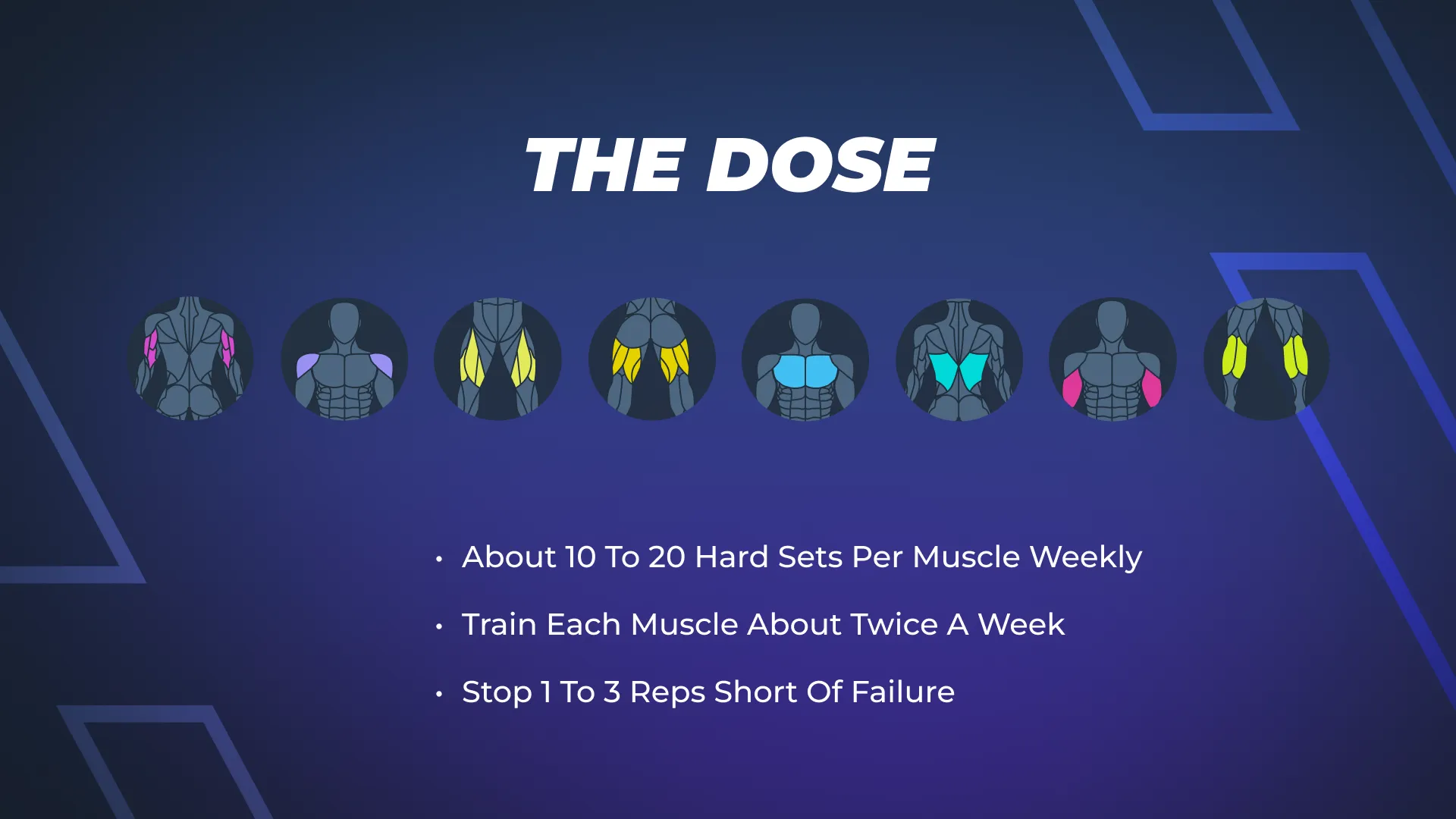
Overload sets the direction. Volume, frequency, and effort set the dose. Start with volume, which means your weekly hard sets per muscle. Schoenfeld and colleagues (2017) found a graded dose-response. Groups doing fewer than 5 weekly sets gained about 5.4 percent in muscle size, 5 to 9 sets gained 6.6 percent, and 10 or more sets gained 9.8 percent. More sets meant more growth across the range they studied. A practical target is 10 to 20 hard sets per muscle per week. Beginners sit near the bottom. Trained lifters sit near the top. These are group averages from fairly short studies, so treat the numbers as starting points and adjust for your own body.
Frequency matters less than people think. A later review (2019) found that once weekly volume is matched, training a muscle more often does not add much on its own. So frequency is a tool to fit your sets in with good quality, not a magic lever. Splitting a muscle’s sets across two sessions a week often makes it easier to keep every set high quality.
Effort is the last piece, and you do not need to train to failure. Research on proximity to failure (Refalo and colleagues, 2023) found that stopping sets short of failure builds muscle about as well as grinding to failure. Leaving about 1 to 3 reps in the tank is a practical target that keeps effort high without the extra fatigue. The ACSM position stand suggests raising the load by about 2 to 10 percent once you can do one or two reps beyond your target on two sessions in a row. Big changes to your training belong with a doctor or a qualified professional, especially with an injury or a health condition.
What app-based strength progression does that a static plan cannot
App-based strength progression means the plan changes in response to what you actually lifted, instead of following fixed numbers printed weeks ago. A paper plan cannot react. A good app can. It reads your logged performance, nudges the next load up or holds it, and keeps each set in the productive zone for growth.
It also protects the parts people skip. It spreads your volume across sessions so effort stays high on each set. It builds in lighter weeks, because the adaptation happens during recovery, after the session that triggered it. And it bends around a bad week. A rigid plan punishes a missed Tuesday. A good app just moves the work and keeps your progression intact. For the full framework behind these principles, read The Gymverse Method.
Where an app falls short: the honest part
An app only progresses you from the numbers it has, which are your logged sets and your rating of how hard each one felt. It cannot see your form. It cannot spot you. It cannot tell a genuinely rough day from a lazy one. If you log sloppily, or round your effort to look good, the math drifts and the plan drifts with it.
Judging how close a set is to failure is also a skill, and new lifters are bad at it early on. That is why a sensible app stays conservative for the first few weeks while you calibrate. None of this makes an app useless. It makes it a tool. It handles the programming decisions that quietly stall most lifters, and it leaves the things a tool cannot do, like coaching your technique or clearing you to train with an injury, to a real person.
How Gymverse applies progressive overload for you
Gymverse builds a multi-week plan around your goal, your schedule, and your equipment. Then it applies progressive overload, calibrated volume, and RIR effort for you. It logs your working sets and raises the weight from week to week based on what you actually lifted, so there are no manual weight decisions to make at the rack. It spreads your sets across about two sessions per muscle and keeps them near 1 to 3 reps short of failure.
The 500+ exercise video library gives the plan enough movements to progress without repeating the same lift every session, with form guidance before you load up. Logging takes seconds between sets, so tracking never slows your session down. When life gets busy, it re-sequences the week instead of making you start over. It will not lift for you, and it cannot replace a coach’s eyes on your form. What it does is handle the set math and the load calls so you do not have to. You focus on the lifting. We handle the progression. Get your plan and start a free 7-day trial to see your own progression programmed for your body and your week.
Frequently asked questions
How do workout apps track progressive overload?
Workout apps track progressive overload by logging every set you complete and comparing it against your last session, then setting your next target from that record. The log is what lets the app know when to add reps or load, so progression is built in rather than left to memory.
Does progressive overload in a workout app actually build muscle?
Yes, as long as the app keeps raising the demand over time, which is the mechanism behind strength and muscle gains. An app helps by tracking the numbers and prescribing the next step, which is exactly the part most people get wrong on their own.
Is app-based strength progression good for beginners?
Yes, because automatic tracking and load steps remove the two mistakes that stall most beginners, which are not logging and not progressing. A good app also starts conservative while you learn to judge effort, then adds load as you adapt.
Do I have to add weight every week to progressively overload?
No. Adding reps at the same weight counts as overload too, and progress naturally slows as you get more advanced. Chasing a heavier bar every single week is a fast way to stall or get hurt, so small, steady steps win.
Can a workout app replace a personal trainer?
No. An app can program your sets and progress your load. What it cannot do is watch your form, spot you, or judge an off day the way a coach can. It works best as the structure around your training, not a stand-in for expert eyes.
Sources & further reading
- Progressive overload is the gradual increase of stress on the body, and systematic progression drives continued adaptation. ACSM recommends load jumps of about 2 to 10 percent once you can clear your rep target: Ratamess and colleagues. Progression Models in Resistance Training for Healthy Adults (ACSM Position Stand). Medicine and Science in Sports and Exercise, 2009.
- Lifters who kept load and reps fixed grew roughly half as much muscle as those who progressively overloaded: Kassiano and colleagues. Progressive Overload Affects the Magnitude of Muscle Hypertrophy. Medicine and Science in Sports and Exercise, 2026.
- Adding load and adding reps are both viable ways to progress for strength and muscle over an 8 week cycle, with a small strength edge to load: Plotkin and colleagues. Progressive overload without progressing load? PeerJ, 2022.
- Weekly sets drive muscle growth in a graded dose-response, with more sets producing more growth across the studied range: Schoenfeld, Ogborn and Krieger. Dose-response relationship between weekly resistance training volume and muscle mass. Journal of Sports Sciences, 2017.
- Training frequency does not meaningfully change hypertrophy once weekly volume is matched: Schoenfeld, Grgic and Krieger. How many times per week should a muscle be trained. Journal of Sports Sciences, 2019.
- Sets stopped short of failure build similar muscle to sets taken to failure: Refalo and colleagues. Influence of resistance training proximity to failure on skeletal muscle hypertrophy. Sports Medicine, 2023.
- The overload ladder, double progression, and the role of tracking: Gymverse. What Is Progressive Overload?
- The 10 to 20 hard sets range, training each muscle about twice a week, and a 1 to 3 RIR target with built-in deloads: Gymverse. The Gymverse Method.
- 500+ exercise videos, AI-optimized load management, and the free 7-day trial: Gymverse.
- Full reference list behind our guides: Gymverse References and Research.
All Gymverse articles are reviewed against current research. See our full References & Research page.
Turn what you just learned into a training plan that works for you. Personalized structure. AI coaching. Real progress.
START TRAINING →