Trap Bar Deadlift vs. Barbell Deadlift: Which One Should You Be Doing?
 By Amnon V. ·
To be honest, most lifters treat this as a loyalty test more than anything else. However, what you need to know is that both lifts load your body differently enough that picking the wrong one can stall your progress.
That’s why we’ll cover what each lift actually trains, what the studies say about muscle activation and spinal load, how to run both with clean technique, the mistakes that quietly cost you reps, and how to pick the right one for your goal. We’ll also cover dumbbell alternatives for the days you have no bar at all.
Comparison: Trap Bar Deadlift vs. Barbell Deadlift
| Factor | Trap Bar Deadlift | Barbell Deadlift |
|---|---|---|
| Primary muscles | Quads and glutes, with the hamstrings and spinal erectors assisting | Hamstrings, with the glutes and lower back assisting |
| Bar path and torso angle | Load sits in line with your body, so your torso stays more upright | Load sits in front of you, so your torso hinges further forward |
| Load potential | Most lifters move more weight | Most lifters move less weight |
| Lower back demand | Lower shear and torque on the spine | Higher demand on the lower back and hips |
| Learning curve | Short. Most lifters get a safe rep on day one | Longer. Setup and bracing take practice |
| Best for | Beginners, quad development, athletes, lifters with cranky lower backs | Powerlifters, posterior chain size, raw hinge strength |
What Is A Trap Bar Deadlift?

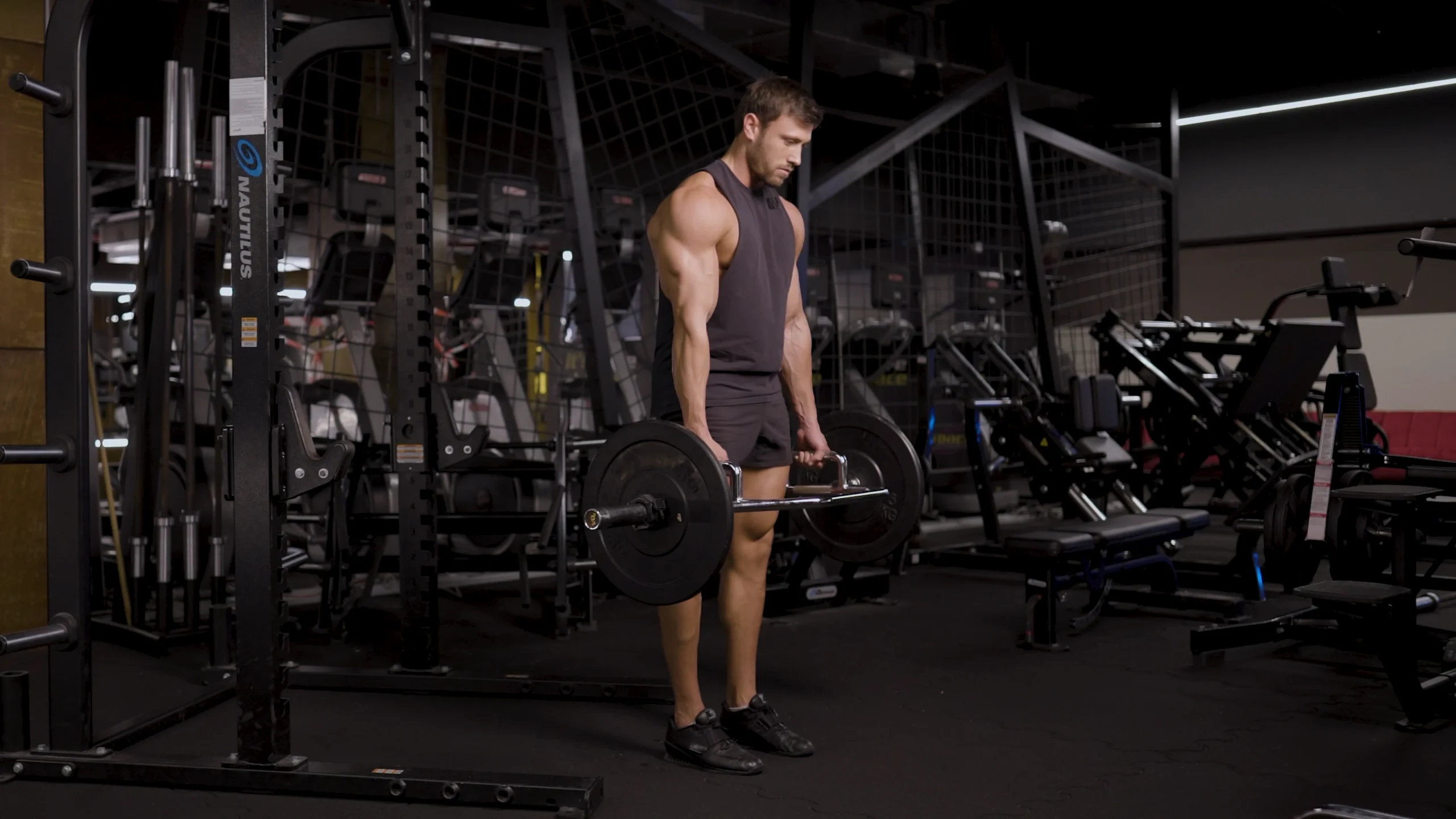
The trap bar deadlift is a pull done with a hexagonal frame instead of a straight bar. You stand inside the frame and grip handles at your sides, so the weight sits in line with your center of mass instead of in front of it. Most gyms label it the hex bar deadlift, both names describe the same lift.
What Is A Barbell Deadlift?

The barbell deadlift is the version most people picture when they hear the word. The bar starts on the floor in front of your shins and travels straight up your legs, which forces a deeper hip hinge and a more horizontal torso. This is the lift used in powerlifting and strongman events.
How The Two Lifts Compare
The difference comes down to four things:
1) Muscles Worked
The trap bar keeps your torso more upright, which shifts emphasis toward your quads, with your glutes and hamstrings assisting. The barbell’s forward lean loads the hamstrings, with a secondary focus on your glutes and lower back.
A 2016 study in the Journal of Strength and Conditioning Research by Camara and colleagues found greater quadriceps activation in the hex bar deadlift and greater hamstring and erector spinae activation in the conventional barbell deadlift. Neither lift skips the posterior chain. The barbell just asks for more of it.
2) Load Potential And Power Output
Most lifters pull more weight with a trap bar. Swinton and colleagues (2011) found that lifters produced higher peak force, peak power, and bar velocity with the trap bar compared to the straight bar across multiple loads.
For you, this means the trap bar lets you train heavy without the same technical breakdown you get on a maxed-out barbell pull.
3) Stress On Your Lower Back
The same Swinton study recorded lower peak moments at the lumbar spine with the trap bar, because the load sits closer to your hips. Less shear force on your spine means less recovery cost per session.
This makes the trap bar a smart pick if you have a history of lower back pain, or you stack deadlifts on top of a physical job.
4) How Long It Takes To Learn
A barbell deadlift punishes small setup errors. For example, the bar drifts forward, back rounds, hips shoot up first, and the lift falls apart. The trap bar forgives most of those mistakes because the load already sits where your body wants to pull from. That’s why it works as a strong entry point for beginners.
How To Properly Do A Trap Bar Deadlift
- Stand with your legs approximately hip-width apart inside the trap bar.
- Bend your knees and hinge your hips back.
- Grip the bar by the handles and keep your spine in a neutral, braced position.
- Lift the bar until your knees and hips are fully locked.
- Lower the bar all the way down to the starting position.
- Avoid bending your elbows at any time during the lift.
How To Properly Do A Barbell Deadlift
How To Do Barbell Deadlift – Proper Form & Technique
- Stand with your legs approximately hip-width apart.
- Bend your knees and hinge your hips back.
- Grip the bar wider than your stance, brace your core, and keep your spine neutral.
- With the bar touching your shins, lift the bar until your knees and hips are fully locked.
- Lower the bar all the way down, keeping the bar close to your body throughout the movement.
- Do not bend your elbows at any time during the lift.
Mistakes Lifters Make With Both Lifts
These mistakes cost you reps and put your back at risk:
- Rounding your upper back under heavy load. This shows up faster on the barbell because of the forward torso angle, but it happens on the trap bar too when you get greedy with the weight.
- Squatting the trap bar. Dropping your hips too low turns the lift into a bad squat and kills your leg drive.
- Yanking the bar off the floor. Pulling the slack out first protects your lower back and gives you a stronger first inch.
- Chasing a number every session. Both lifts are demanding to recover from, so adding weight every workout stops working quickly. Instead, have a structured strength tracking log that tells you when to increase load or when to increase the number of reps.
Which One Should You Be Doing?
It depends on your goal, not on which lift is harder on your muscles. For example:
If You Want Raw Strength
Both build strength. If you compete in powerlifting or you test a barbell deadlift max, you’ll need to train the barbell deadlift. The setup, the bar path, and the bracing pattern will all transfer directly to your test day.
If You Want Muscle Size
The trap bar wins for quads. However, the barbell is much better for your lower back. That said, both work your hamstrings and glutes.
If You Are New To Lifting
We recommend starting with the trap bar. You learn to brace and drive through the floor without fighting a technical setup at the same time.
If Your Lower Back Gets Cranky
The trap bar gives you most of the training effect at a lower spinal cost. You keep pulling heavy, and your back gets a break.
Can You Run Both?
You can, and we like this the most for general lifters. Run one heavy barbell session and one trap bar session per week, or swap the main lift every 6 to 8 weeks.
Are You Ready To Stop Guessing And Start Progressing?
Most lifters don’t, and it makes them waste a lot of effort. The good news is that the Gymverse app logs every set, rep, and weight, then programs your next session based on what you actually did.
Your plan gets heavier week over week on purpose, not by guesswork. Your plan also adapts to the equipment in front of you (trap bar, barbell, dumbbell, or bodyweight only). And the best thing is that the app builds a routine around your gear, your schedule, and your goal.
Start your free 7-day trial and create your personalized plan (find the app on iOS and Android).
Conclusion
The trap bar and the barbell are not rivals. They are two tools that load your body differently, and each one is better for a different job.
The trap bar emphasizes your quads and glutes, moves more weight, and asks less of your lower back. The barbell focuses on your hamstrings, glutes, and spinal erectors to build a thicker posterior chain. It also teaches you a stricter hinge and stays the standard for powerlifting.
Beginners and lifters with cranky backs get more from the trap bar. Powerlifters and posterior chain hunters get more from the barbell. Most general lifters get the most from doing both.
Pick one based on your goal, log every set, and let the numbers guide your workout.
Frequently asked questions
Is the trap bar deadlift better than the barbell deadlift?
Neither lift is better in a vacuum. The trap bar is ideal for quad development, load potential, and lower back safety. The barbell is ideal for posterior chain development and any goal tied to a barbell test.
Does the trap bar deadlift work the same muscles as the barbell deadlift?
Both train your quads, hamstrings, glutes, and spinal erectors. However, the trap bar biases the quads and the barbell biases the hamstrings and erectors (according to the Camara study we cited above).
Should beginners start with a trap bar or a barbell?
We recommend the trap bar. The setup is easier, the technical margin is bigger, and you can add weight faster without your form falling apart.
How much more can you lift with a trap bar?
Lifters produce higher peak force, power, and bar velocity with a trap bar at the same load (based on the Swinton study we cited above). Most also handle somewhat more weight, though how much varies by lifter and wasn't measured in that study.
Can you build a strong back with only trap bar deadlifts?
Yes, you can build a strong back with trap bar deadlifts, especially when you pair them with rows and pull-ups. However, if your goal is maximum spinal erector development, the barbell version puts more direct work on those muscles.
Can you deadlift without a barbell?
Yes, dumbbell Romanian deadlifts, suitcase deadlifts, single-leg deadlifts, and sumo deadlifts all train the same movement pattern and build real strength.
Sources & further reading
All Gymverse articles are reviewed against current research. See our full References & Research page.
Turn what you just learned into a training plan that works for you. Personalized structure. AI coaching. Real progress.
START TRAINING →